RAG methods that interleave reasoning and retrieval, such as Search-o1, have the LLM write each next sub-query with all previous reasoning and sub-queries in view. This paper from Northeastern University (China) and Tsinghua starts with a measurement: embed each sub-query, accumulate the step-to-step movements with exponential weights into what it calls "search momentum", and test whether that predicts the direction in which the next sub-query deviates from the original question. Prediction gets more accurate at later steps, from which the authors conclude that later sub-queries keep drifting along the direction earlier ones already took. Their method, MAPS (a macro-adaptive parallel reasoning framework), makes two changes: each round the model sees only the retrieved knowledge and a compressed reasoning state, never the earlier sub-queries or full reasoning; and each round it first lists several complementary search directions, writes one sub-query per direction, retrieves in parallel, and merges the results. On Qwen3-32B, MAPS averages 56.0 Cover-EM (whether the gold answer appears in the response) across six QA datasets, against 49.2 for the strongest baseline, ParallelSearch, and 43.9 for Search-o1. The gains are real, but the "search momentum" diagnostic itself has several weak points, discussed below.
1. The problem: do sub-queries drift further and further?
Multi-hop questions need evidence scattered across several documents, so the common approach is to have the model write sub-queries as it reasons. The sub-query at step t is conditioned on all earlier reasoning and sub-queries, so one early off-target sub-query can pull every later retrieval off course. The appendix case is typical. The question is which of La Môme Vert-De-Gris and The Pod People has the earlier-born director. Search-o1's first retrieval finds director Olivier Dahan, but its reasoning then invents a Pod People directed by Natasha Lyonne and Amy Nicholson, queries Amy Nicholson's birth date, then drifts to documentary production and 1930s organizations, and ends up querying the membership of the Farm Holiday Association, ever further from the question. MAPS's parallel sub-queries find both directors, Bernard Borderie and Juan Piquer Simón, in the first round and then search only for their birth dates.
1.1 How search momentum is computed
The authors embed the original question and each sub-query with E5 to get vectors q_0, q_1, q_2, … and define:
- momentum m_t = β_t·m_{t−1} + (1−β_t)·(q_t − q_{t−1}), i.e. a weighted accumulation of each step's movement, where larger β_t weighs history more;
- alignment S_t = cos(m_t, q_{t+1} − q_0), the cosine between the current momentum and the next sub-query's total offset from the original question.
The fitting data: run Search-o1 (Qwen3-32B) on 1,000 questions each from 2WikiQA, MuSiQue and HotpotQA, keeping only trajectories with at least three retrieval rounds; fit each β_t with L-BFGS-B on the training set to maximize S_t, then report S_t on another 1,000 questions.
| Setting | β1 | S1 | β2 | S2 | β3 | S3 | β4 | S4 | Mean S |
|---|---|---|---|---|---|---|---|---|---|
| Search-o1, 2WikiQA | 0 | 0.41 | 0.64 | 0.57 | 0.76 | 0.65 | 0.88 | 0.70 | 0.58 |
| Search-o1, MuSiQue | 0 | 0.31 | 0.54 | 0.52 | 0.72 | 0.65 | 0.83 | 0.69 | 0.54 |
| Search-o1, HotpotQA | 0 | 0.44 | 0.62 | 0.68 | 0.82 | 0.77 | 0.88 | 0.78 | 0.67 |
| Search-o1, pooled | 0 | 0.39 | 0.60 | 0.57 | 0.76 | 0.68 | 0.86 | 0.73 | 0.59 |
| MAPS, pooled (appendix) | 0 | 0.53 | 0.53 | 0.83 | 0.74 | 0.88 | 0.86 | 0.90 | 0.79 |
Both β_t and S_t rise with the step. The authors read this as: later on, past movement weighs more and the next sub-query's offset aligns more with existing momentum, so reasoning does not correct early drift by itself.
1.2 How much this metric shows
The last row comes from the appendix and is not discussed in the main text: MAPS's own alignment is higher than Search-o1's, 0.79 versus 0.59 on average, and MAPS without disentanglement reaches 0.75. If high S_t meant "drifting further along the old direction", MAPS would be drifting more, which contradicts the paper's later claim that MAPS suppresses momentum. A more plausible reading is that S_t measures how smooth and predictable a trajectory is, not whether it leaves the original question. MAPS averages the vectors of its parallel sub-queries to get q_t each round, and an averaged trajectory is smoother to begin with.
The rise of S_t with the step is also partly built into the formula. q_{t+1} − q_0 is the total displacement from the start, which is itself the sum of all earlier step movements; and the larger β_t, the closer m_t gets to accumulating those same movements. The more steps, the more the two share, so even if every step's direction were random the cosine would roughly rise with t. "S_t rises" is therefore not enough to show the model is drifting by inertia; the stronger evidence is the sub-query-to-evidence similarity in Section 4.
2. Method: MAPS
2.1 Hiding earlier sub-queries from the model
The usual approach hands the model the full trajectory every step: each round's reasoning, sub-query and retrieval results. MAPS keeps only two things: the knowledge o_1…o_{t−1} distilled from each earlier round's results, and a reasoning summary updated every round that contains no earlier sub-queries. The next round's reasoning takes only the original question, the knowledge set and the summary as input. When the knowledge suffices or the round limit is hit, the final answer is generated from those three inputs. The rationale: a model that sees its last sub-query tends to tweak a few words and search again, while a model that sees only "what is known so far" is more likely to go back to the question and ask what is still missing.
2.2 Searching several directions in parallel each round
Each round has three steps: list N complementary search directions from the question, existing knowledge and summary; write one sub-query per direction, retrieve top-K documents for each and merge them; then a refinement step merges the evidence into this round's knowledge o_t and updates the summary. The difference from ParallelSearch is that ParallelSearch writes several sub-queries directly, whereas MAPS first has the model state which directions to pursue and then turns directions into sub-queries. The paper does not give the value of N.
3. Results
To cover different difficulty levels, evaluation has three groups: single-hop QA with NQ (Natural Questions) and PopQA, multi-hop with 2WikiQA, HotpotQA and MuSiQue, and reasoning QA with GPQA Diamond (198 graduate-level science questions); except for GPQA, 1,000 questions are sampled per dataset. Backbones are Qwen3-32B and Qwen3.6-35B-A3B, the corpus is the December 2018 English Wikipedia, the retriever is E5-base-v2 returning 5 passages per call, with at most 10 rounds.
3.1 Main results
| Method | NQ | PopQA | 2WikiQA | HotpotQA | MuSiQue | GPQA | Avg |
|---|---|---|---|---|---|---|---|
| Qwen3-32B | |||||||
| No retrieval | 25.0 | 19.4 | 27.3 | 21.3 | 7.1 | 44.4 | 24.1 |
| Vanilla RAG | 49.0 | 52.1 | 30.0 | 38.3 | 9.9 | 44.2 | 37.2 |
| Search-o1 | 53.1 | 56.5 | 43.7 | 40.0 | 23.7 | 46.4 | 43.9 |
| S3 | 59.5 | 60.6 | 37.2 | 38.3 | 19.4 | 60.7 | 45.9 |
| ParallelSearch | 57.2 | 60.4 | 53.6 | 43.5 | 30.9 | 49.8 | 49.2 |
| MAPS | 63.4 | 64.8 | 59.4 | 48.8 | 37.6 | 62.1 | 56.0 |
| Qwen3.6-35B-A3B | |||||||
| No retrieval | 39.4 | 39.4 | 42.1 | 34.8 | 19.4 | 76.8 | 42.0 |
| Search-o1 | 53.0 | 62.0 | 56.3 | 44.0 | 34.1 | 76.3 | 54.3 |
| ParallelSearch | 58.4 | 56.8 | 55.9 | 53.7 | 41.5 | 77.5 | 57.3 |
| MAPS | 64.1 | 69.3 | 65.8 | 55.1 | 45.2 | 79.2 | 63.1 |
MAPS leads on all six datasets with both backbones. The biggest gains are on multi-hop: on Qwen3-32B, MuSiQue goes from Search-o1's 23.7 to 37.6 and 2WikiQA from 43.7 to 59.4, exactly where sub-query chains are longest and drift is most likely. GPQA is different: Qwen3.6-35B-A3B already scores 76.8 without retrieval, the best retrieval methods add only two or three points, and Self-RAG and IRCoT actually lose nearly 10, so this model barely needs Wikipedia for GPQA and that column says little about retrieval strategy.
3.2 Ablation
The authors remove each of three components: listing directions first (write parallel sub-queries directly), parallelism (one direction per round), and disentanglement (keep the full history).
| Variant (Qwen3-32B) | NQ | PopQA | 2WikiQA | HotpotQA | MuSiQue | GPQA | Avg |
|---|---|---|---|---|---|---|---|
| MAPS | 63.4 | 64.8 | 59.4 | 48.8 | 37.6 | 62.3 | 56.1 |
| No direction listing | 63.0 | 64.3 | 55.8 | 46.9 | 35.6 | 46.0 | 51.9 |
| No parallelism | 60.1 | 61.2 | 54.1 | 45.2 | 33.1 | 45.3 | 49.8 |
| No disentanglement | 61.0 | 58.8 | 53.1 | 48.3 | 34.3 | 45.1 | 50.1 |
Removing any component lowers the average, but the drop is concentrated on GPQA. For "no direction listing", the six datasets lose about 25 points in total, 16 of them on GPQA alone, while single-hop NQ and PopQA barely move, so most of the average's decline comes from the GPQA column.
Stranger still, removing any one component drops GPQA to about 45, close to the no-retrieval 44.4, while full MAPS gets 62.3. GPQA has only 198 questions, so 16 points is about 33 questions. A pattern where losing any single component makes everything fail suggests the GPQA result may be unstable; the paper neither explains it nor reports variance over runs. The ablation table's MAPS GPQA and average (62.3, 56.1) also do not match the main table (62.1, 56.0).
Looking only at multi-hop datasets, the conclusion is more credible: without disentanglement 2WikiQA loses 6.3 points, without parallelism MuSiQue loses 4.5, so both components do contribute. Also, the "no parallelism" variant is essentially single-path retrieval with a knowledge summary and averages 49.8, already 5.9 above Search-o1; the "no disentanglement" variant is direction-first parallel retrieval and averages 50.1, on par with ParallelSearch's 49.2. Only together do they reach 56.
4. Are sub-queries pulled back?
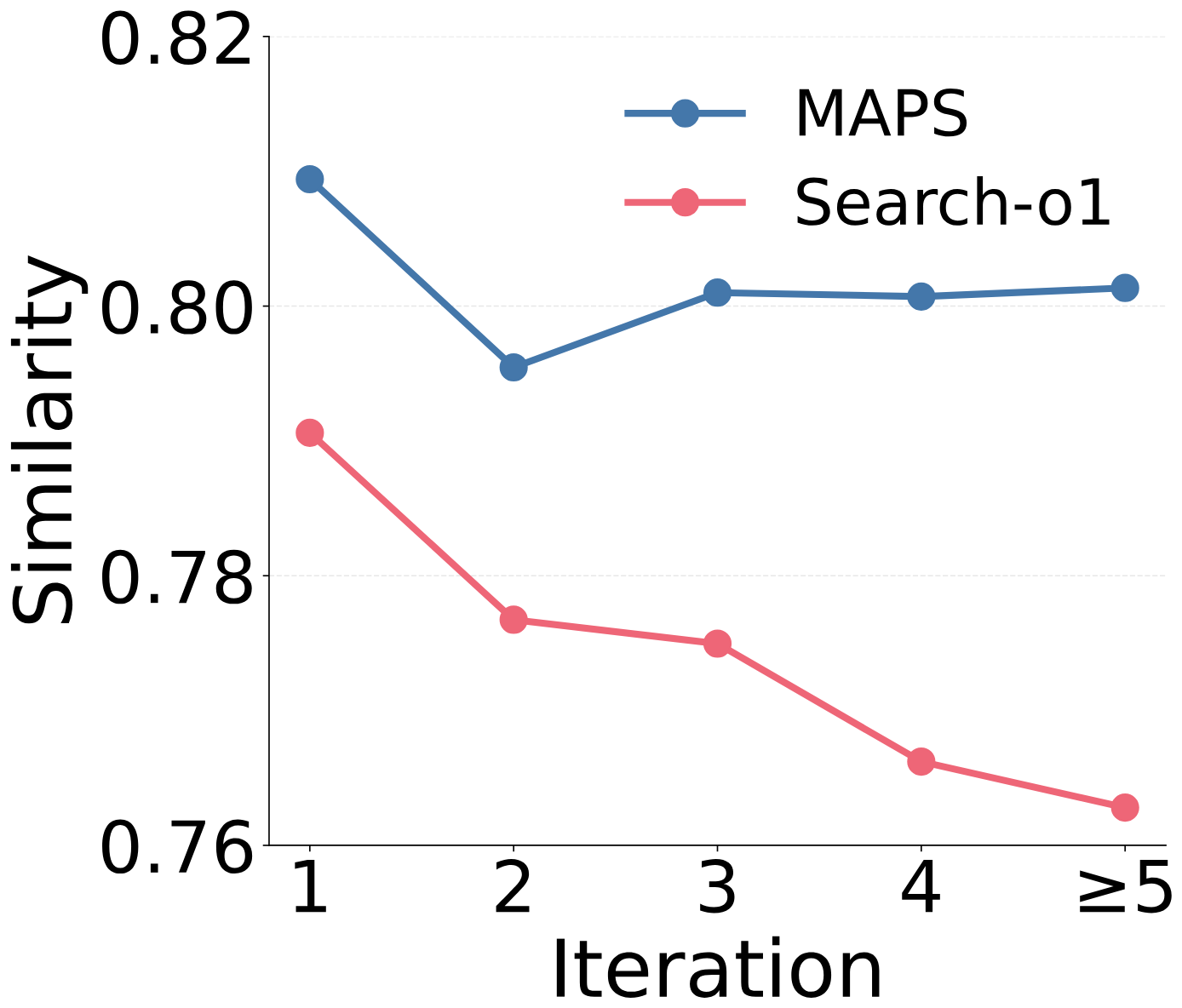
This is the most direct evidence in the paper. On all samples with gold evidence, the authors compute the E5 similarity between each round's sub-queries and every gold evidence document of the question, average over these sub-query–evidence pairs within the sample, then average over samples to get each round's score in the figure (the paper does not separately say how several parallel sub-queries in one round are combined; from its description they are averaged together). Search-o1 falls from about 0.79 to 0.76, meaning later queries look for things further from the evidence actually needed; MAPS stays about 0.02 to 0.04 higher, dips slightly in round 2, then returns to about 0.80 and holds. The gap looks small, but cosine similarities between E5 vectors are all packed into a fairly high range, so a stable 0.02–0.04 gap is meaningful.
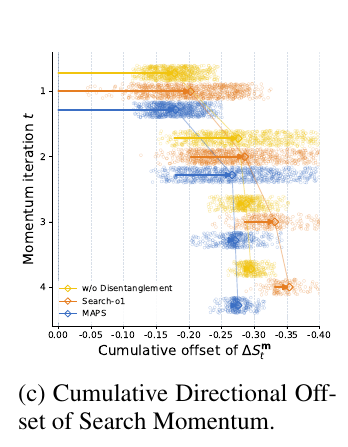
The cumulative-offset plot shows the same thing from another angle: each round, the cosine similarity between the search momentum and the original question's vector is computed, the change from the previous round is recorded, and these changes are added up round by round. The paper does not say whether absolute values are taken; if not, the running total is simply the current round's cosine minus the first round's. As rounds increase, MAPS's running total grows more slowly than Search-o1's or the non-disentangled variant's, so its momentum direction is steadier.
4.1 Stopping round and cost
In the paper's stopping-round distribution, 62.7% of MAPS samples finish at step 2, versus 50.4% for Search-o1 and 58.5% for ParallelSearch; but only 1.8% of MAPS samples finish at step 1, against 10.2% and 13.3%; and 14.9% of MAPS samples need 5 or more steps, against 12.5% and 5.1%. The average steps marked on the plot are about 2.7 for MAPS, slightly above about 2.6 for Search-o1 and about 2.3 for ParallelSearch. That means MAPS does not run fewer rounds than Search-o1, and each of its rounds adds three calls (directions, sub-queries, refinement) and N retrievals, so total cost is almost certainly higher. The paper reports no call counts, token usage or latency, which is the biggest gap in evaluating this method.
5. Limitations
Beyond the cost gap above, several points deserve attention. N is not given and there is no sensitivity study on it, so readers cannot tell how much of the gain comes from simply searching more. The retriever is the fairly weak E5-base-v2 and the corpus is 2018 Wikipedia; with a stronger retriever or a reranker, slightly worse sub-queries might be rescued on the retrieval side, and whether the gap holds is untested. The momentum analysis is fitted only on Search-o1 trajectories, and as Section 1.2 argues, S_t behaves more like a smoothness measure, so it is not sufficient evidence of drift. The metric, Cover-EM, only checks whether the gold answer appears in the response, which longer answers hit more easily, and the paper does not report whether MAPS's answers are similar in length to the baselines'.
6. Practical takeaways
When building a multi-hop RAG agent, two changes are cheap to try. First, do not feed earlier sub-queries back to the model each round; give it only the distilled knowledge and a reasoning summary, so it writes the next sub-query from "what is still missing" rather than by rewording the last one. Second, before writing sub-queries, have the model list a few complementary directions, for example one path per entity. The paper's multi-hop results and evidence-similarity curve both support these two points. But measure the added calls and latency yourself before shipping, and do not use the momentum alignment score as a drift monitor; looking directly at the similarity of sub-queries to the original question or to known evidence is more reliable.