CTR/MRR/behavioral NDCG assume the user sees ranked results. In an agentic assistant a generation layer consumes retrieval first, so attribution breaks on who saw results, when the user acted, and what caused the outcome—Adobe’s attribution gap. LARA measures retrieval quality, engagement/outcomes, and product success as layers joined by a four-field lineage schema. On Adobe Express, one retrieval stack serves gallery and assistant: retrieval rate on assistant prompts is 0.31%; chat reformulation 44.4% vs gallery 33.1%. Do not evaluate agent retrieval as if the user clicked a SERP.
1. Problem
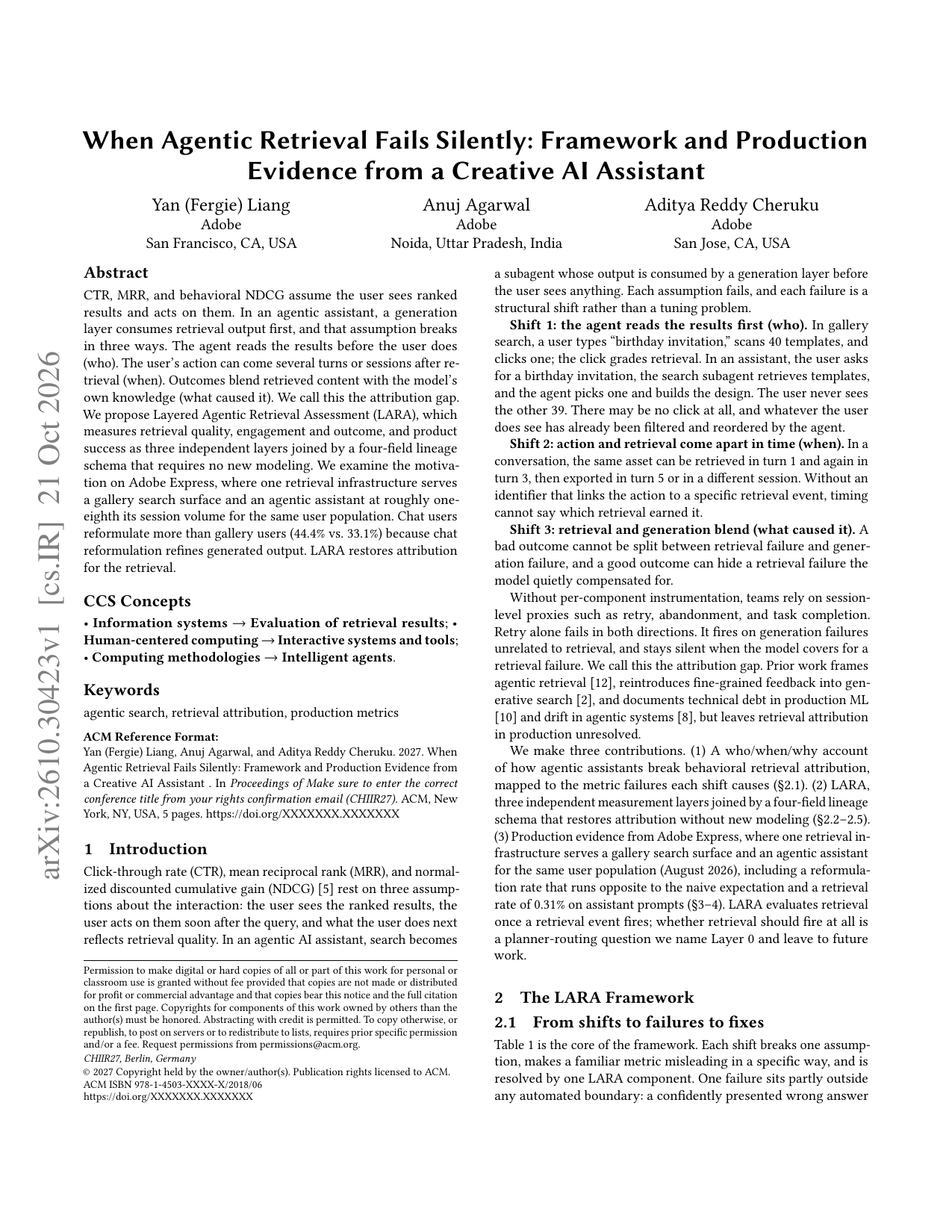
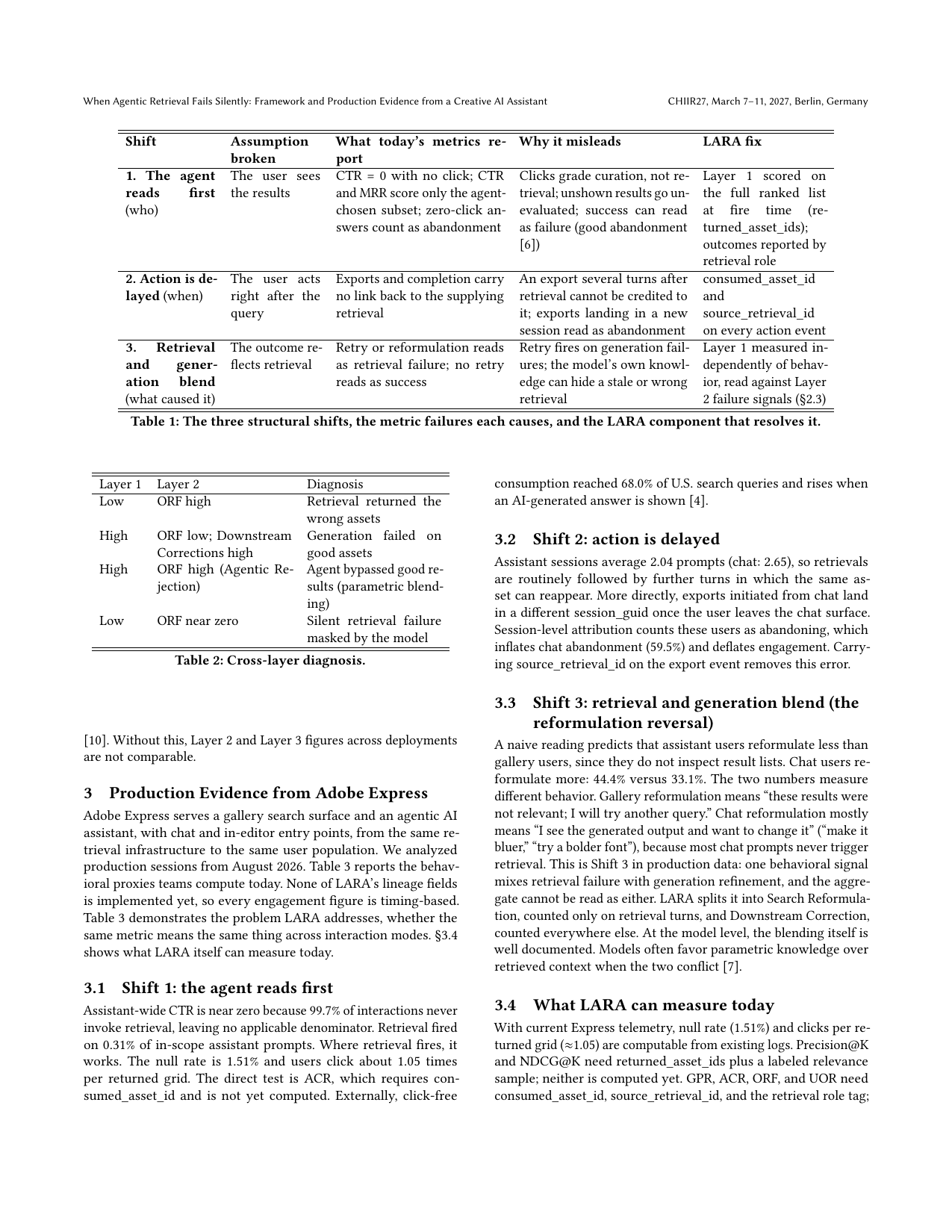
Classic metrics assume the user is the first consumer of results. Agents read first, act later, and blend parametric knowledge—session retries cannot isolate retrieval.
2. Method
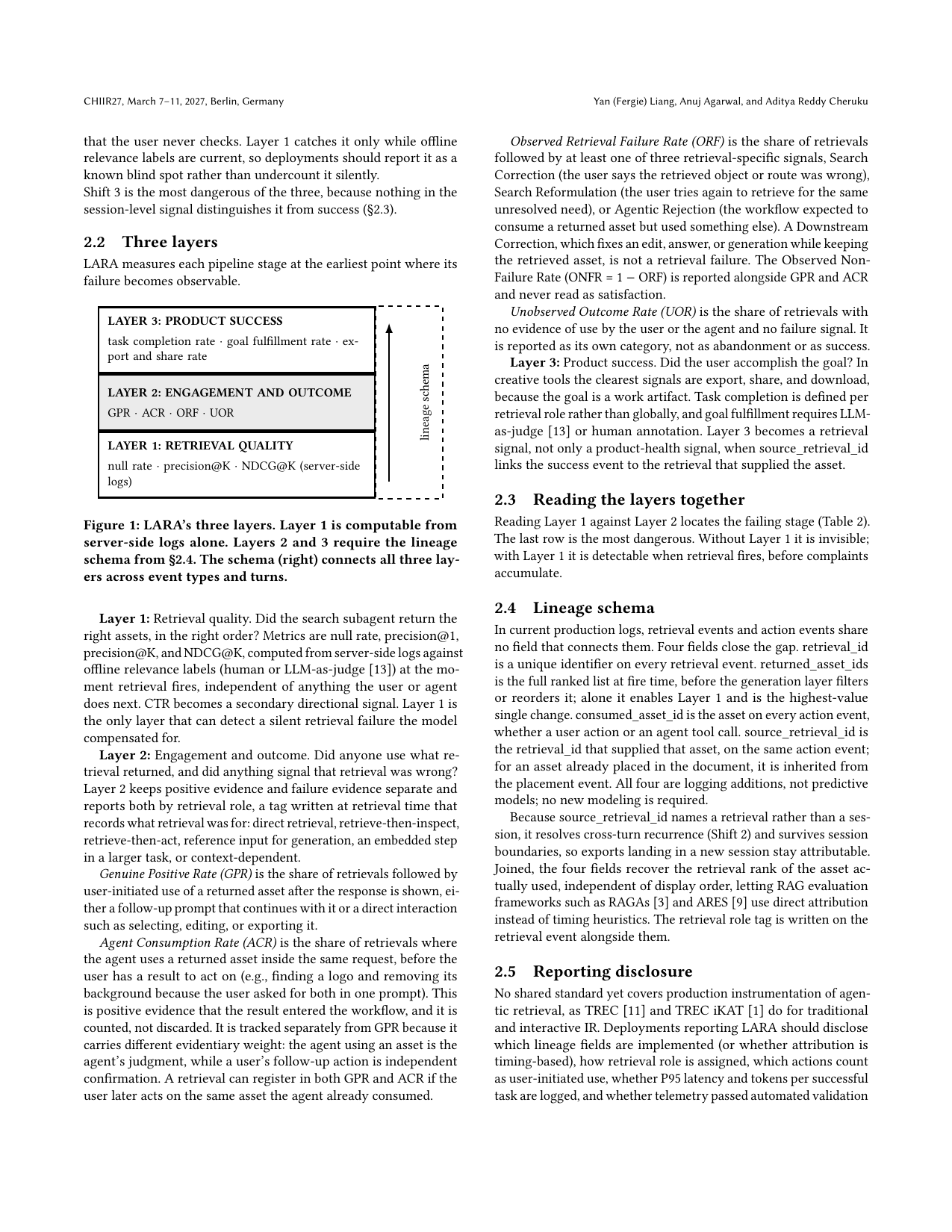
Three layers (retrieval quality; engagement/outcomes; product success) plus four-field lineage. Compared on Express gallery vs agentic assistant sharing infrastructure.
3. Core claim
Move from behavioral proxies to layered metrics with lineage. Without lineage you cannot tell retrieval failure from unused retrieval.
4. Experiments
Assistant retrieval rate 0.31%; chat reformulation 44.4% vs gallery 33.1%; gallery volume ~8–9× the assistant.
5. Limits
Single-product evidence; product policy drives retrieval rate; layers still need human causal reading.
6. Practice
Ship lineage + layered dashboards before optimizing recall; do not use CTR/NDCG alone as success.