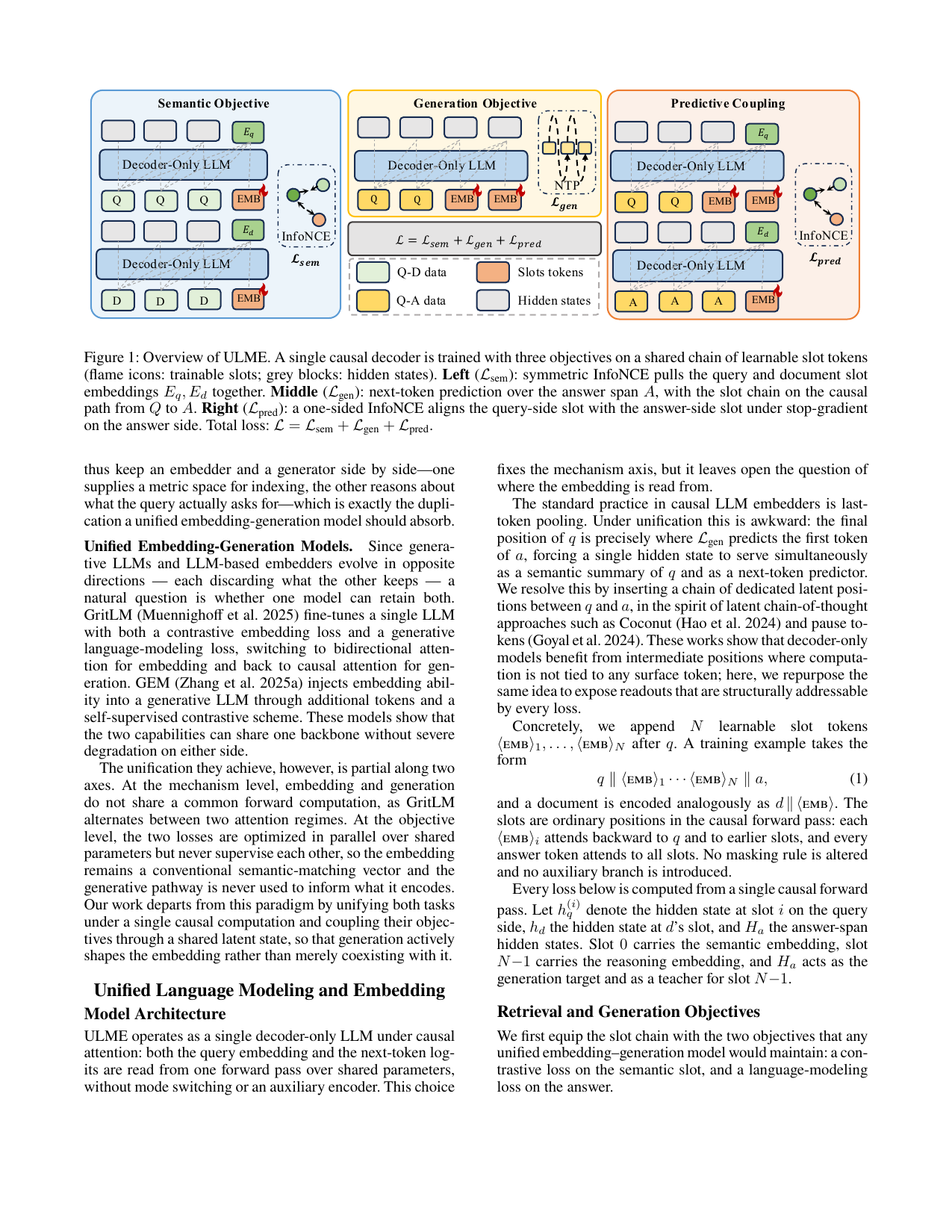
Embedding and generation are usually separate specialists; unified models like GritLM either switch attention regimes or train parallel losses. ULME uses predictive coupling: learnable slots between query and answer on a causal decoder, reading semantic and reasoning embeddings from designated slots, with three objectives on one backbone. Versus LLM2VEC-GEN, BRIGHT nDCG@10 improves and AdvBench-IR harmful retrieval falls 25.3%/20.3% on Qwen3-1.7B/8B. Unifying embed+generate is about objective coupling, not shared weights plus a mode switch.
1. Problem
RAG/agents embed then generate the same query with conflicting specialists. Parallel multitask or mode switches do not reinforce both sides.
2. Method
Post-train a slot chain between query and answer; read embed/reasoning from two slots; joint causal objectives (e.g., AdamW 1e-5 on generation, cross-rank in-batch negatives).
3. Core claim
Predictive coupling beats parallel losses/mode switches. Slots in one forward match RAG’s embed-then-generate use.
4. Experiments
BRIGHT nDCG@10 up vs LLM2VEC-GEN; AdvBench-IR −25.3%/−20.3% on 1.7B/8B.
5. Limits
Post-train cost; slot count/placement sensitive; hyperparameters tied to base models.
6. Practice
If one decoder must also embed for retrieval, try slot predictive coupling before deploying a second embedder.