On LinkedIn Premium Browsemaps, production Holistic-171 only reaches MAR@100 0.288 and an off-the-shelf 0.6B embedding 0.192—both learn profile similarity, while high-value Premium interactions are often complementary (job-seeking engineers need recruiters, not other engineers). PAIR turns production exposure logs into exposure-conditioned preferences: clicked over exposed-not-clicked, plus random negatives. A 0.6B model hits MAR@100 0.450 (56% over Holistic, 2.3× over the base encoder). Online, CTR +7.5%, Premium retention +2.1%, page-load latency +0.1%. Task-specific preference supervision beats scaling a generic member vector.
1. Problem
Premium users are denser and more goal-driven; intent shifts weekly. Static profile vectors miss “who to contact this week,” and similarity retrieval clusters peers with peers. PAIR reframes retrieval as preference ranking inside the production exposure support.
2. Method
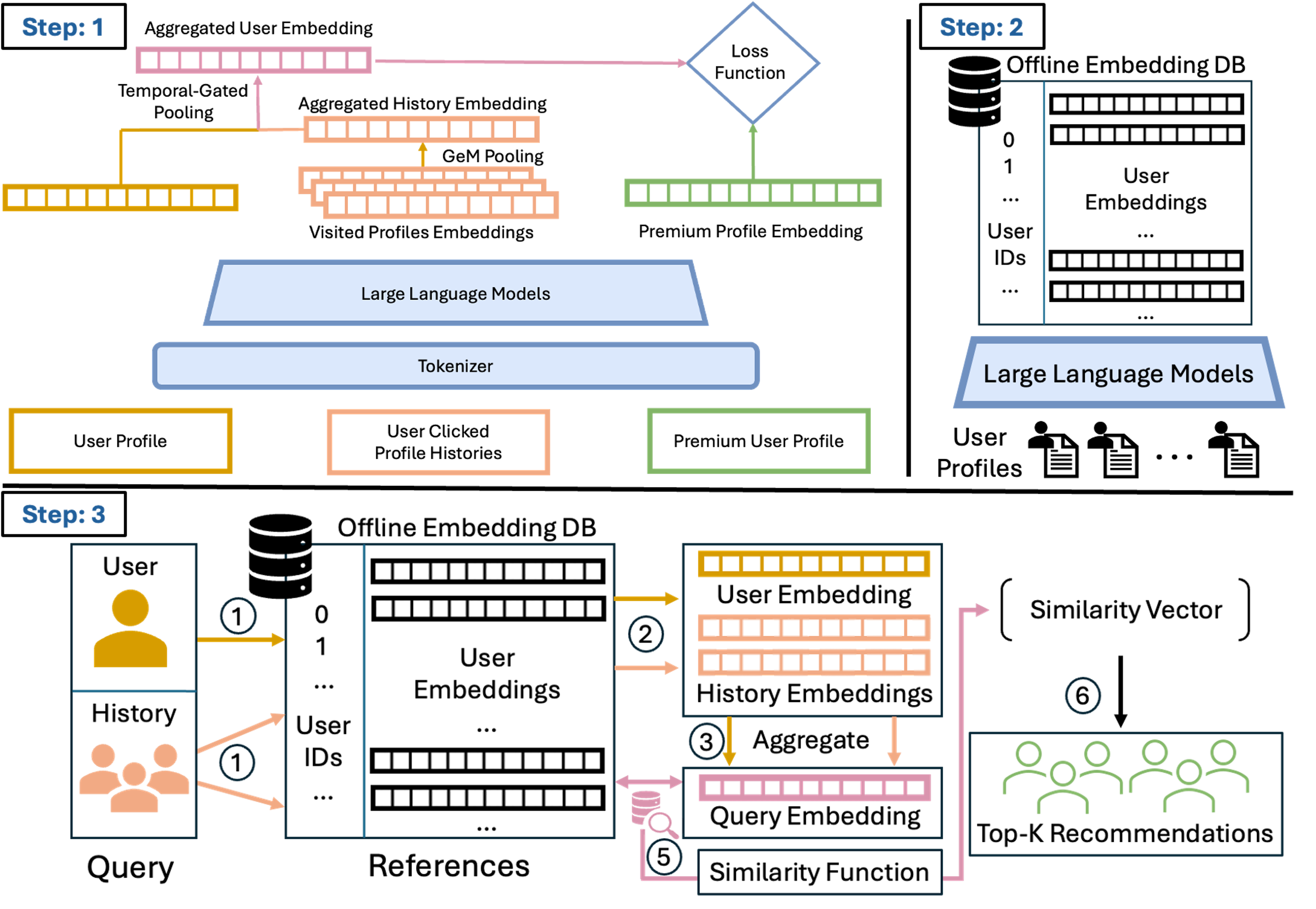
Positives are clicks in Premium Browsemaps impressions; negatives use a 1:3 pool of same-impression non-clicks plus random members. Standard contrastive fine-tuning still yields a similarity space; exposure-conditioned preference contrastive learning redirects it toward complementary intent. Serving avoids online LLM re-inference: profile/candidate towers are batch-offline; history updates are $O(Kd)$ over a window of precomputed embeddings with positional attention. Matryoshka loss supports 200/256/512/1024-d prefixes from one model.
3. Core claim
Two-tower PAIR (no history) already reaches MAR@100 0.436; P-ATT history reaches 0.450. Most of the lift vs Holistic is preference fine-tuning, not 171→1024 dimensions—256-d PAIR still hits 0.432.
4. Experiments
| Model | ACC | MAR@25 | MAR@100 |
|---|---|---|---|
| Holistic-171 | 0.794 | 0.169 | 0.288 |
| Off-the-shelf 0.6B | 0.771 | 0.100 | 0.192 |
| PAIR two-tower | 0.960 | 0.255 | 0.436 |
| PAIR + P-ATT | 0.967 | 0.265 | 0.450 |
Matryoshka: 1024-d 0.450; 512-d 0.444; 200-d 0.421. Online A/B (PAIR+P-ATT@1024 vs Holistic, same ranker): CTR +7.5%, Premium retention +2.1%, page load +0.1%, coverage −0.2%. Offline MAR gains shrink online because the ranker and product layers absorb part of the retrieval lift.
5. Limits
Preferences are only observed inside historical exposures (selection bias). Window and temperature need per-surface retuning. A/B swaps only the retrieval embedding.
6. Practice
For complementary-role people retrieval, change the training signal before scaling the encoder. For dynamic intent without online LLM, aggregate precomputed history with $O(Kd)$ ops and serve multiple latency budgets via Matryoshka.