Contents · 5 sections
1The next item a generator prefers may not make the best page2Compare completed pages at the same prefix3Turn full-page values into next-item probabilities4Move comparison into training, not serving5What the offline scores establishSHARE

The next item a generator prefers may not make the best page
Suppose a page already contains item A. The generator prefers B next, but that choice may leave an unhelpful continuation. Choosing C first and placing B later could make a better complete page. A score for B's own slot cannot distinguish those consequences.
This study from Meta brings that comparison into generative re-ranking training. It fixes a partial page, tries alternative next items, and lets the current generator complete each page. The resulting full-page scores supervise the next choice. At serving time, the trained generator selects legal candidates without querying the evaluator.
The change is how next-item supervision is constructed; the reported evidence is offline page quality on fixed candidate pools.
Compare completed pages at the same prefix
The input is a request with user context and a candidate pool. The output is an ordered page satisfying placement constraints. Candidate entries are selected without replacement. Other legality rules depend on the dataset: the industrial setting, for example, constrains spacing between sponsored and organic content. Item IDs are not universally required to be unique across an entire page.
The paper takes the complete-page evaluator as given. One training difficulty is that a single sampled page score gives every position the same signal. It does not directly compare alternative choices at one position. Another approach imitates target pages built before training, but those targets may stay fixed as the generator improves.
Training proceeds in rounds. Within a round, the current generator is fixed. It samples pages and collects the partial page before each position. At each such prefix, a scored candidate is placed next and the fixed generator samples the remaining items.
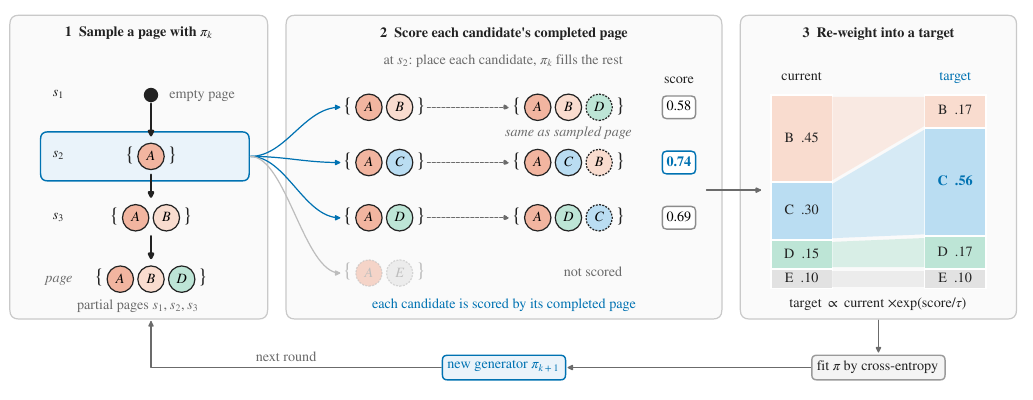
In the figure, choosing B yields A→B→D, whereas choosing C yields A→C→B. The evaluator scores the prefix, candidate, and continuation together. It does not merely compare the individual scores of B and C. Because the current generator supplies the continuation, the comparison asks which choice works better with its present continuation policy.
Turn full-page values into next-item probabilities
Let p denote the current next-item probability. Let Q be the expected complete-page score after choosing a candidate at a fixed prefix and completing with the current generator. Penalizing changes from the current distribution gives the target:
q(a|s) ∝ p(a|s) × exp(Q(s,a)/τ)
Here s is the prefix, a is the next candidate, and τ controls the strength of the update. The current probability remains a prior. Full-page values reweight it rather than assigning all probability to the highest-scoring candidate in one round.
Exact Q values require expectations over completions. The practical procedure samples one completion per scored candidate and uses its page score as an estimate. It does not train an additional critic.
When many candidates are legal, only a subset is scored. It combines high-probability candidates with candidates sampled uniformly from the remaining legal set. The set is selected before evaluator queries.
Unscored candidates keep their original probabilities. The scored subset keeps its original total probability mass, which is redistributed only within that subset. Limited candidate evaluation therefore does not directly change every unevaluated option.
<details>
<summary>The probability example used in the illustration</summary>
This example is constructed from Eq. (5), not measured in the paper. B and C are scored; D is not. Assume exp(estimated page score/τ) produces multipliers 1 and 3 for B and C. These are not raw page scores.
| Candidate | Old probability | Multiplier | New target |
|---|---|---|---|
| B | 0.500 | 1 | About 0.286 |
| C | 0.300 | 3 | About 0.514 |
| D, unscored | 0.200 | Not used | 0.200 |
The unnormalized weights for B and C are 0.5 and 0.9. Their shared mass stays at 0.8, giving targets 0.8×0.5/1.4 and 0.8×0.9/1.4. C gains probability while D stays unchanged. Displayed values are rounded and imply no online gain.
</details>
Cross-entropy then fits the generator to these position-specific targets. The updated generator constructs the next round's prefixes, candidate sets, completions, and target priors. Training does not repeatedly imitate targets constructed once at the beginning.
The improvement and convergence results concern exact target updates under their stated conditions. Practical single-sample estimates and finite cross-entropy fitting approximate those updates. The theory is not a guarantee that every neural-network optimization step improves page quality.
Move comparison into training, not serving
The trained generator chooses the highest-probability legal item at each position. It neither samples candidate completions nor queries the evaluator during serving. Those full-page comparisons occur in training.
The following results come from Table 2. Each value is offline score improvement over logged pages. Public-dataset values are averages across the reported length settings; the industrial result uses its reported page setting.
| Dataset | Proposed method | Strongest baseline and lift |
|---|---|---|
| KuaiRand-1K | 34.35% | PPO: 32.75% |
| RL4RS-SeqSlate | 7.09% | GRPO: 6.43% |
| Industrial logs | 13.92% | DeGRe: 12.75% |
The industrial values share the same logged-page reference. The proposed method's 13.92% is not its relative improvement over DeGRe.
The paper also compares against beam search ranked by placed-prefix scores. On the industrial dataset, mean generation time is 0.075 ms per page for the generator and 30.801 ms for width-32 search, as reported in Table 3.
These are batch-amortized times on one A100 80GB GPU. They include candidate generation and feature construction, excluding data and model loading. They are not single-request online latencies and do not directly imply an end-to-end serving throughput ratio.
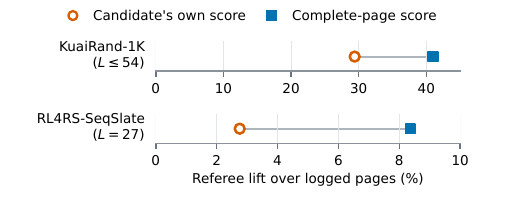
Replacing complete-page scores with the candidate's own slot score produces worse pages. A separate ablation freezes the generator that constructs training data. The two comparisons support full-page supervision and continuing to refresh the data-construction policy, respectively.
What the offline scores establish
On public and industrial data, final test scores come from a separately trained evaluation model called the referee. Public-data referees are trained on test-period logs, but generators do not query them during training or checkpoint selection. This is simulator-based offline evaluation: the results describe predicted page value, not measured online changes in clicks or revenue.
Candidate pools also limit the claim. The industrial task reorders entries already served on a page. KuaiRand expands candidate pools using items exposed later, making it a retrospective offline benchmark.
The paper additionally evaluates a synthetic task whose optimal pages can be enumerated. The proposed method reaches 97.16% of the optimal score, versus 94.64% for PPO. Its advantage mainly comes from the page-context contribution rather than a larger independent-item contribution. That decomposition is evidence from the synthetic environment.
The useful training idea is to compare complete-page consequences of alternative next choices at the same prefix. It is more specific than broadcasting one page reward to every position. Turning the resulting score gains into user value still depends on the evaluator, candidate pool, and deployment environment.
How did this read for you?
Hoot made a note. Thanks for the feedback.

One tap, no sign-in; tap again to undo. Only anonymous counts are kept, never who you are.
Discussion
Add experiment details, reproduction notes or a different take. Requires a GitHub sign-in.
Loading the discussion…