Contents · 5 sections
1Does a longer item code make recommendation more accurate?2Continuous history, quantized candidates3A fixed user vector separates out the quantization error4Training one model for several code lengths5Prefix training improves a tradeoff, not every settingSHARE

Does a longer item code make recommendation more accurate?
Compressing an item into a short code reduces the need to store a large table of continuous item vectors. But in a recommender that generates a Semantic ID one position at a time, code length also determines how many predictions the model must make. Better reconstruction of an item vector does not necessarily make the next item easier to rank.
LQ-Rec changes where quantization happens. Historical items remain continuous vectors, allowing a sequence model to predict a user vector first. Candidate items are stored and matched through residual codes. The system retains compact item representations without requiring the recommendation model to generate each code position.
Continuous history, quantized candidates
LQ-Rec is a content-based sequential recommender. A frozen text encoder represents each item, and a trainable MLP projects that representation into a continuous vector. The sequence Transformer reads those continuous vectors for the items in a user's history. Its final-position output becomes the user vector. No additional per-item ID embedding is learned (paper §IV-B).
Quantization sits on the candidate path. A residual quantizer selects a codebook vector at each stage, approximating the original item vector by their sum. Storage keeps the selected indices. Scoring takes the inner product between the user vector and the reconstructed item vector.
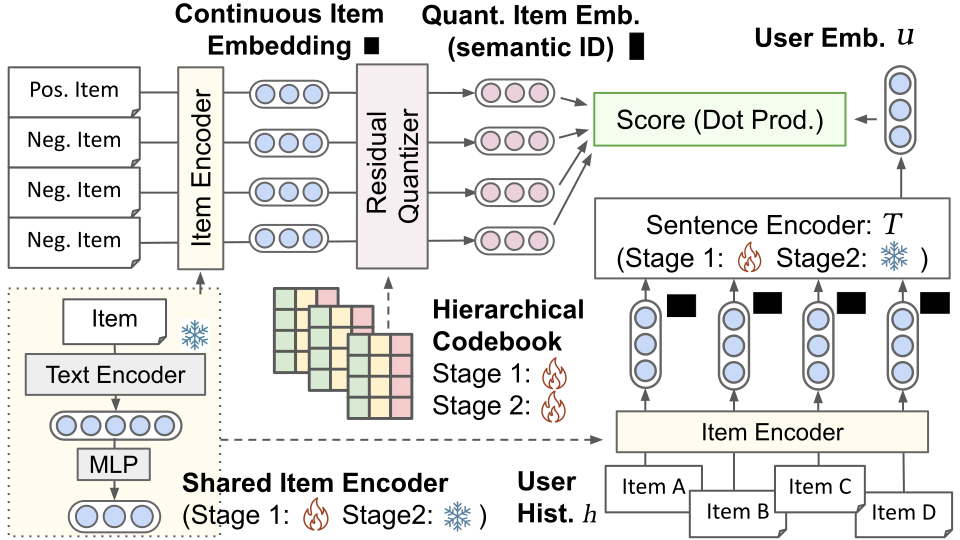
Non-autoregressive does not mean search-free. Inference still uses beam search over a prefix tree of valid item codes. Each expansion compares user–centroid inner products, which can be calculated in advance for that query. The user Transformer runs once, rather than running again as the code expands. A complete code's score equals the inner product against its reconstructed item vector. Missing a high-scoring item because the beam is finite is a separate approximation error.
When historical items are expanded into multiple tokens, longer codes also lengthen the history seen by the Transformer. LQ-Rec avoids that coupling. The cost has not vanished: candidate storage and tree search still depend on code length.
A fixed user vector separates out the quantization error
The change creates a useful analytical condition. Once the trained continuous model is fixed, quantizing candidate items does not change the user vector. The quantized score can therefore be decomposed as:
Quantized score = continuous score + projection of item reconstruction error onto the user vector
If the historical inputs were quantized too, modifying a codebook could also change the user vector. The candidate-side perturbation would no longer be the only moving part. LQ-Rec separates the continuous model's existing prediction error from the extra score perturbation introduced by quantization (Proposition 1). This does not make the continuous model correct; it makes the two errors separately analyzable.
For a pair of items, a sufficiently large initial score gap cannot be reversed by bounded quantization errors. One sufficient condition in Theorem 2 is that the continuous margin along the unit user direction exceeds the sum of the two reconstruction-error norms. Failure to satisfy this conservative condition does not imply an actual reversal. It only means the bound cannot guarantee the ordering.
This guarantee compares continuous and quantized scores, not those scores with true user preferences. It also does not guarantee that a finite beam finds every high-scoring item. An error bound is different from a guarantee of improved recommendation metrics.
Training one model for several code lengths
Because reconstruction adds successive residual code vectors, inference can use only the first few stages to reduce storage and shorten search. Being able to truncate a code does not mean the truncated representation ranks well. The paper addresses that distinction with two-stage training (§V).
The first stage begins with cross-entropy over continuous item vectors, initializes the residual codebooks, and gradually shifts the objective toward quantized scoring. The continuous model and quantizer are then trained jointly, with a commitment loss constraining the distance between item vectors and their quantized representations. This is not merely an independently fitted compressor applied after recommendation training has finished.
The second stage freezes the continuous model and optimizes the codebook using the mean cross-entropy across residual prefixes. It also learns a temperature-calibration scalar for each prefix. Shorter prefixes can produce smaller vector norms, so those temperatures adjust score scales across lengths. Truncation removes residual stages, not dimensions of a continuous embedding. Hoot says

Illustration of residual prefixes of one item, not a measured curve. Left: training only the full code and truncating at inference leaves the short prefix untrained as a scoring target. Right: the second stage freezes the continuous model, fine-tunes the shared codebook with prefix cross-entropy, and learns per-prefix temperatures; user vectors are not updated in this stage.
Source
Paper §V-A, §V-B. This figure only shows what is updated during training and does not quote table metrics.A checkpoint trained for a dataset can consequently serve different code lengths without retraining at each setting. Table IV reports the following Recall@10 values. Each column reuses the same checkpoint for that dataset:
| Code length used | Toys | Beauty | Sports | Yelp |
|---|---|---|---|---|
| 4 | 0.0860 | 0.0874 | 0.0511 | 0.0538 |
| 8 | 0.0966 | 0.0972 | 0.0585 | 0.0611 |
| 16 | 0.1037 | 0.0995 | 0.0613 | 0.0640 |
Results improve across these three measured settings, supporting a deployment-time quality–cost adjustment. This is not a monotonicity guarantee for every length or dataset. The earlier ordering condition cannot establish that broader claim either.
Prefix training improves a tradeoff, not every setting
The ablation does not support the simple interpretation that more training improves everything. The second stage improves short-code results on Toys, Beauty, and Yelp, but Sports regresses. On Sports, Recall@10 at length 4 changes from 0.0523 after the first stage to 0.0511 for the complete pipeline. At length 16, it changes from 0.0633 to 0.0613 (Table VI). Prefix fine-tuning optimizes a tradeoff across lengths, not a lossless gain at every operating point.
The complete LQ-Rec configuration leads most ranking metrics in the main comparison, but remains below VQ-Rec on Yelp NDCG@5 (§VI-B). Making longer codes easier to exploit and winning every metric are different claims.
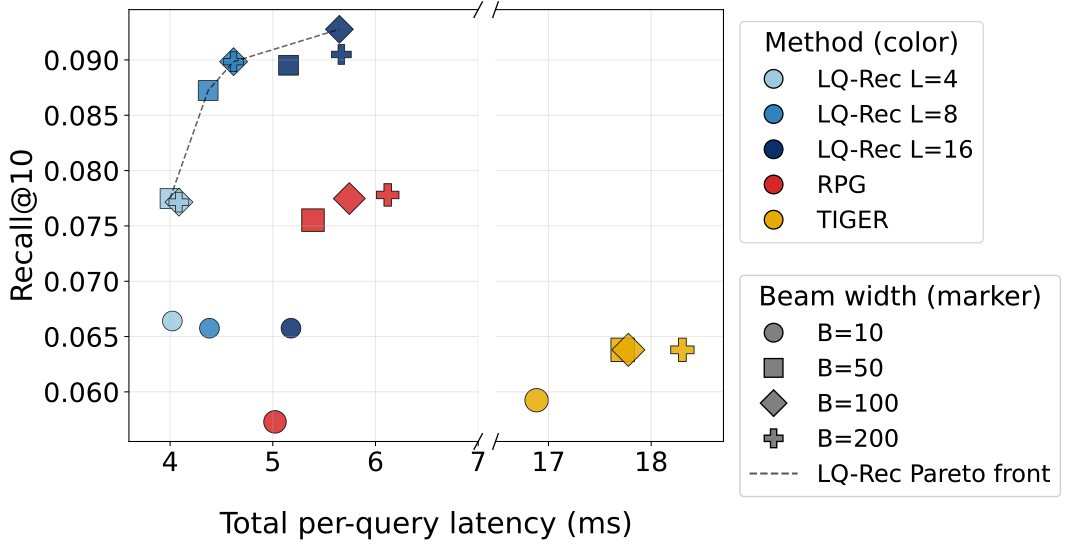
The latency accounting includes encoding historical item text for LQ-Rec, whereas TIGER and RPG, a parallel-code-prediction and graph-search baseline, look up precomputed item codes. The setup and latency sections use inconsistent names for the text encoder, so its exact identity is not treated here as established. What is clear is that history-text encoding is included in the cost.
The catalog-size experiment injects additional items into the Sports catalog to reach half a million items. It measures latency and storage, rather than ranking on newly collected real interactions at that scale (§VI-F).
LQ-Rec separates how a model understands history from how candidates are compressed. Continuous historical inputs, residual candidate codes, and inner-product scoring create an analyzable structure. Quantization-aware training and prefix fine-tuning turn that structure into adjustable operating points. Adoption still depends on the actual costs of text encoding, candidate search, and ranking quality at each code length—not merely the number of bytes saved per item.
How did this read for you?
Hoot made a note. Thanks for the feedback.

One tap, no sign-in; tap again to undo. Only anonymous counts are kept, never who you are.
Discussion
Add experiment details, reproduction notes or a different take. Requires a GitHub sign-in.
Loading the discussion…