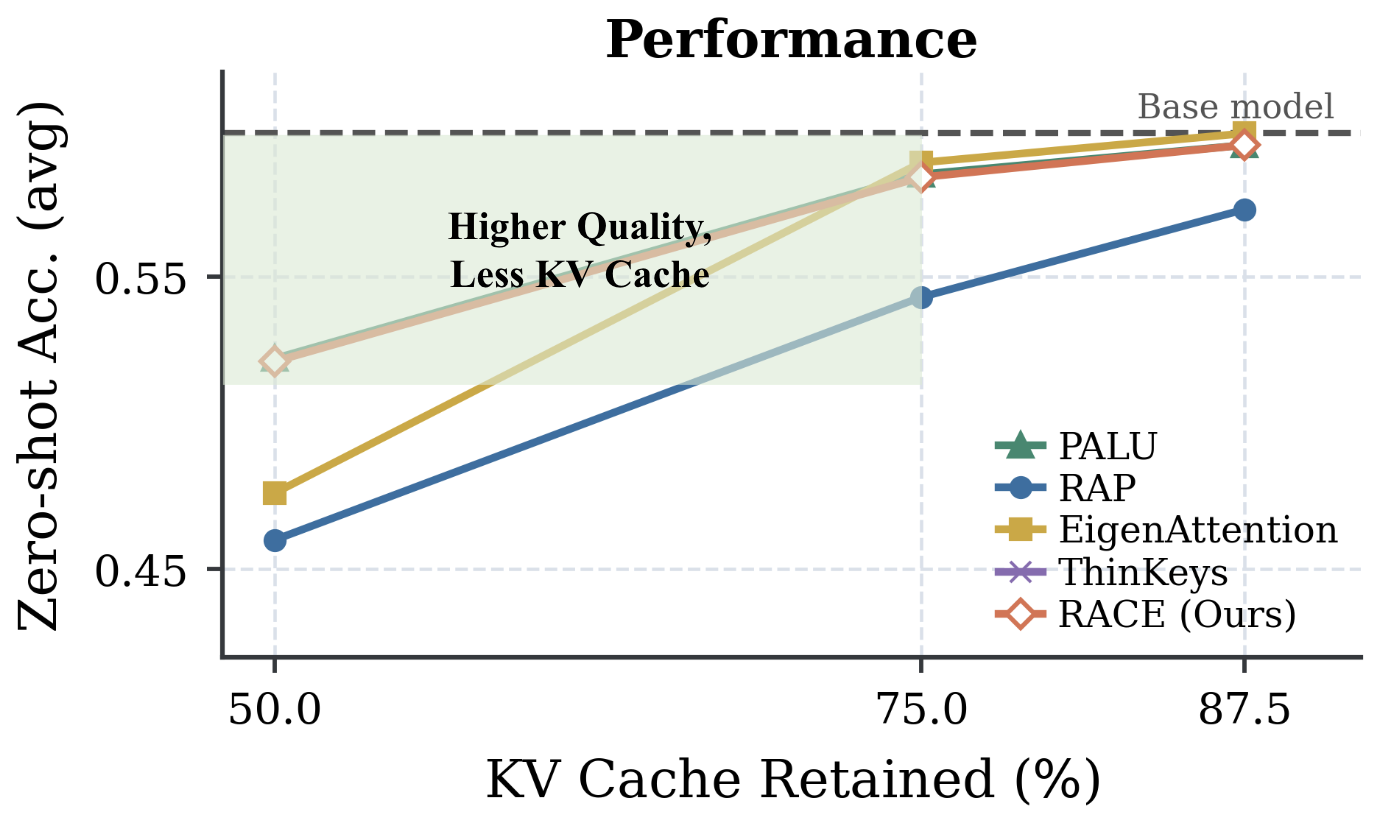
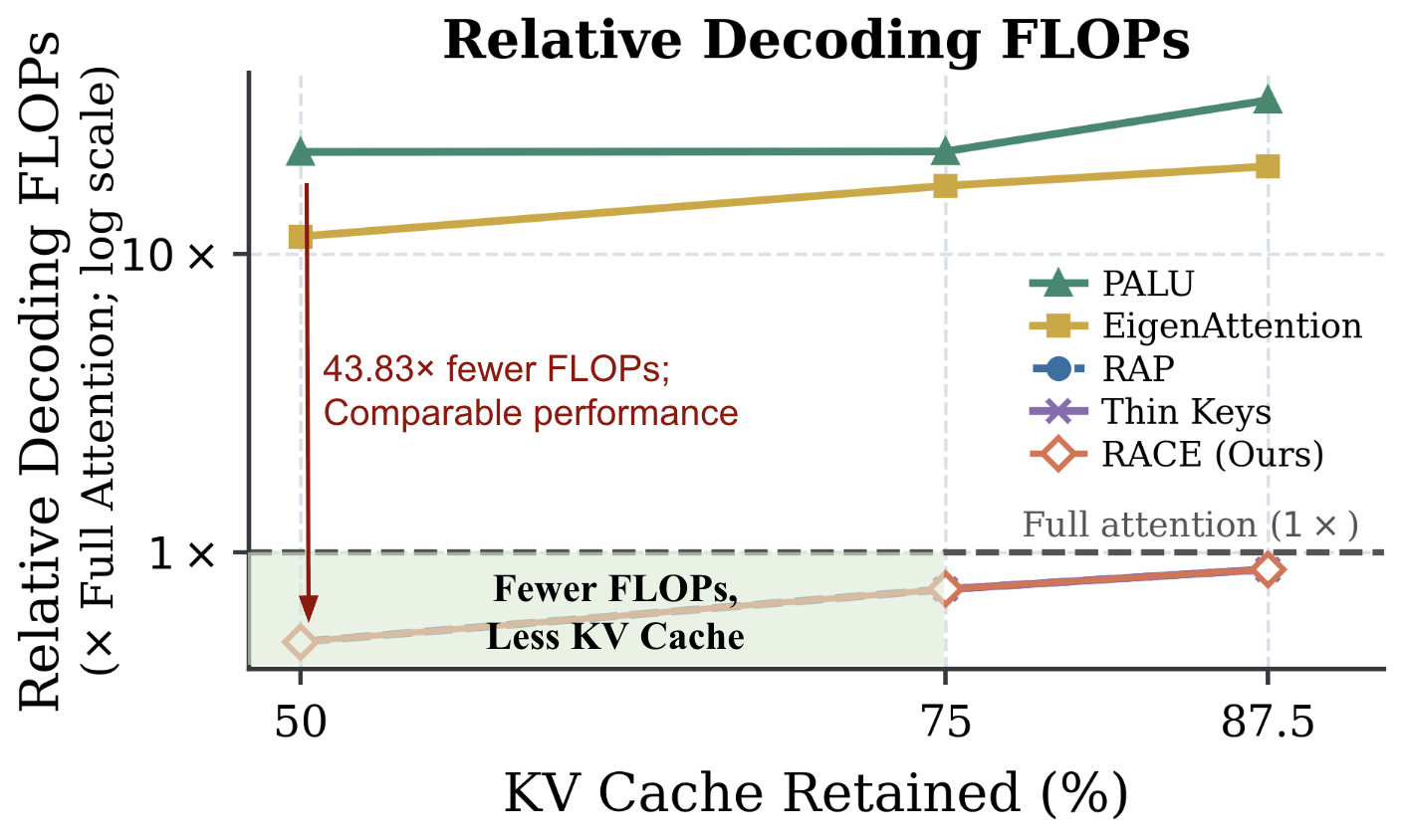
Head-dimension KV compression often reconstructs full-width tensors at decode and adds FLOPs. RACE calibrates pretrained attention into a natively reduced form: shared Q/K projections that stay RoPE-aligned, compressed by query–key activation energy, cutting KV storage and attention compute together. At 50% KV retention and 256K context: total inference FLOPs −47.8%, throughput 1.79×, TTFT −43.2%, allocated GPU memory −28.1%. Versus EigenAttention/PALU/Thin Keys/RAP, RACE checks RoPE keep, shared projection, storage cut, attention-FLOPs cut, and no decode reconstruct. Head-dim compression must be native reduction, not reconstruct-at-decode.
1. Problem
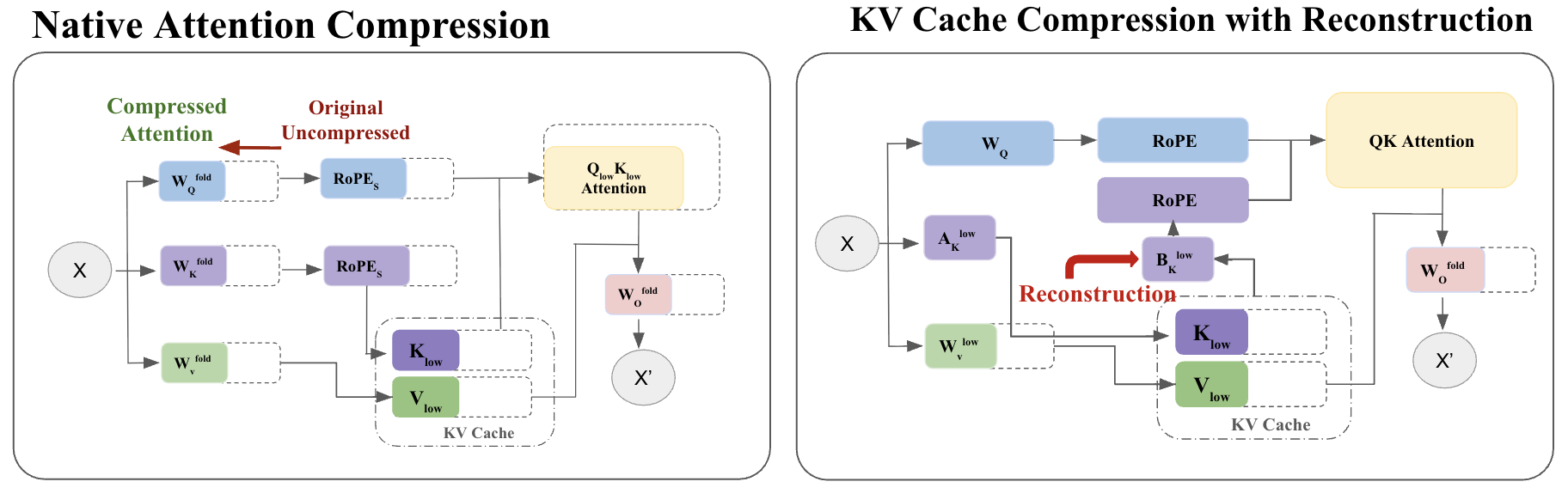
Growing KV hurts memory/bandwidth. Width compression that rebuilds full K/V at decode trades memory for FLOPs. Calibration should produce reduced attention natively.
2. Method
Shared projections map Q/K into one low-dim space with RoPE still aligned; activation energy picks directions; V compresses with them. One calibration; no up-project at decode. Composes with token reduction and quantization.
3. Core claim
Compression becomes a reduced attention operator that preserves RoPE geometry. The same projection that saves memory should also save attention FLOPs.
4. Experiments
On Llama/Qwen zero-shot, PPL, LongBench: at 50% / 256K → FLOPs −47.8%, 1.79× throughput, TTFT −43.2%, memory −28.1%.
5. Limits
Calibration domain shift; retune retention with aggressive quant; other ops still bound end-to-end speed.
6. Practice
When KV memory is tight, try native reduced attention before compress-and-reconstruct; scan 50% retention against TTFT and LongBench.