On long agent trajectories KV I/O dominates cost; editing the prefix invalidates later cache and forces re-prefill. Cache engineering lets agents drop selected cache and repos retained keys’ position indices—controlling active KV without rewriting trajectory text. Versus threshold-triggered summarization, a tool-response drop policy cuts average cost 27.7% and lifts scores 1.7 points; with AKV, ~1.2× output throughput and ~1.5× better P95 latency; RSI saves another 7.1% on held-out tasks. KV reads can be 82.4% of API cost. Agent savings often mean not invalidating cache, not only shorter summaries.
1. Problem
Context engineering trims/summarizes text but invalidates suffix KV. KV reads can be most of the bill. Need a control plane over active KV, not only over strings.
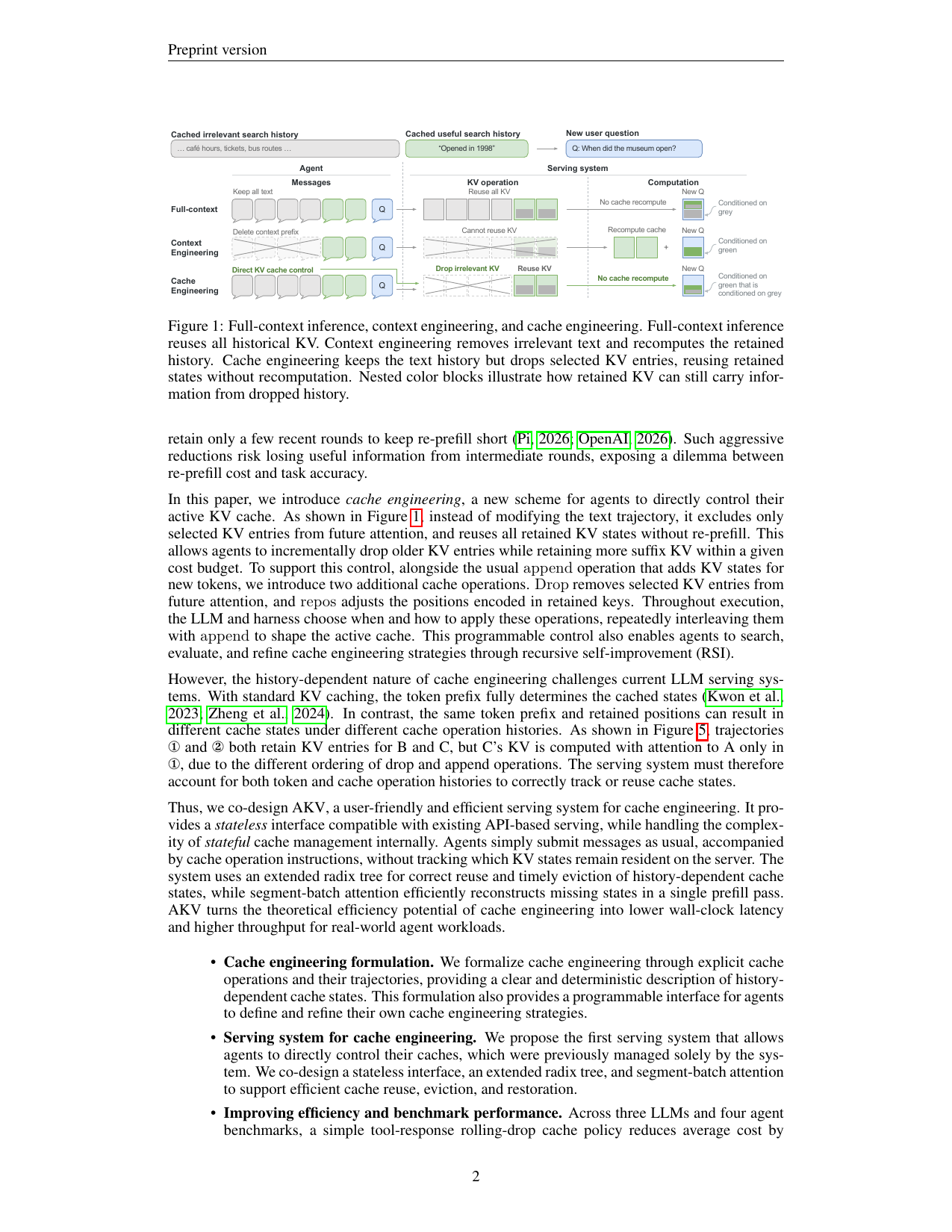
2. Method
Primitives drop / repos: drop hides spans from future attention; repos rewrites position indices without changing bytes. Policies can be hand-written (drop tool payloads) or RSI-searched.
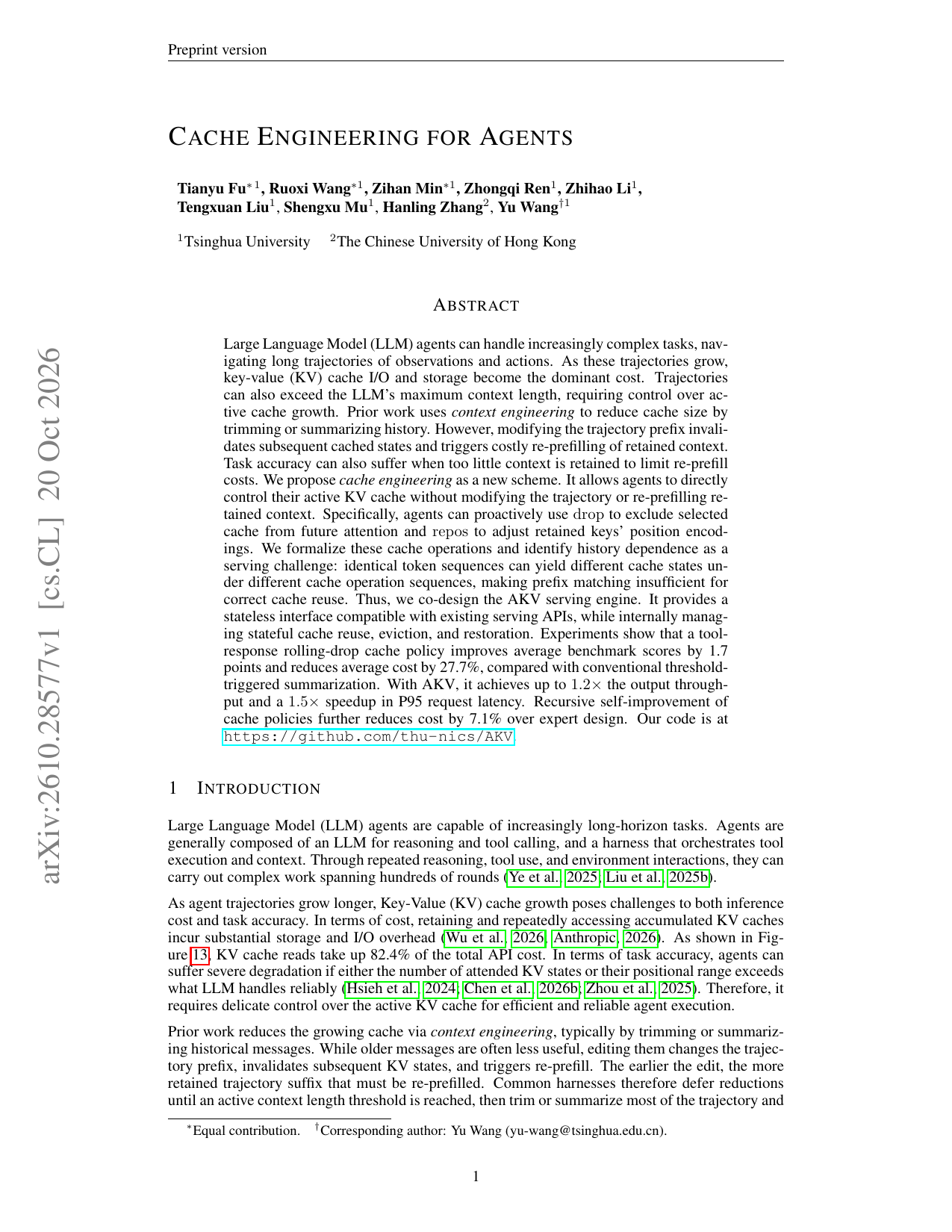
3. Core claim
Optimize the active KV set, not only the prompt string. Keeping prefix bytes ≠ keeping prefix cache—one invalidation re-pays prefill.
4. Experiments
Tool-response drop: −27.7% cost, +1.7 score; AKV ~1.2× throughput / ~1.5× P95; RSI −7.1% more. Threshold summary (~48k) can cut ~7% cost but lose ~5 accuracy points.
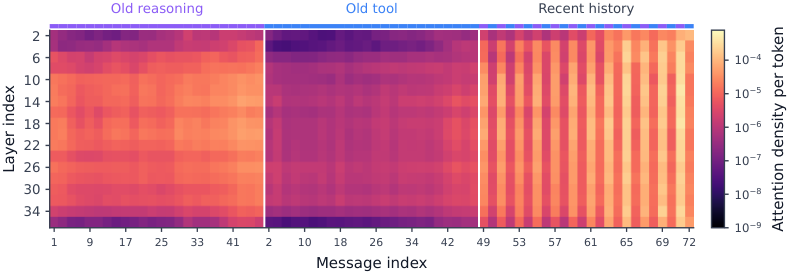
5. Limits
Needs a writable cache API; aggressive drops lose tool evidence; RSI search has its own cost.
6. Practice
Wire a droppable KV layer into agent runtimes; drop reconstructible tool payloads before summarizing.