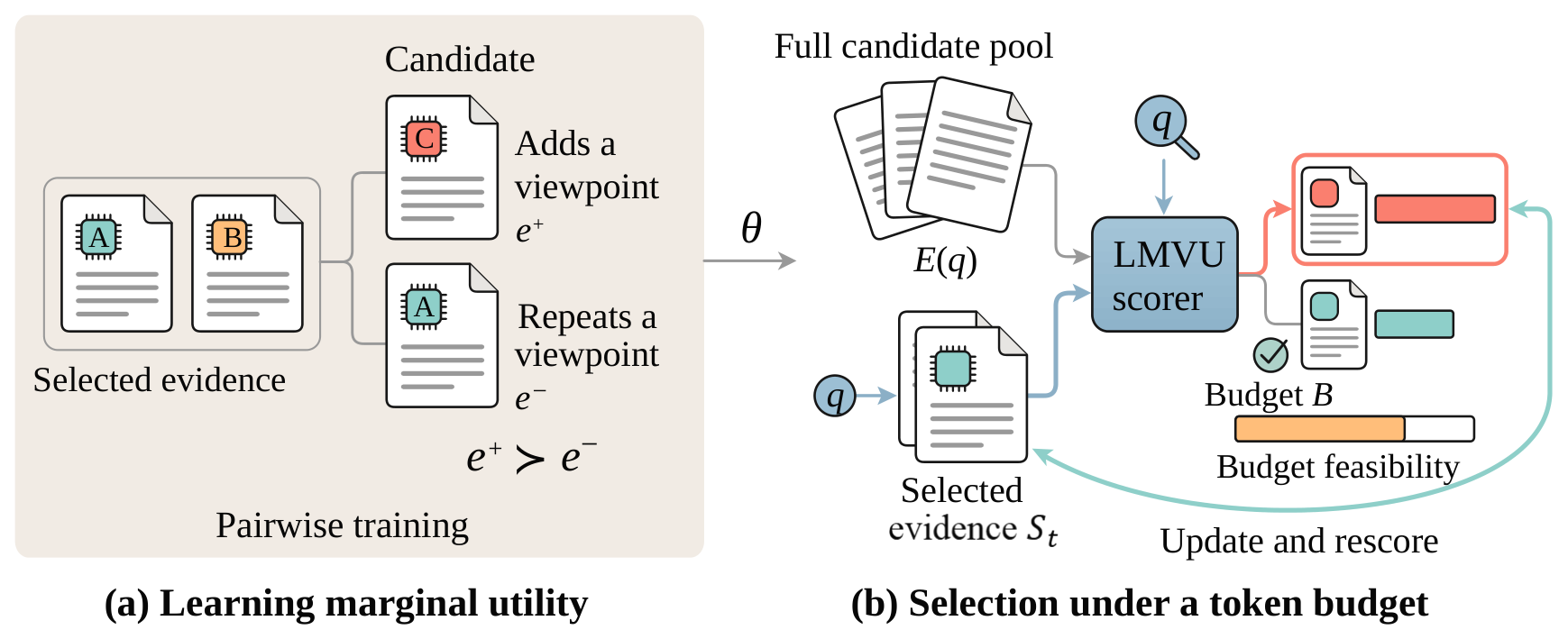
Multi-viewpoint RAG must keep distinct answers/stances under a fixed context budget. LMVU ranks by the marginal viewpoint coverage a candidate adds to the current selection, trained with within-state comparisons on development viewpoint labels, and rescoring budget-feasible candidates as context grows. It reaches 94.6% coverage on Perspectrum and matches/nears full coverage on WVS/ESS10, beating strong baselines. Rank multi-viewpoint evidence by marginal coverage, not per-doc relevance alone.
1. Problem
Relevance-greedy selection re-covers one viewpoint until the budget dies. Need explicit marginal coverage utility.
2. Method
Train on within-state marginal coverage gains; at inference, greedy Algorithm 1 fills budget B. Optional MMR-oversampled pools (e.g., 4×) then refine.
3. Core claim
Diversity becomes marginal coverage of annotated viewpoint units. Relevant evidence that adds no coverage should yield.
4. Experiments
94.6% on Perspectrum; WVS ΔRVC vs MMR often excludes 0; dropping state features collapses WVS NDCG@5 ~0.66→0.44.
5. Limits
Needs viewpoint labels; budget is tokenizer-dependent; unlabeled domains need proxies.
6. Practice
For contested QA RAG, train within-state marginal coverage objectives instead of similarity-only selection.