In vector retrieval, short queries often under-specify intent. A common fix is to gather feedback text—top documents from a first-round search, or an LLM-written hypothetical answer (HyDE)—and use it to update the query vector. Most methods average the feedback vectors or linearly interpolate with the original query, treating each feedback as "what the new query should look like" and pulling the query toward it as a whole. Tsinghua's DIFF argues that this causes interference: each piece of feedback usually supports correcting the query along only one direction; other directions carry no information from it, yet are still pulled back. DIFF first extracts the direction each feedback adds beyond the original query, requires the corrected query to agree with the feedback only along that direction, weights constraints by feedback quality, adds a "do not drift too far from the original" term, and has a closed-form solution that needs no training. On 14 BEIR subsets, 3 retrievers, and 4 feedback sources, DIFF's mean NDCG@10 is best or tied for best in 12 of 12 settings, but with first-round retrieved documents as feedback it barely improves over the unfeedbacked query.
1. Treating feedback as target points loses complementary information
Let the original query be and the correction proposed by feedback relative to be , with unit direction and magnitude . Pointwise fitting minimizes . The authors split it:
The first term asks 's component along to equal —desired. The second penalizes on every other direction, which may be exactly what other feedback supports. Example: query "apple event"; one feedback doc is about a new phone, another about a new laptop; pointwise fitting pulls the query halfway between them and travels only halfway on each direction.
They prove that under the same weights, directional constraints yield a correction magnitude at least as large as pointwise fitting, with equality only when all feedback directions are collinear; when feedback directions are pairwise orthogonal, pointwise fitting dilutes each direction's correction by the other feedbacks' weights.
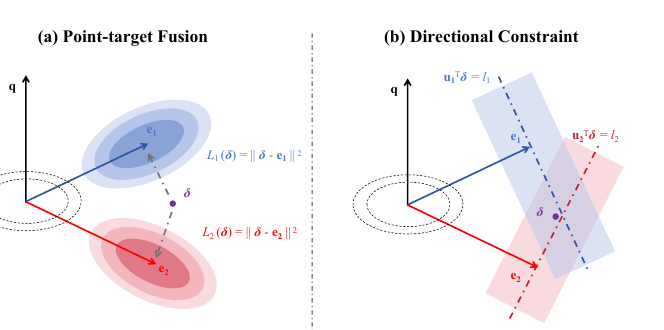 toward the middle of and . Right: directional constraints; each feedback only constrains 's projection on its own direction, so can satisfy both." loading="lazy" decoding="async">
2. Method: four steps
Step 1: new direction per feedback. All vectors are L2-normalized on the unit sphere. For feedback , compute similarity , then subtract the component parallel to to get . Direction is where this feedback wants to rotate the query; length equals the sine of their angle—how much new content it adds.
Step 2: credibility per feedback. Credibility has two layers. Per-item quality : standardize the values under the same query by median and MAD, then pass through a sigmoid, so feedback closer to the query weighs more without depending on absolute similarity scales across models. Group credibility : mean of all correction vectors , then compare to dispersion around that mean; is high when directions agree and low when they conflict, then multiplied by mean per-item quality.
Step 3: jointly solve for the correction. The objective keeps only each feedback's own-direction constraint plus a penalty on correction size:
It has a closed form: solve a linear system ( feedbacks, 5 in the main experiment), cost for dimension .
Step 4: map back to the sphere. The final rotation angle is the min of and " × max allowed angle", then . When the group is untrustworthy, is small and the query barely moves.
3. Experiments
Setup: 14 BEIR subsets (ArguAna, FEVER, HotpotQA, MSMARCO, NQ, SciFact, TREC-COVID, …), three retrievers bge-base-en-v1.5, e5-base-v2, Qwen3-Embedding-0.6B. Feedback is either the top- first-round documents (PRF) or three Qwen3.8-27B generations (HyDE hypothetical docs, Q2D query expansion, CoT reasoning). All methods share the same encoder, the same feedback, and the same index—only fusion differs. Baselines include vector averaging (VPRF), concatenate-and-reencode (Concat-P/L), orthogonal-component OR-PRF, dimension-weighted DIME and Eclipse, and AnchorQE which needs extra retrieval to estimate weights.
3.1 Main results
This checks whether DIFF beats other fusion methods across retrievers and feedback sources. Mean NDCG@10 over 14 subsets; parentheses are the unfeedbacked query:
Two results stand out. First, with retrieved-document feedback, simple averaging (VPRF) pulls scores below the original query—on BGE from 0.5492 to 0.5045; DIFF in that column merely does not lose: 0.5522 on BGE, 0.5252 on E5, 0.5491 on Qwen, barely changing versus the original. Second, with LLM-generated feedback every method gains; DIFF reaches 0.5717 on BGE with HyDE and 0.5777 on Qwen. It is close to AnchorQE (0.5717 vs 0.5700 on BGE + HyDE) but needs no extra retrieval for weights.
3.2 Ablations
This checks whether directional constraints and credibility weighting are each necessary. On BGE, remove or replace one part at a time:
Switching back to pointwise fitting is among the largest drops, directly supporting the paper's core claim: constraining each feedback only along its own direction beats pulling the query toward feedback as a whole. Dropping per-item quality under HyDE falls from 0.5717 to 0.5481—generated hypothetical docs vary in quality and must be treated differently.
3.3 Feedback count
As grows from 1 to 20, VPRF drops quickly under retrieved-document feedback because later documents are noisier. DIFF stays stable across ; the authors attribute this to group credibility shrinking the correction when feedback becomes mixed.
4. Limitations
The main-table point: with first-round retrieved documents as feedback, DIFF barely beats the unfeedbacked query and is slightly worse on Qwen (0.5491 vs 0.5492). Its value is mainly "not being dragged down by noise" and "using generated feedback well." Experiments are only on BEIR with retrievers up to 0.6B; production-scale corpora and larger embedding models are untested. Group credibility and max rotation angle have hyperparameters whose sensitivity is not analyzed in the body.
5. Takeaways
If you already use HyDE or query expansion and average the encoded text with the original query, consider DIFF: it depends only on vectors, needs no training and no extra retrieval, and solves one 5×5 linear system per query. If feedback is first-round retrieval, this paper's results say gains are limited—at least confirm that averaging is not already hurting metrics.