Contents · 7 sections
1Deployment looks at hundreds of candidates; reporting stops at the first ten2The items pushed out were already in the middle of the ranking3Walkthrough: how black ink drops out of the candidate list4An exactly optimized objective would not lose recall; the estimated update does5Out-of-rollout anchoring: constrain the relative scores of anchors outside the rollout6What this means for people who post-train generative recommenders7LimitsSHARE

The top ten get sharper, but hundreds of candidates handed downstream go missing: RL post-training for generative recommenders, and out-of-rollout anchoring
When a generative recommender is deployed, the common use is to generate a list of candidates and hand them to a downstream ranker or reward model. Some systems also show the first few results directly to the user. One retriever hands over 1,500 items; another generates 512. For the first use, the channel is judged by whether the item the user will actually choose is still on that list.
Post-training is now almost standard: supervised fine-tuning on the logged next item, then a round of reinforcement learning, most often GRPO. Prior work mainly reports hit rate and NDCG at small K, usually the first ten. Looking only at those reports, a recall loss deeper in the list is easy to miss.
Researchers at the Hong Kong University of Science and Technology and Trip.com Group scored every item in the catalogue and ranked each test prompt all the way to position 500. They found that reinforcement learning raises hits at the very top, yet lowers recall of the candidate list on all five datasets they studied. They place the root cause here: each user usually has only one logged next item, together with how the rollout is updated and the fact that parameters are shared. Other highly plausible candidates in the rollout are treated as wrong and given negative advantages. Those candidates are often what similar users will actually choose, so they drop out of those users' lists. The authors add out-of-rollout anchoring, which pulls a separately sampled set of items outside the rollout toward the relative scores of the supervised model, and therefore toward their original order. Across the five datasets the top-of-list gains remain, and recall comes back near the supervised level: on four datasets it reaches or slightly exceeds that level, while Office still leaves a small gap. On the Office products data, hit@500 falls from 52.84% to 47.69%; the anchor recovers 4.4 of the 5.1 points that were lost.
On the five datasets measured here, reinforcement learning turns a generative recommender into a better ranker and a worse retriever; out-of-rollout anchoring keeps the top-of-list metrics and brings recall back near the supervised level, but this paper has not yet put a downstream ranker into an industrial online test.
Deployment looks at hundreds of candidates; reporting stops at the first ten
Each item is first written as a short string of discrete tokens, its Semantic ID. Like a language model, the system "writes" the ID of the next item from the user's recent history. Supervised fine-tuning only raises the probability of the logged item; it does not name anything as wrong. Reinforcement learning is different: the policy first generates a small group of candidates for that history, which the paper calls a rollout. The candidate that matches the logged next item is rewarded. A common recipe also assigns a negative score to the candidates that do not match.
This paper follows the GRPO setup in MiniOneRec. Each rollout draws 16 distinct candidates. If the target is among those 16, it gets a positive advantage and the other 15 get negative ones. If the target is not drawn at all, every advantage in the group is zero, and there is no policy gradient on that step. The backbone is Qwen2.5-1.5B-Instruct, fully fine-tuned. The reference policy is a fixed supervised checkpoint.
They run paired comparisons on five datasets, with three seeds for each reinforcement-learning setup, and report the mean. Office and Industrial are the 2018 Amazon review benchmarks released with MiniOneRec, with 3,459 and 3,686 items. Beauty, Toys, and Sports are 2014 Amazon 5-core subsets with larger catalogues, about 12,000 to 18,000 items; the reinforcement-learning hyperparameters were not tuned separately for these three. For each test prompt they score every item in the catalogue, record the exact rank of the target, and report hit@K and NDCG@10. Each prompt has one target, so hit@K here is recall at that cut-off.
After one epoch of GRPO, the first ten do look better. On four datasets, NDCG@10 and hits in the first ten both rise; on Sports, hits in the first five rise as well. So an evaluation that stops at the very top would conclude that post-training worked.
Further down the list, the curve crosses below zero. On Office the loss begins around rank 20, and on Industrial around rank 50. That means once the list is used even a little beyond a few dozen items, the books have already turned.
The Office numbers make both ends clear. NDCG@10 rises from 11.59% to 12.55%, hit@50 falls from 25.73% to 24.22%, and hit@500 falls from 52.84% to 47.69%, so a sharper top and a thinner candidate list happen together. Of the test targets that the supervised model had ranked in its top 500, 22% are gone after reinforcement learning. Across the five datasets that share is between 14% and 22%, which means dropping out of the candidate list is not unique to Office.
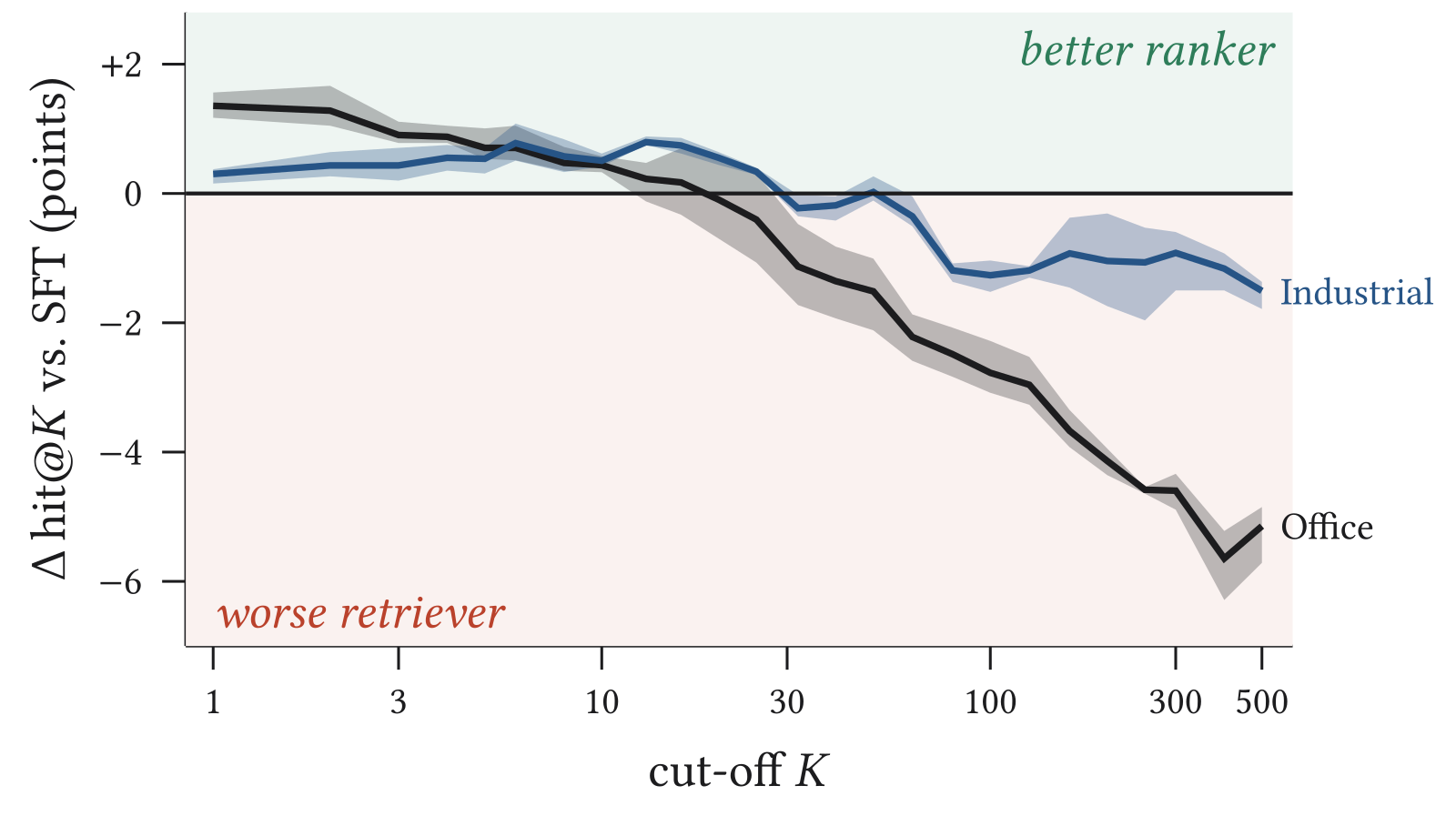
The loss is not an artifact of exact ranking alone. With a constrained beam of width K, Office still loses 2.59 points at hit@200 and 3.06 at hit@500; Industrial loses 1.96 and 1.83. So when candidates are produced with the beam used in deployment, the mid-to-deep loss remains.
But under a common protocol, a beam of 50 scored only at the first ten, hit@10 on Office and Industrial still shows gains of 0.39 and 0.46 points. That means the same models, judged only at the first ten, report a gain and miss the recall loss entirely.
The loss is still there under other reinforcement-learning setups. When the reference policy moves toward the current policy during training, Office hit@500 falls 6.4 points, and a second epoch deepens that to 8.9. With REINFORCE++ and a baseline, the recall loss is three to four times that of this GRPO run.
The items pushed out were already in the middle of the ranking
Grouping test prompts by the rank the supervised model gave their target, the movement is not at the very top, but in the middle. On Office, targets that already ranked first stay first at the median. Those at ranks 2 to 10 move up and down in about equal measure, and the median goes from 4 to 3. So the very top is barely taken apart, which matches the stronger first ten.
The real drop is from ranks 11 to 500. On Office, demotions are almost twice as common as promotions: the median at ranks 11 to 50 falls from 26 to 44, and 62% are demoted; the median at ranks 201 to 500 falls from 326 to 497. That means many targets the supervised model already treated as close enough for a candidate list are pushed out of the usual window. On Industrial, 54% to 57% in these bands are demoted too, with a smaller shift in the median. Targets beyond rank 500 improve slightly.
What reinforcement learning hurts are the items the supervised model already thought were reasonable for that user, just not at the very top.
Sharpening the distribution is not enough to explain this. On Office, the entropy of the item distribution falls from 6.0 to 3.1, so it does become more peaked. But rank-based metrics are invariant to monotone transforms of the scores: changing only the temperature, or only concentrating probability at the head, would leave hit@K unchanged at every K. A recall loss requires new inversions: a pair the supervised model ranked correctly is ranked the other way after reinforcement learning.
Walkthrough: how black ink drops out of the candidate list
The paper strings this together with an illustrative example. The walkthrough below follows that story. Except where a number is marked as coming from an experiment, the figures are illustrative.
Start with one training example. In this log, the user's next item is colour ink. The model rolls out 16 candidates for this history, colour ink is in the rollout, so it gets a positive advantage and the other 15, including black ink, get negative ones. Colour ink rises relative to those competitors, and the top of the list gets sharper.
Next, look at black ink's own ledger. For many users it looks like a plausible next purchase, so it is sampled again and again, but it is rarely itself the target. Penalties pile up on this item. As an illustrative tally: if it is only a runner-up in 15 of 16 rollouts, the ledger shows 15 minuses against one plus.
Then see who shared parameters carry this to. The parameters are shared by all users. For someone with a similar history whose next item really is black ink, the score of that item is pulled down too.
If that person's own rollout never draws black ink, this update has no push back. Items that are rarely sampled are not pushed down, and may overtake it and crowd it out of the top K.
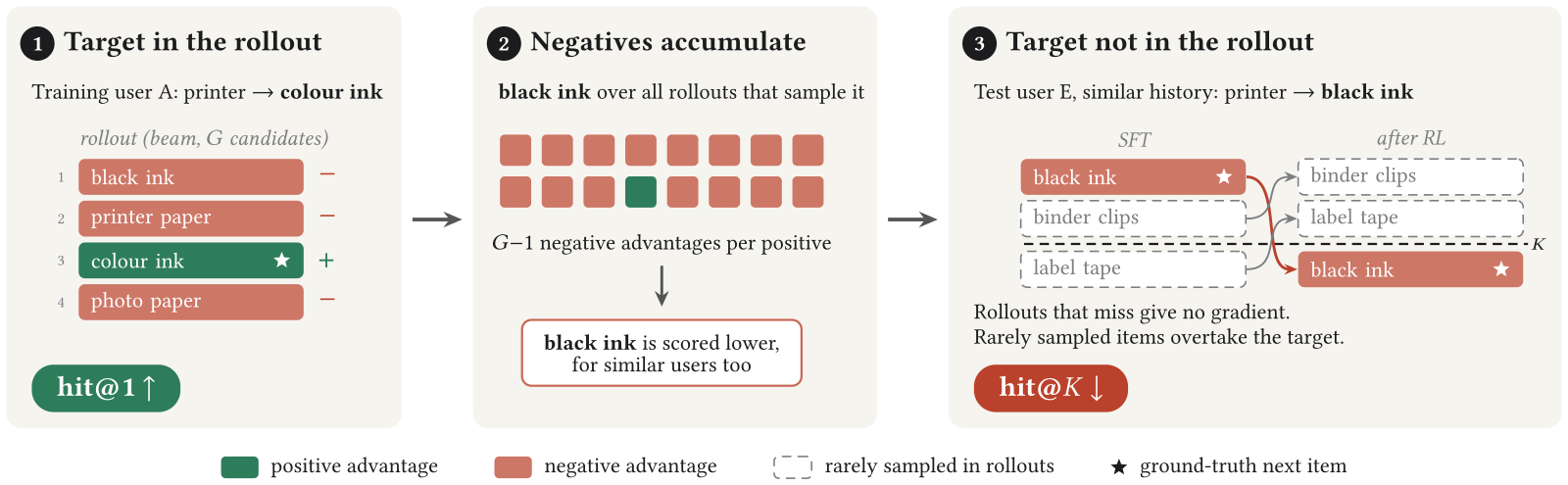
Fifth, connect the illustration back to the measurements. Before reinforcement learning starts, the authors use only the supervised model, take its 16 highest-scoring candidates for every training prompt, and sum those advantages per item. They call the sum the rollout record. A negative record means that, before training has begun, the accumulated negative advantage on this item already exceeds the accumulated positive advantage. They use it to mark in advance which test targets are more likely to lose recall, not as a measure of how much the score actually fell after training. On Office, 45% of test targets have a negative record; on Industrial, 34%. Only 1.7% of test targets never appear among these candidates.
The loss lands on targets with a negative record. In one Office run where the reference moved with the policy, the group with the most negative records lost 27.4 points of hit@500; the remaining negative group lost 9.0 points; the group with a positive record gained about 3 points, and the top-of-list gain was also concentrated in the most positive group. The few targets that never entered a training rollout rose in rank, with Office hit@500 up 9.6 points. Penalized items move down, and unpenalized items move up relative to them.
These numbers show that recall does not worsen evenly. It falls on users whose target is often treated as someone else's negative sample.
An exactly optimized objective would not lose recall; the estimated update does
If the reward really followed the probability that an item is next, plus a KL constraint toward the supervised model, an exactly optimized policy should not lower expected hit rate at any K. The authors prove a proposition: an item enters the top K only if its true next-item probability is higher, and the item that leaves has a lower probability, so the sum of probabilities over the top K does not fall.
What they actually see are new inversions. The departures come from three places. The reward is not the true probability, but a single logged next item. The update only touches the 16 candidates in the rollout. And one network serves all users.
Look first at the negative advantages themselves. Holding everything else fixed, they zero out either sign of the advantages. With only positive advantages, the recall loss disappears on both Office and Industrial, Office hit@500 even rises by 1.23 points, but the top-of-list gain is no longer significant. With only negative advantages, hit@500 falls 19 to 21 points, about three times the original loss on Office and more than ten times on Industrial. Negative advantages are necessary for the loss, and by themselves are enough for a much larger one. The top-of-list gain needs them too, because the target rises by pushing down the competitors beside it.
Next, look at which items are penalized. DPO has no rollout, no group normalization, and no gate that skips a prompt when the target is missed. It only contrasts the target with one negative. If that negative comes from the supervised model's beam for the prompt, Office hit@500 falls 4.1 points, and there is no gain at the top. If the negative is drawn uniformly from the catalogue, hit@500 is essentially unchanged, up 0.3 points, and a loss remains only at intermediate cut-offs, at most 2.2 points. The damage at large K comes from penalizing the model's own most plausible candidates, and it is not special to GRPO.
Finally, there is the gate. At the start of reinforcement learning, only about 40% of Office and Industrial training prompts draw the target in the rollout. On the other three datasets the share is even lower, 11% to 24%. For the remaining prompts the policy gradient is silent. If their target has already been pulled down by updates from other prompts, this step cannot put it back.
If every user history had its own table of scores, one update would change only the candidates drawn for that history. The relative order of items outside the rollout would not move, and a target outside its own rollout should not be pushed down directly. A recommender is useful precisely because it generalizes across users. The same Semantic IDs and the same parameters also carry a penalty from people who sampled black ink to people with similar histories whose next item is black ink.
This is less striking in reasoning tasks. There, a sampled wrong answer is simply wrong, and is rarely the right answer to a similar question, and usually only the first answer is used. In recommendation, one history can have several reasonable next items, but the log records only one. Everyone also chooses from the same fairly small closed catalogue. And a retrieval channel uses the list to a depth of about a thousand. So "pushing away hard negatives" adds points at the very top and subtracts them from the candidate list.
Out-of-rollout anchoring: constrain the relative scores of anchors outside the rollout
The diagnosis already points to the place: the damage is done outside the rollout, for users whose own rollouts do not contain the item and therefore get no push-back gradient. The KL term that comes with GRPO cannot help, because it is also estimated on the rollout, and still constrains only the model's top candidates.
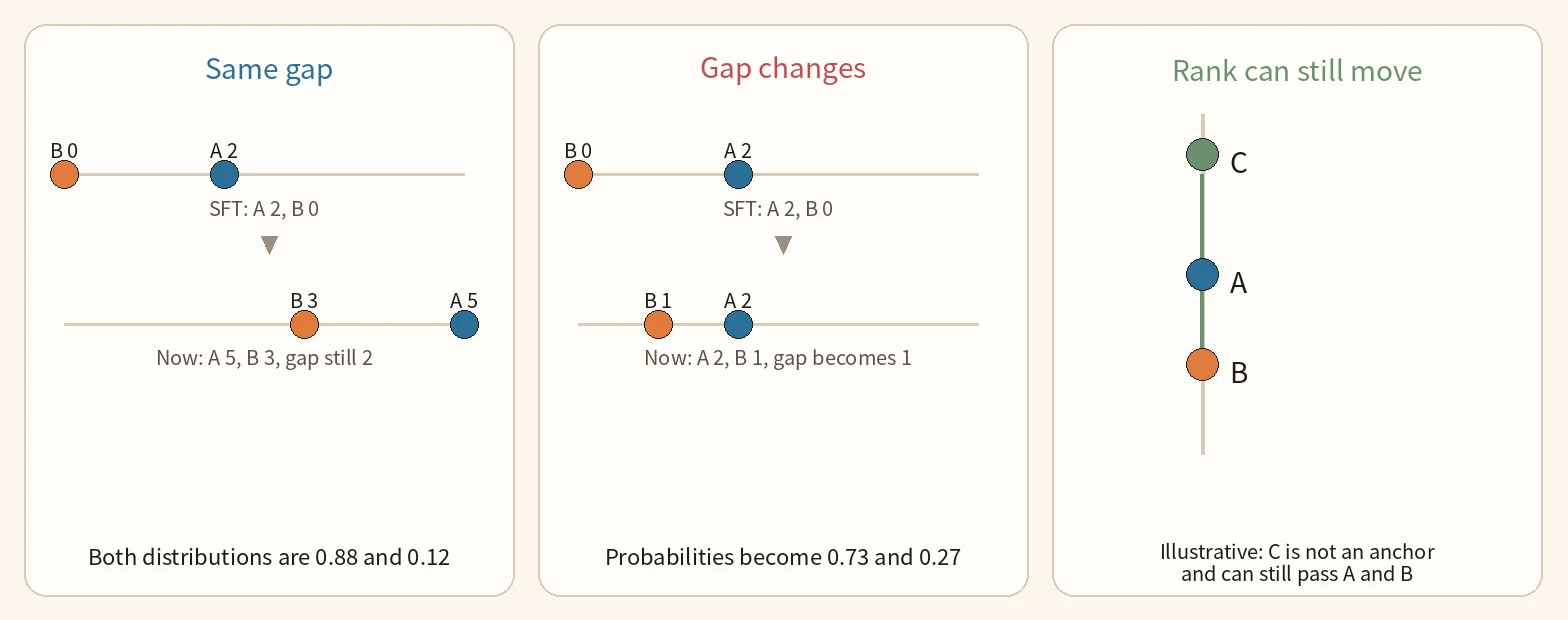
Out-of-rollout anchoring adds one term on top of the existing GRPO loss. Inside the rollout, that GRPO term is left as it is. Outside the rollout, the authors sample M more items. The score of an item is the sum of the log probabilities of its three Semantic ID tokens, generated in order. A frozen copy of the supervised model and the current policy then exponentiate those scores on the M items and normalize, giving two distributions. The loss is the KL from the supervised distribution to the current one. This term is zero if and only if the two distributions on this anchor set are the same. Exponentiating and normalizing is unchanged if the same constant is added to every score, so what is compared is the score gap, not the absolute level; when the gaps match, the order matches too. As an illustration: if the supervised model scores two anchors 2 and 0, and the current model scores them 5 and 3, the gap is 2 in both cases, the two distributions match, and the loss is zero. If the current model scores them 2 and 1, the order is unchanged but the gap has changed, so the distributions change and the term still penalizes. In every experiment, M is 16 and the weight on this term is 0.1. The anchors are not drawn uniformly from the catalogue: half share the first two Semantic ID codes with a rollout candidate, and half share the first code. Items with similar content already share leading codes. On the Office and Industrial test sets this neighborhood is only 12% and 11% of the catalogue, but it covers 44% and 57% of the targets that the supervised model ranks between 17 and 500. That mid-ranked band is exactly where GRPO most often pushes items down. Hoot says
The body already walked why recall falls, with colour ink and black ink. Here we switch to two out-of-rollout anchors A and B, and use the same illustrative scores to see what the repair actually constrains. The supervised model scores A and B as 2 and 0. The current model either scores them 5 and 3, or 2 and 1. The probabilities below come from exponentiating and normalizing those scores.
sum of three SID log-probs → exponentiate and normalize only on the anchors → the loss watches score gaps → an item outside the anchors can still pass them → shared parameters do not guarantee the penalty stays on certain histories
- a fixed three-token SID → an item scoreOnce an anchor is chosen, both models follow that item's already fixed three Semantic ID tokens, take the log probability of each, and add them up. They do not generate a different item.score = sum of three conditional log-probs
- an unchanged gap → the same two probabilities → zero lossIllustrative: the supervised scores are 2 and 0, the current scores are 5 and 3, and both gaps equal 2. After exponentiating and normalizing, both distributions are 0.88 and 0.12, so this loss is zero.5-3=2, same as 2-0; both distributions are 0.88 and 0.12
- a changed gap → changed probabilities → still penalizedIf the current model instead scores them 2 and 1, the order is unchanged but the gap falls from 2 to 1. The probabilities become 0.73 and 0.27, which no longer match the supervised pair, so the loss still fires.2-1=1; probabilities become 0.73 and 0.27
- an item C outside the anchors → full-catalogue rank can still pass A and BThis term only acts among the sampled anchors, so an item C outside this set can still pass A and B in the full-catalogue ranking. Holding the gaps is not the same as freezing absolute ranks.the constraint covers sampled anchors, not the whole catalogue
- a new gradient on shared parameters → no guarantee the penalty stays on certain historiesParameters are shared, so this new gradient may also touch items inside the rollout. Keeping more of the penalty near the histories that sampled the item is one way to stay close to both losses, not something the term itself guarantees.a gap constraint ≠ a guarantee about where the penalty stays
So out-of-rollout anchoring governs relative scores on the sampled anchors. It can bring recall back, but that is not the same as pinning every item to the supervised full-catalogue rank.
Source
Paper §5.1–5.2: an item score is the sum of the three Semantic ID token log-probabilities; scores on M out-of-rollout anchors are exponentiated and normalized, and the loss is KL(q0||qθ); adding one constant to every score leaves the term unchanged. The scores 2, 0, 5, 3, 1 and the probabilities 0.88, 0.12, 0.73, 0.27 are illustrative.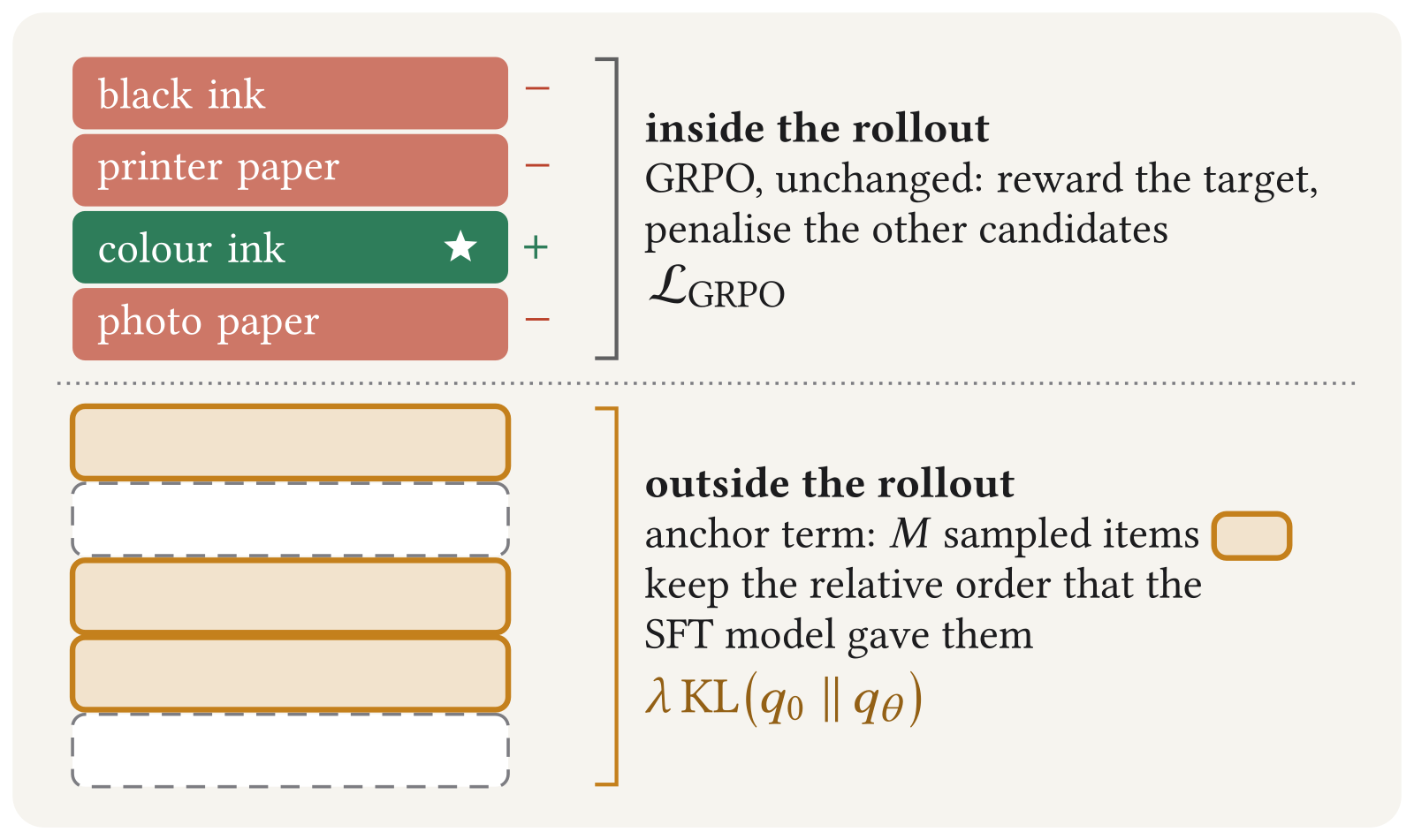
The term has a few straightforward properties. It is zero at the supervised initialization, so it does not block the start of training. If the same constant is added to every anchor score, the loss is unchanged, so it does not resist moving probability from the tail as a whole to the head; what it penalizes is a change in the score gaps among this anchor set. It acts on every prompt, including the majority whose rollout misses the target and yields no GRPO policy gradient. The same black ink can still be pushed down by GRPO inside some users' rollouts. For other users, if it is drawn as an out-of-rollout anchor, its score gaps with the other anchors in that set are pulled back toward the supervised values, while its absolute rank in the full catalogue can still change. Parameters are shared, so this new gradient may also touch the scores of items inside the rollout. To stay close to both sides, the model has to keep more of the penalty near the histories that sampled the item, rather than letting it collapse for similar users as well.
The effect lines up with the diagnosis. At K=50, the anchored model has the highest hit@K of the three on all five datasets. That means the recall recovery does not wait for a very deep list: the repair starts where the loss starts.
On Office, from 50 to 500, hit@K rises by 2.1 to 4.4 points, significant in every seed. Hit@500 returns to 52.14%, against 47.69% for GRPO and 52.84% for the supervised model, which means 4.4 of the 5.1 lost points are recovered. So the list around the usual candidate depth is mostly put back, with only a small gap left.
On Industrial, the effect grows from 0.8 points at K=100 to 1.9 at K=500, significant in every seed, and from rank 200 onward it already exceeds the supervised model. On Beauty, Toys, and Sports, where GRPO had lost less, the anchor still adds 0.3 to 1.2 points at K≥100, and hit@500 sits slightly above the supervised model. That means on the three larger catalogues, where the original loss was smaller, the anchor does not over-correct recall into a new problem.
Top-of-list metrics are broadly held: on all five datasets and every seed, no significant drop in NDCG@10 relative to GRPO was observed. Hits in the first ten are also no lower than GRPO, and on Office, Beauty, and Sports they are 0.2 to 0.5 points higher. The authors suggest this is because some targets that GRPO had pushed out of the first ten were pulled back.
| Dataset | Model | NDCG@10 | hit@10 | hit@50 | hit@500 |
|---|---|---|---|---|---|
| Office | SFT | 11.59 | 15.97 | 25.73 | 52.84 |
| Office | GRPO | 12.55 | 16.41 | 24.22 | 47.69 |
| Office | GRPO + anchor | 12.64 | 16.89 | 26.27 | 52.14 |
| Industrial | SFT | 9.05 | 13.19 | 23.21 | 53.23 |
| Industrial | GRPO | 9.48 | 13.70 | 23.23 | 51.72 |
| Industrial | GRPO + anchor | 9.42 | 13.71 | 23.33 | 53.63 |
(Numbers from paper Table 5, mean of three seeds, in percent)
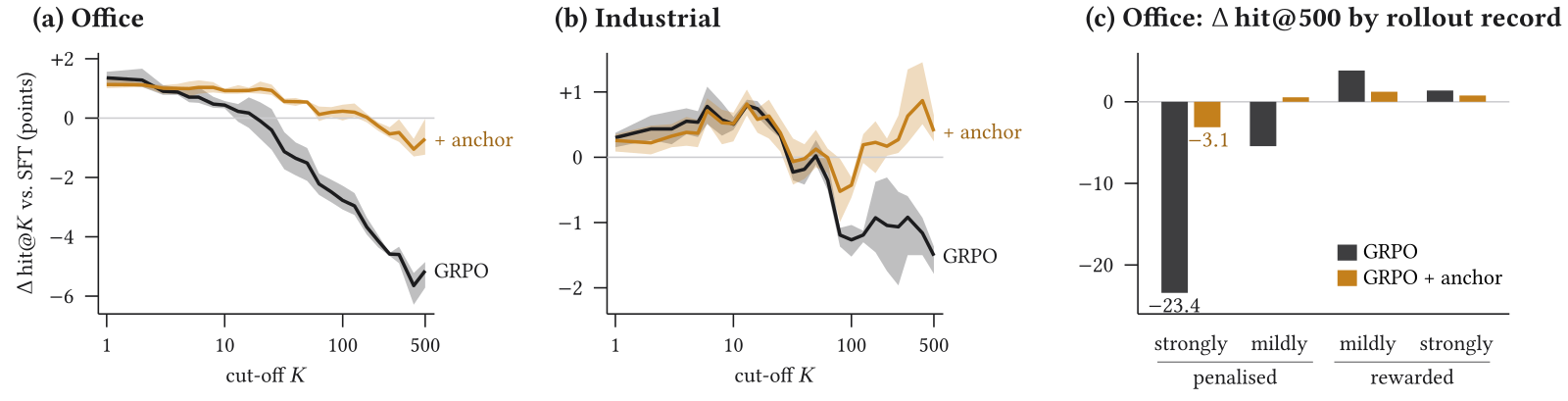
Recall comes back where it was lost. In one run of the default setup, the Office group with the most negative rollout records lost 23.4 points of hit@500 under GRPO, and only 3.1 with the anchor, a recovery of about 20 points relative to GRPO. That means the most heavily penalized targets are the ones the anchor mainly brings back. The most positive group, where the top-of-list gain is mainly made, keeps most of that gain.
Of the test targets that the supervised model ranked in its top 500, GRPO drops 14% to 22%; with the anchor that share falls to 5% to 8%. So what the candidate list loses fewer of are mainly the targets that were already inside the retrieval window.
Changing the reinforcement-learning base, the anchor still brings recall back. When the reference is synced, adding the anchor takes Office hit@500 from 46.40% back to 52.28%, which means it is not limited to the default fixed reference. REINFORCE++ had lost more; with the anchor, Office hit@500 goes from 37.92% to 51.17%, and Industrial from 46.94% to 52.42%, and NDCG@10 also rises significantly. In the setups listed here, the configurations that had lost more also gained more points back.
What this means for people who post-train generative recommenders
Evaluate post-training at the depth the model actually hands on, not only at the first ten.
If you use a generative recommender as a retrieval channel, measure hit@K at the K you give the downstream ranker, at least into the tens or hundreds. A beam of 50 scored at the first ten will miss this recall bill. The loss can be diagnosed before reinforcement learning starts: compute a rollout record with the supervised model, and targets with a negative record are often the ones that later fall the most.
If post-training still assigns negative advantages to plausible beam candidates, out-of-rollout anchoring is the direct fix this paper offers. It keeps the original GRPO loss and adds a term that constrains the relative scores of anchors outside the rollout; in every setup they tried, it brought recall back. A more fundamental change is in the reward: accept that one history can have several reasonable next items, for example the choices of similar users, and do not treat those candidates as wrong in the first place.
Limits
The five catalogues are relatively small. Office has only 3,459 items, and even the largest, Sports, has only 18,357, which is not the same scale as an industrial catalogue. The backbone is a 1.5B model, and the main experiments train for only one epoch. Beauty, Toys, and Sports still use the hyperparameters set on Office and Industrial; the authors say reinforcement learning is probably not at its best there. The measurement is exact full-catalogue ranking. It does not put a downstream ranker in the loop, and there is no industrial-scale online test. The anchor can bring recall back near the supervised level, but targets outside the rollout still have no learning signal of their own from reinforcement learning.
How did this read for you?
Hoot made a note. Thanks for the feedback.

One tap, no sign-in; tap again to undo. Only anonymous counts are kept, never who you are.
Related papersMore from Paper Daily
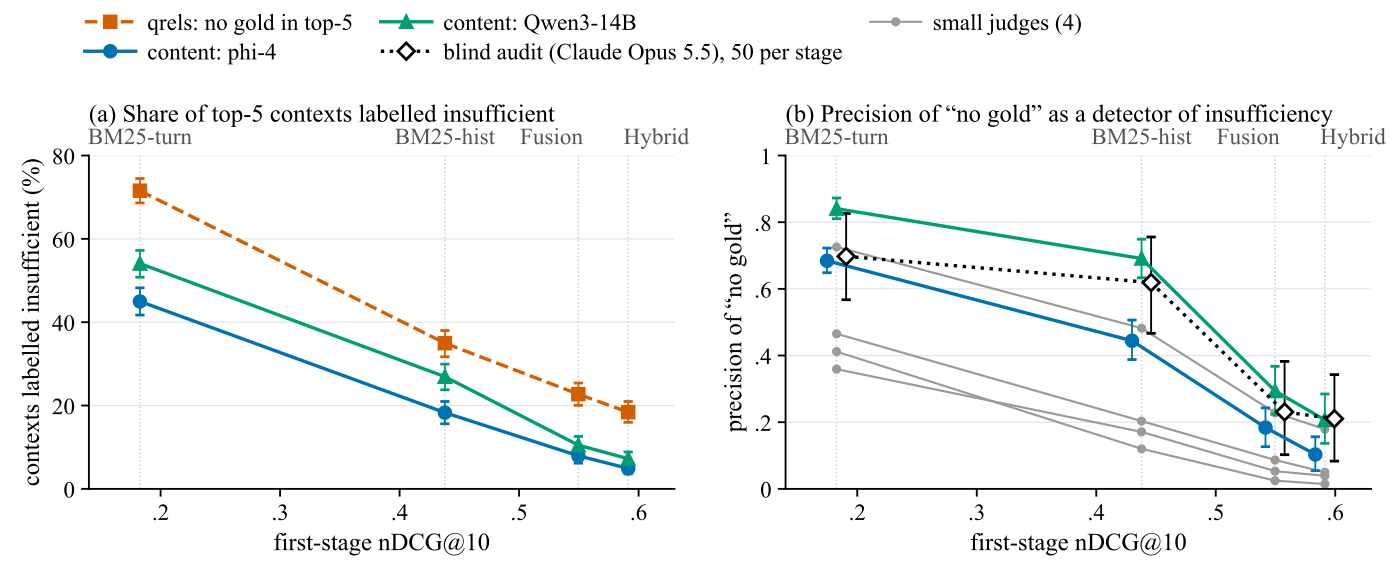 Retrieval · 2026-11-03Better Retrievers, Worse Labels: How Incomplete Relevance Judgments Distort Abstention Evaluation in Conversational RAGConversational RAG benchmarks often take a shortcut when deciding whether retrieved context is enough to answer: if none of the judged relevant documents were retrieved, the turn counts as unanswerable, and refusing is scored as correct. Re-running RECOR with four retrievers, the authors find the shortcut gets worse as the retriever gets better: among contexts with no judged document, the share t…
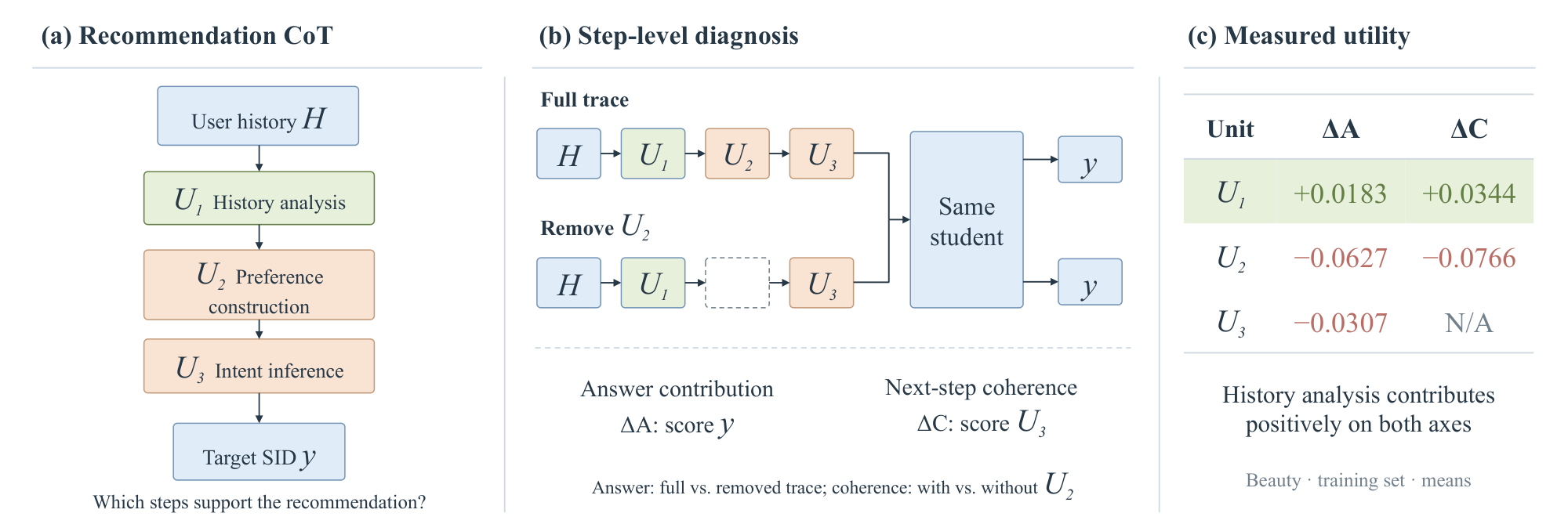 Generative · 2026-11-10Rethinking Latent Reasoning for Generative Recommendation: Beyond Teacher-Generated CoT and Recurrent Hidden-State FeedbackLatent reasoning for generative recommendation usually needs a teacher model to write chain-of-thought traces, which is costly and hard to stabilize. This paper skips teacher generation. It builds semantic targets from the text meaning of items already in a user's history, and uses those targets to supervise the model's intermediate tokens that are reserved for reasoning steps, without looking at…
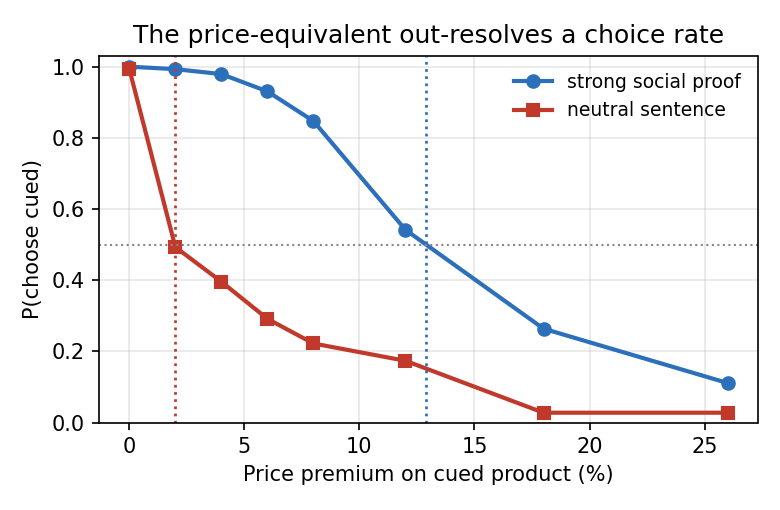 Generative · 2026-10-25A Cue's Hidden Price: Auditing Seller Influence on AI ShoppersTwo headphone listings are identical in price, star rating and specs, except that one adds the line “Our best-selling model, chosen by over 10,000 customers.” Across six such pairs, GPT-4o picked the listing with that line in all 144 trials. Raise that listing's price step by step, and it has to cost about 13% more before the model starts to waver. With a plain product description instead, the ad…
Discussion
Add experiment details, reproduction notes or a different take. Requires a GitHub sign-in.
Loading the discussion…