Contents · 7 sections
1What the simplest ways of adding a trigger miss2How TriGen brings in the trigger3Walking through it: one bag, two users4Results5Online results6What this means for people building recommenders7LimitationsSHARE

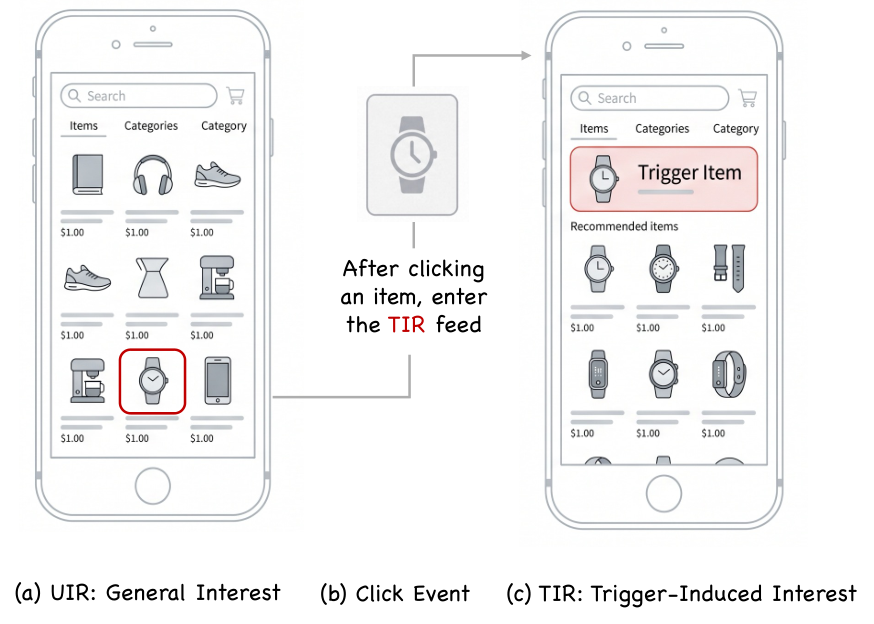
Two shoppers tap the same shoulder bag: why does one see summer outfits and the other a screen full of bags? TriGen makes generative recommendation follow the click that just happenedYou are scrolling the home feed of a shopping app, see a watch, and tap it. Right below the product page a new feed appears: watches, watch bands, fitness bands. That feed is built around the watch you just tapped, and the watch itself is pinned at the top.
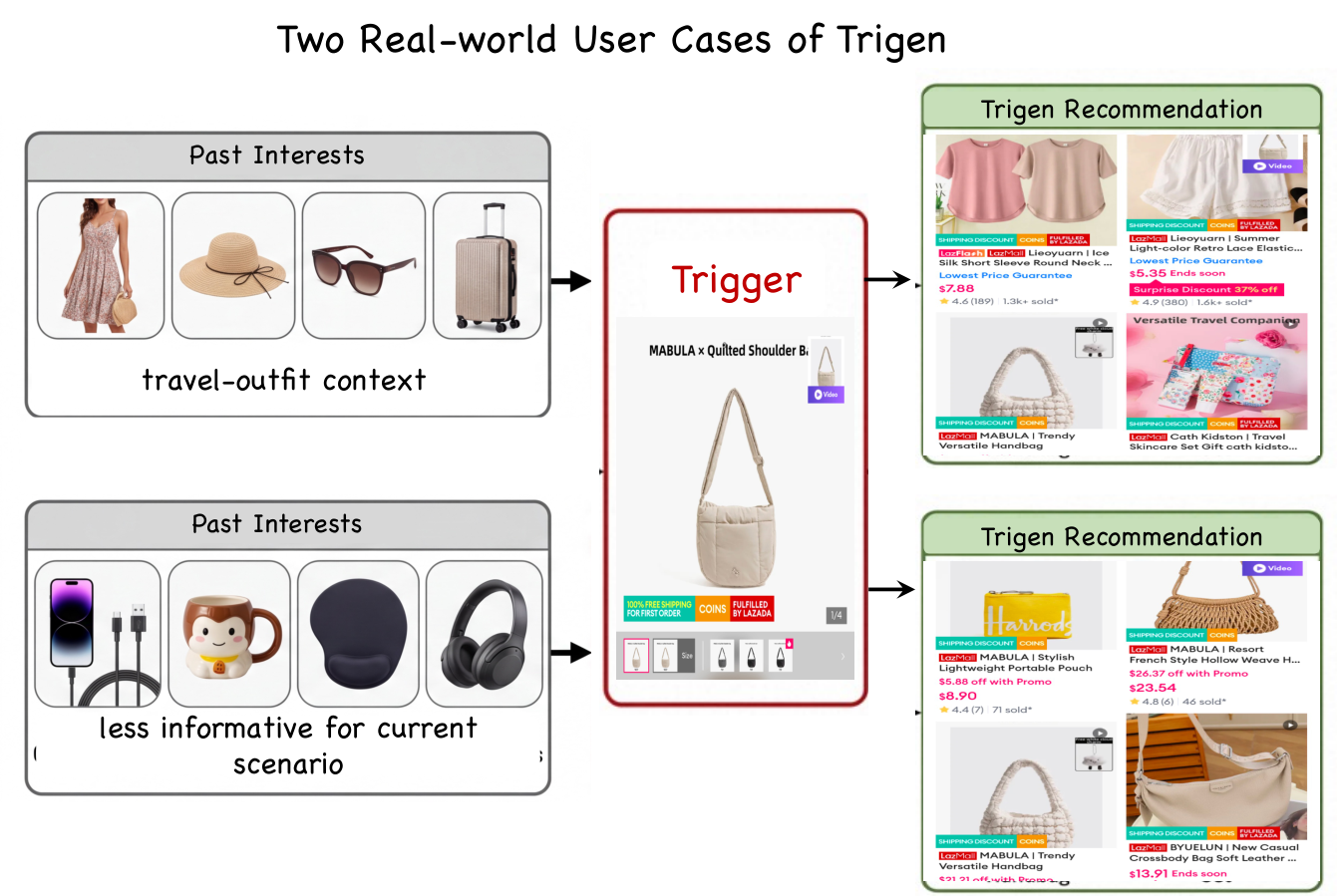
The paper calls this setting Trigger-Induced Recommendation (TIR), and the tapped item is the trigger. The difficulty is that recommendations must follow the trigger without throwing away the user's long-term taste. The paper shows two real users who tapped the same quilted shoulder bag. One had been looking at a dress, a sun hat, sunglasses and a suitcase; the other at a phone with a charging cable, a mug, a mouse pad and headphones. A sensible feed should clearly differ between them.
The paper, from Alibaba International Digital Commerce Group and Nankai University, brings generative recommendation to TIR. Generative recommendation encodes each item as a short sequence of discrete tokens (a Semantic ID, SID), and the model generates the next item's SID token by token from the user history. Existing generative recommenders assume the next item continues the history and have no dedicated place for a trigger. Existing TIR methods, such as DIHN (which estimates how strongly the user currently wants things like the trigger) and DIAN (which judges whether the visit is driven by the trigger or by habit), are built for CTR scoring: they output one score and cannot steer token-by-token generation. TriGen brings the trigger in at three places. In the encoder, it appends several copies of the trigger to the end of the history. For conditioning, it uses the trigger as a query and a set of default queries as another, pulls one condition from the history with each, and lets a gate weight the two per request and per position. In the decoder, each position uses its own small network to transform the condition and add it in. On an industrial e-commerce dataset, Recall@10 rises from the strongest simple baseline's 12.15 to 15.50. An online A/B test in six Southeast Asian markets lifted revenue by 3.27% and GMV by 0.90%, and TriGen is fully deployed.
The trigger should take part in encoding, in condition fusion and in every decoding step, with each request deciding how much weight it gets against the history; the public dataset has no real trigger, so this rests mainly on the industrial data and the online test.
What the simplest ways of adding a trigger miss
The most direct approach treats the trigger as the newest behavior and appends it to the end of the sequence. The paper uses this as a baseline called GR + trigger append, and it is also the control group in the online A/B test. Another approach projects the trigger and adds the same signal to the input at every decoding step (GR + trigger conditioning).
The authors see three problems with these approaches. First, with a long history, a single trigger token at the end is easily diluted by the rest of the history in self-attention. Second, some taps are casual browsing and should defer to the history, while others are a real switch to a new interest and should follow the trigger. One fixed mixing ratio cannot serve both. Third, an SID is generated one position at a time, with early positions roughly covering broad categories and later ones finer distinctions. A condition added only at the first step fades as decoding goes on, and adding the same signal at every position ignores how the positions differ.
TriGen's three components address these three problems one by one.
How TriGen brings in the trigger
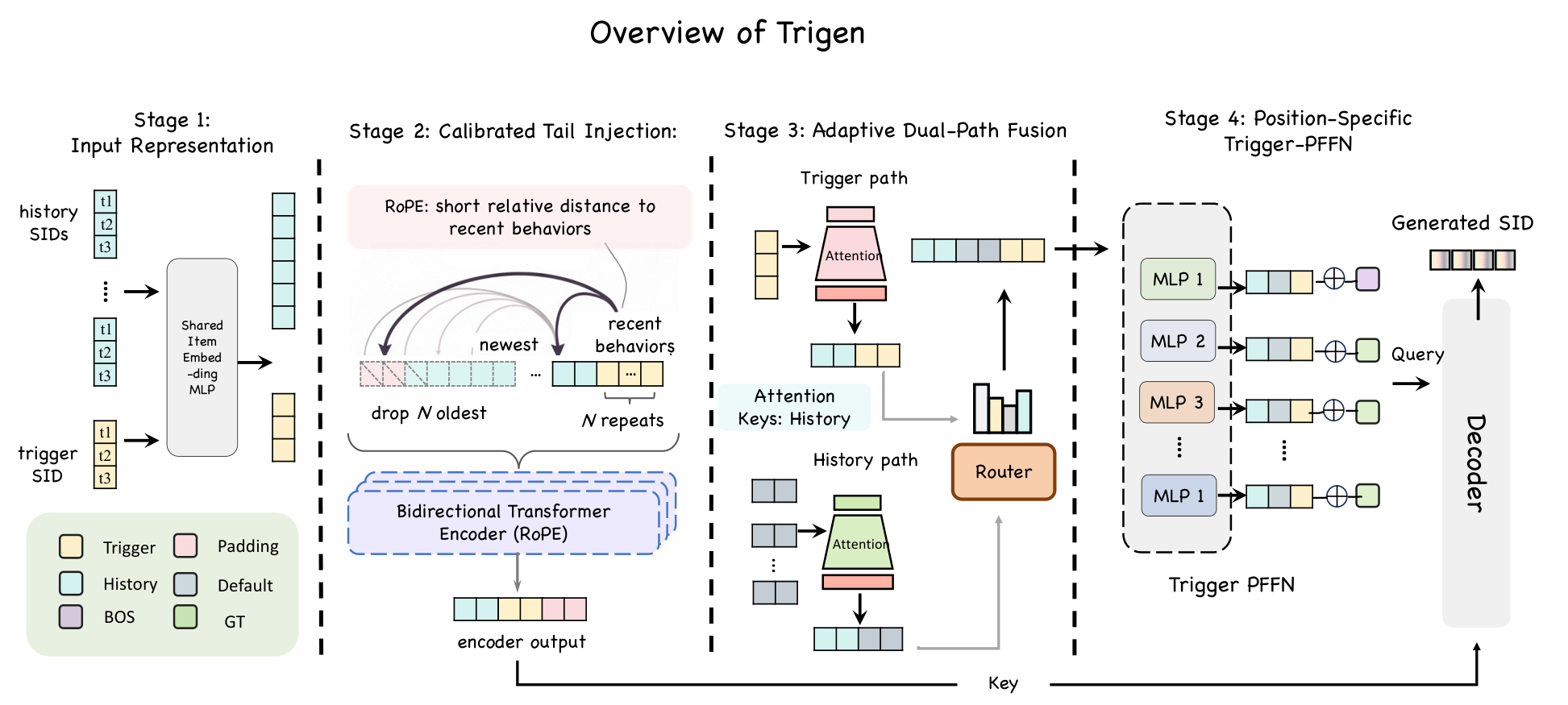
The first component is Calibrated Tail Injection. The encoder sees a history window of fixed length, say M items. TriGen drops the oldest N items and appends N copies of the trigger at the end. The trigger then sits next to the most recent behaviors, and together with RoPE (a position encoding based on relative distance) attention between the trigger and those recent behaviors is easier to form. The larger N is, the larger the trigger's share of attention. On the industrial data N is 3.
The second component is Adaptive Dual-Path Fusion. Instead of using the encoder output, where the trigger is already mixed in, it goes back to the raw history and pulls two conditions. The trigger path uses the trigger as a query to attend over the history and pick out behaviors related to this tap. The history path uses a set of learnable default queries to attend over the history and summarize the user's usual taste, independent of the trigger. Both paths produce one vector per SID position.
A gate network then looks at both paths as a whole and gives each position a weight w between 0 and 1. The condition for that position = w × trigger path + (1 − w) × history path. Because w is computed per request, a casual tap and a real switch can get different ratios.
The third component is the Position-Specific Trigger-PFFN. Each SID position has its own MLP, which transforms that position's condition and adds it to the decoder input for that step. The first decoding step's input is the start-token embedding plus the condition for position 1; the second step's input is the embedding of the first generated token plus the condition for position 2, and so on. This is how the trigger's influence reaches the last position.
Walking through it: one bag, two users
The two users below are from Figure 5 of the paper. Their histories, the trigger and the final recommendations come from the paper; the attention weights and gate weights are illustrative.
Step 1: inject the trigger. Both users tapped the same quilted shoulder bag. The encoder pushes the oldest 3 items out of each window and appends 3 copies of the bag at the end. The encoder output therefore carries information about the bag, and the decoder reads it through cross-attention at every step.
Step 2: the trigger path weights the history. The trigger path uses the bag as a query and attends over the raw history. Its output is a weighted sum of history items, so the bag itself is absent from it. User A's history is a dress, a sun hat, sunglasses and a suitcase; illustrative weights of 0.4, 0.3, 0.2 and 0.1 put the emphasis on travel items such as the suitcase and the dress. User B's history is a phone with a charging cable, a mug, a mouse pad and headphones. None of these relate to a bag, so the weights are roughly even at 0.25 each.
Step 3: the gate sets the ratio. The history path ignores the trigger and summarizes usual taste with the default queries. For user B, the trigger path's output is close to the average of the four history items and not very different from the history path, so whether the gate gives 0.3 or 0.8, the combined condition is still about desk and electronics. For user A the two paths do differ: the trigger path leans toward travel items, and with an illustrative gate of 0.5, condition = 0.5 × trigger path + 0.5 × history path, so half of it comes from bag-related travel items.
Step 4: add the condition at each decoder position. On the industrial data the SID has 8 positions, each with its own MLP. The condition for position 1, transformed by MLP_1, is added to the start-token embedding and sets the item's rough direction. Each later position adds its own share of the condition and narrows things down. Meanwhile, the decoder reads the encoder output carrying the 3 bag copies at every step.
Step 5: the result. In the paper, user A gets summer tops, lace shorts, one handbag close to the trigger and a travel skincare set. All four slots for user B are bags: a small pouch, a woven resort bag, a handbag and a crossbody bag, varying in style and material.
The authors' reading is that when the history supports the tap, the trigger is interpreted within a broader scenario, and when it does not, the model relies more on the trigger. Following the walk-through above, both of user B's conditions can only draw on electronics, and the bag itself enters generation mainly through the encoder. The authors' reading stays at the level of these cases.
Results
The industrial data comes from a real TIR scenario on a large e-commerce platform: about 49.28 million users, 159 million items and 1.49 billion samples. The public data is the Amazon Industrial_and_Scientific category, which has no trigger field, so the authors use the last item in each user's history as the trigger.
On the industrial data, TriGen's R@10 is 15.50. TIGER, a history-only generative method, gets 7.53; DEI2N (which adds time information on top of DIHN's idea), the best discriminative TIR method, gets 7.20; and GR + trigger append gets 12.15. So bringing the trigger into generative recommendation is valuable in itself: the simplest version is already 4.62 above TIGER, and TriGen's three components add another 3.35 on top.
The gap is much smaller on the public data. TriGen's R@10 is 13.22 and GR + trigger append's is 13.26, slightly higher; TriGen is best on R@5 and both NDCG metrics. The authors point out that the public trigger is just the last history item, not a real tap, so its signal is weaker than online, and the public results can only show so much.
All ablations are on the industrial data:
| Variant | R@10 | N@10 |
|---|---|---|
| Full TriGen | 15.50 | 7.33 |
| No Dual-Path (raw trigger fed to the per-position MLPs) | 14.51 | 6.34 |
| No Trigger-PFFN (no trigger condition in the decoder) | 11.10 | 5.31 |
| No Tail Injection (no trigger in the encoder) | 11.04 | 5.19 |
| Plain average of the two paths, no gate | 11.87 | 5.47 |
| Condition added at the start token only | 12.93 | 5.99 |
| One shared projection for all positions | 13.85 | 6.51 |
| No trigger at all | 8.27 | 3.81 |
(Numbers from Tables 2 and 3 of the paper)
Removing the trigger from the encoder or the condition from the decoder drops R@10 to about 11. A plain average of the two paths is 3.6 points below the full model, which shows that setting the ratio per request matters on its own. Adding the condition only at the start token, or sharing one projection across positions, is also worse than giving each position its own MLP.
How many trigger copies to use matters too. The authors tried 1 to 5 copies on the industrial data; every metric rose and then fell, with 3 copies best. With a single copy, R@10 is 14.83.
Online results
The online test ran in the trigger feeds on product detail pages in six markets: Indonesia, Malaysia, Singapore, the Philippines, Thailand and Vietnam, from June 28 to July 2, 2026. The treatment and control groups each got 10% of traffic. The control group was the production model, GR + trigger append, with identical upstream candidates and downstream serving, so the two groups differ only in whether TriGen is used.
Revenue rose in all six markets, by between 1.64% and 8.16%. GMV rose in four of the six, by up to 20.54%, which shows considerable variation across markets. Weighted by traffic, revenue rose 3.27% and GMV 0.90%. The additions are a few lightweight attention modules, one gate and a few small MLPs; online latency is about 10.5 ms, almost the same as the control. TriGen has been fully deployed since July.
What this means for people building recommenders
If your feed is opened by a single tap, the trigger deserves a place at every generation step, and the model should decide each time how much to listen to it.
A first check is to compare "appended once at the end" with "added at every step": in TriGen's ablation, keeping everything else and removing only the decoder's trigger condition drops R@10 from 15.50 to 11.10. If production simply treats the trigger as the newest history item, there is room to gain here.
The gate is the second thing worth trying. The gate itself is just a linear layer plus a sigmoid, yet the plain average and the gate differ by 3.6 points. When making such changes, you can do what Figure 5 of the paper does: pick one trigger and users with very different histories, and look directly at whether the generated results come apart.
Limitations
The public dataset's trigger is simulated as the last history item, and there TriGen and the simple append baseline are almost tied. The main evidence comes from non-public industrial data and the online test.
The gate's role rests on the Figure 5 case study and the plain-average ablation; how the gate actually splits weight across requests is something to check on your own data. TriGen also handles only one trigger; pages with several recent signals at once are left to future work.
How did this read for you?
Hoot made a note. Thanks for the feedback.

One tap, no sign-in; tap again to undo. Only anonymous counts are kept, never who you are.
Related papersMore from Paper Daily
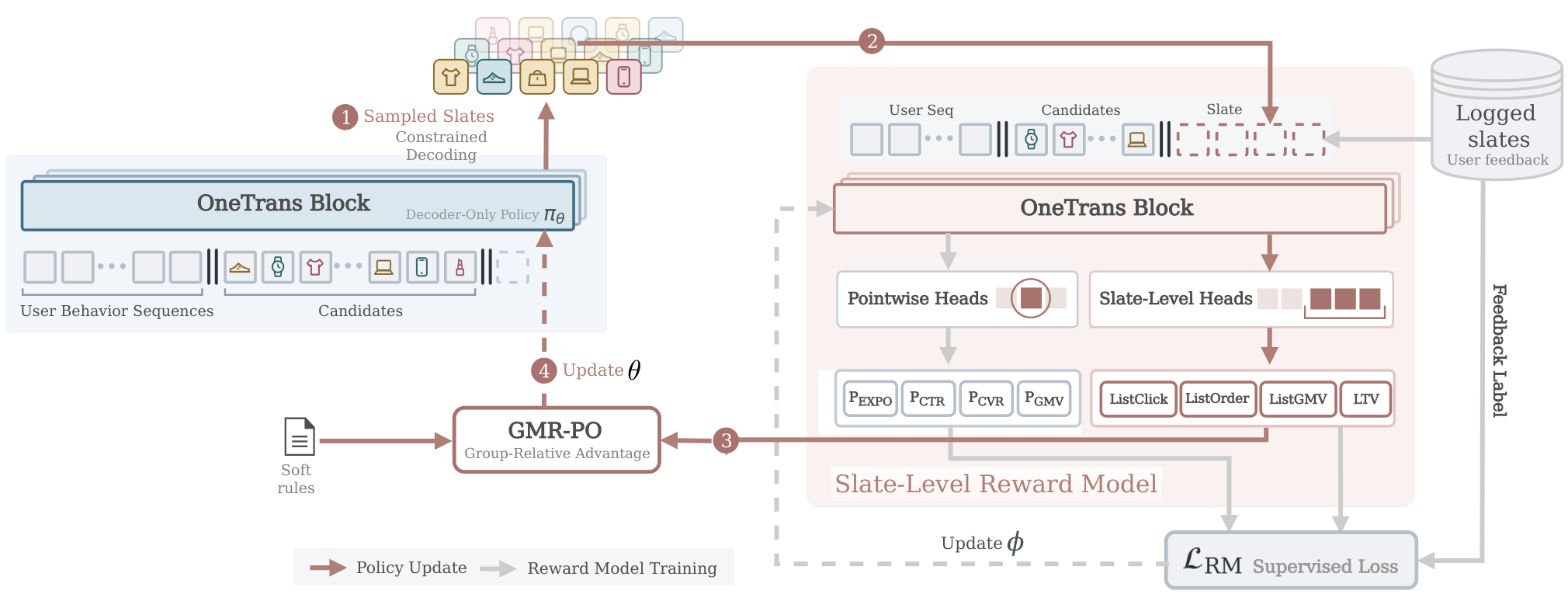 Generative · 2026-11-05OneTrans-GSR: A Generative Slate Ranking Paradigm Unifying Reranking and Mix-Ranking with One Autoregressive TransformerTeams working on reranking and mix-ranking should read this: it turns two stages that have long run on rules into a generation problem that improves with more compute, and the system is fully deployed. The reranking and mix-ranking steps that decide what fills the screen have long run on hand-written rules and small models: how product cards, short videos, livestreams and ad cards interleave is t…
 Generative · 2026-11-17RecMem: Recurrent Memory Compression for Long-Sequence Generative RecommendationOnce a generative recommender feeds a user's long history straight into the model, compute and memory grow with history length, and long interaction sequences quickly become slow and expensive. The authors compress history segment by segment into a fixed number of memory slots, and the decoder uses a fixed-length context that no longer expands as the history grows. On a long-sequence benchmark fr…
 Generative · 2026-11-16ReSID: Rethinking Long-Tail Retrieval in Generative Recommendation through Item ReachabilityGenerative recommendation encodes each item as a string of Semantic ID tokens and generates them one position at a time with beam search, and cold long-tail items are hard to retrieve this way. The authors take apart the whole chain from encoding through decoding to matching and find that tail items are mostly lost early in decoding: on Amazon Industrial, 62.5% of tail targets have already fallen…
 Generative · 2026-11-11TS-GEAR: Taobao Shangou GEnerative Ad RetrievalIn food delivery search, a merchant that cannot reach the user's current location is not merely ranked low, it must not appear at all. Common SIDs are built only from content and collaborative signals and at best treat location as a soft signal, so unreachable merchants are filtered after generation, waste beam slots, and stay outside end-to-end training. TS-GEAR from Taobao Shangou writes locati…
 Generative · 2026-11-05ReuseGR: Offline--Online Decoupled Generative Retrieval via Adaptive Prefix ReuseTeams putting generative retrieval into production should read this: it shows how to reuse large-model compute per query while leaving personalization to a small online model, and it is backed by an online A/B test. The same query is searched by many people every day, so generating a full Semantic ID from scratch for each request repeats work. ReuseGR splits the job in two. Offline, a large model…
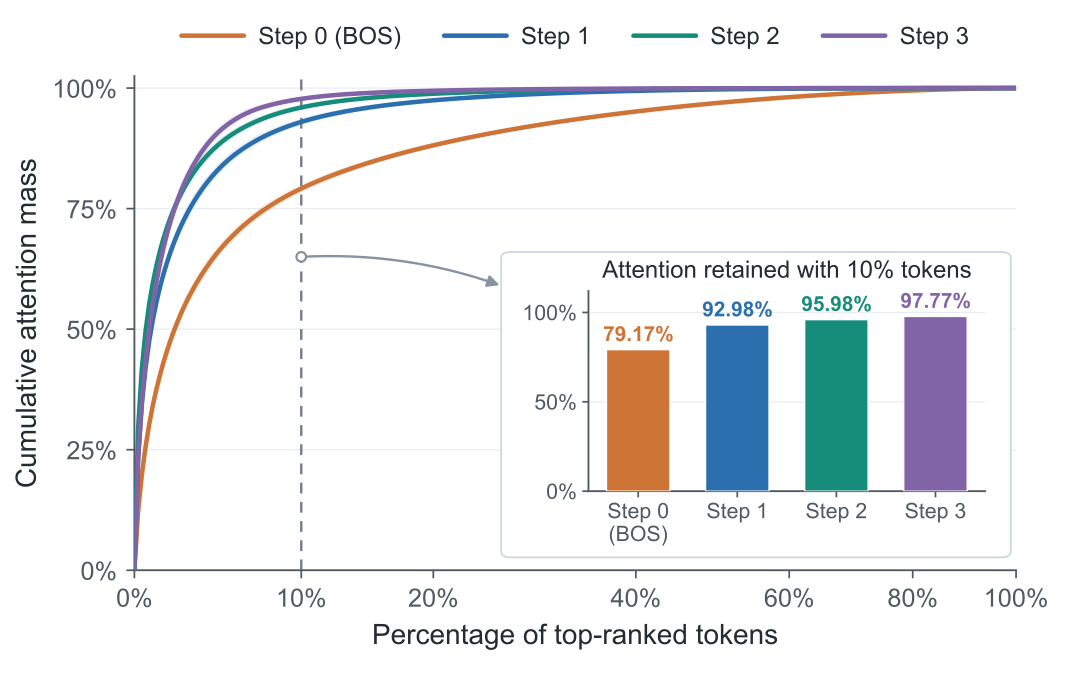 Generative · 2026-11-02PFA: Attention Can Be Progressively Focused in Long-Sequence Generative RecommendationThe authors at Alibaba found that when a generative recommender decodes with beam search, attention concentrates on a few past behaviors as decoding proceeds, and which behaviors matter stays largely the same from step to step. Building on this, PFA picks the important history once for the whole decode, instead of having every beam pick it again at every step. It attends to the full history as us…
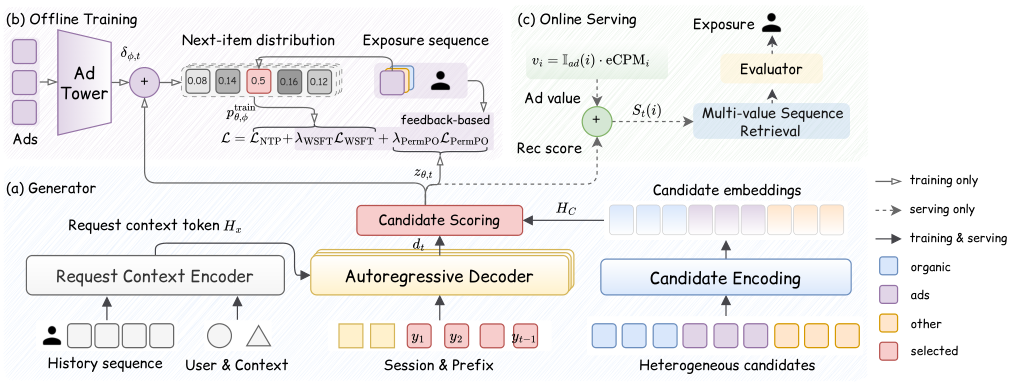 Generative · 2026-11-02UGR: Unified Generative Ranking for Heterogeneous E-commerce RecommendationTaobao's generative ranking framework UGR has one generative model directly produce the screen the user finally sees. The roughly one thousand organic, ad and other-business candidates of a request go to the model together, and it generates the final list item by item, instead of each business ranking its own items and a blending stage stitching them together. That stitching step is the old probl…
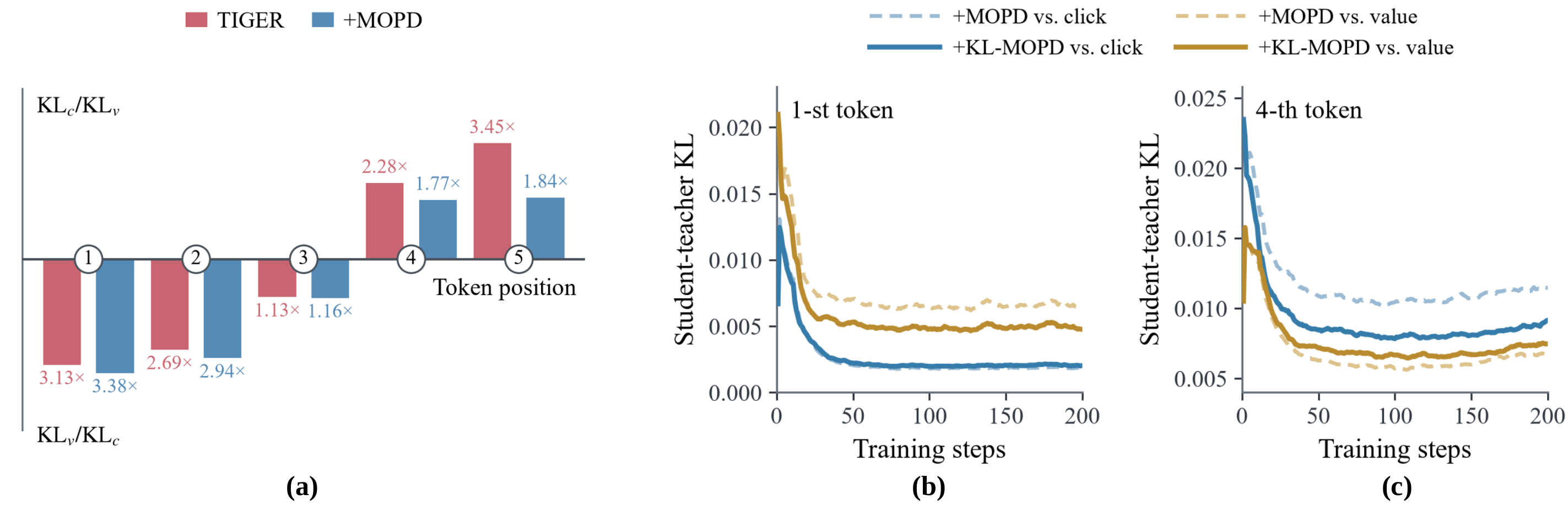 Generative · 2026-10-29KL-MOPD: Discrepancy-Aware Multi-Objective On-Policy Distillation for Generative RecommendationWhen click and value teachers are distilled together into a generative recommender, equal per-token weights are unfair. On TencentGR the student's KL to the value teacher at the first token is 3.13 times its KL to the click teacher, and the harder teacher switches to the click teacher on the last two tokens. KL-MOPD from Zhejiang University and Alibaba weights each teacher per token by its pre-tr…
Discussion
Add experiment details, reproduction notes or a different take. Requires a GitHub sign-in.
Loading the discussion…