Contents · 5 sections
1What problem is it solving?2Method: teach a small model to judge transferability, then learn two vectors3Results4Limitations5How to use itSHARE

Live-stream recommendation at Kuaishou is data-poor: for the same users, the average person has 224.93 positive interactions with short videos but only 20.78 with live streams. The natural idea is to carry interest from short videos over to live streams, but "watched this kind of short video" does not always mean "will enter this kind of live room", and transferring the wrong interest hurts. This paper proposes RGCD-Rep (Reasoning-Guided Cross-Domain Representation). A large multimodal model first judges, pair by pair, whether a short video and a live stream match on category, key subject and topic, and that judgment is taught to a 2B model. The small model then computes vectors for every short video and live stream, split into a part that transfers across both sides and a part that belongs only to its own domain. Offline HR@10 is 17.59% above the strongest baseline, and online follows rise 0.83%.
It is worth reading for anyone doing cross-domain recommendation, or anyone who wants a large model in retrieval but is blocked by online latency: no large model runs online, and all vectors are precomputed into a nearest-neighbor index. Evidence comes from one Kuaishou scenario, and the offline test uses only one week of data.
What problem is it solving?
The paper's one-week log covers about 110 thousand users who use both services; live streams get only about a tenth as many interactions as short videos, so live-stream behavior data is far thinner. Live rooms in the bottom half by frequency account for only 10.90% of interactions, and 14.65% of test users had no positive live-stream feedback in the previous six days, making them new to live streams.
Existing multimodal cross-domain methods usually take pre-extracted image and text vectors as item features. These vectors are fixed and cannot explain why the audience of a short video would go to a particular live room, so cross-domain signals are unreliable and negative transfer is common: unrelated interests get pulled together and quality drops.
Method: teach a small model to judge transferability, then learn two vectors
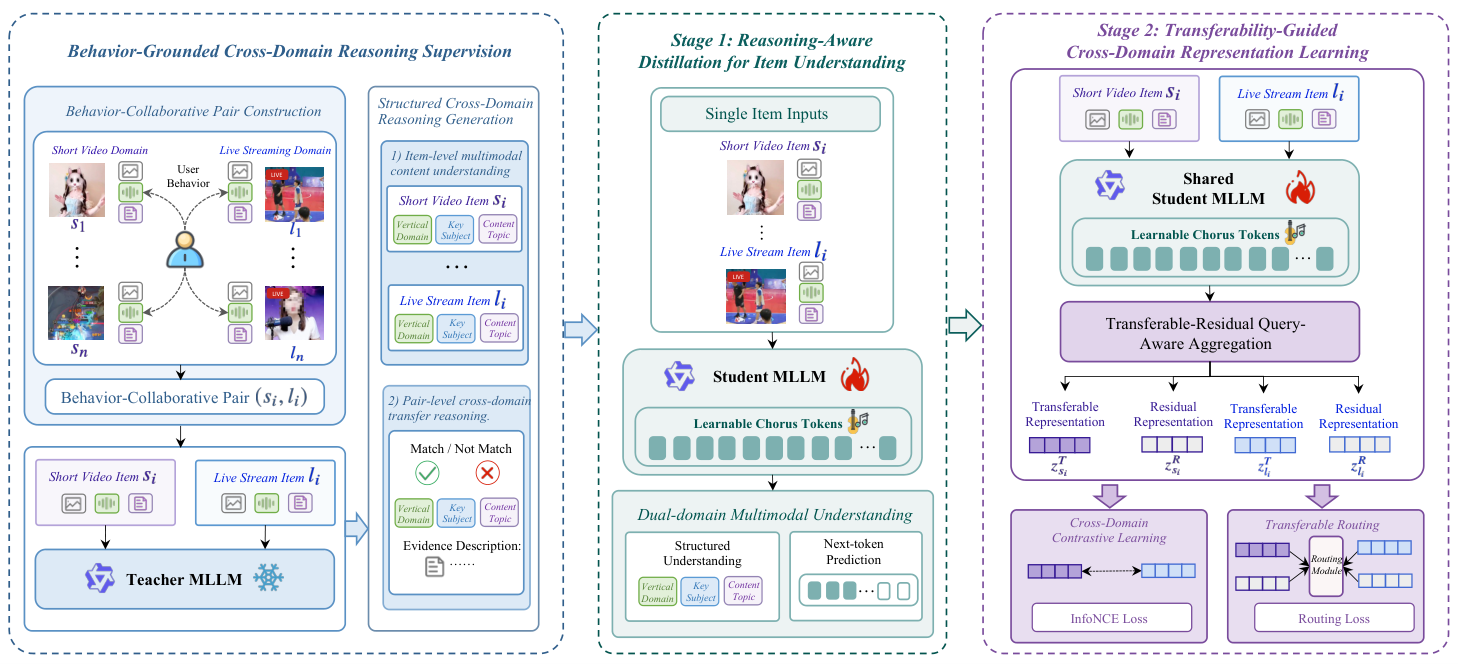
Before training, the authors build pairs: a short video and a live stream watched by the same group of users within the same time window. Each pair gets a behavior strength score from two parts: how often the two co-occur for the same users, and how deeply users engage with them (watch time, completion, like, comment and share for short videos; watch time, gifts, follows, likes and comments for live streams). Only high-scoring pairs are kept.
Stage 1 teaches the small model to understand content. The teacher is a frozen Qwen3.6-35B-A3B. For each pair it breaks both items down along three aspects, category, key subject and content topic, giving a label and a short piece of evidence for each, then judges whether the two match on that aspect (1 if they do, 0 otherwise). The mean over the three aspects is the pair's semantic transfer score. So that the small model can later handle any single item on its own, each pair's reasoning is split into two single-item samples, and the student Qwen2-VL-2B is trained with the standard next-token objective to write out the teacher's three labels. Sixteen learnable special tokens (the paper calls them chorus tokens, following earlier work) are inserted into the student's input, and their last-layer outputs summarize the item's multimodal content.
Stage 2 learns two vectors. Short videos and live streams share the same student model as encoder. Each item yields 16 special-token outputs, and two learnable query vectors each take a weighted average of them: dot the query with each token output, divide by the square root of the dimension, apply a softmax to get 16 weights, sum, and normalize. One result is the transferable vector, the other the residual vector.
The transferable vector is trained contrastively: the short video and live stream in a pair are positives, items from other pairs in the batch are negatives, using cosine similarity with temperature 0.05, computed in both directions and averaged.
Co-watching alone does not guarantee interest really transfers. So the authors add the behavior strength score and the semantic transfer score and rank all training pairs: the top 20% are treated as truly transferable, the bottom 20% as not transferable, and the middle is left out of this loss. For each pair they compute similarity under both vectors, multiply the difference by 10 and apply a sigmoid to get the probability that the pair should be explained by the transferable vector. Transferable pairs push the transferable similarity higher; non-transferable pairs push the residual similarity higher, so domain-specific factors and behavioral noise stay in the residual. This loss, weighted by 0.05, is added to the contrastive loss.
| Stage | What is trained | Purpose |
|---|---|---|
| Preparation | Score short video–live pairs by co-watching and engagement depth | Train only on credible pairs |
| Stage 1 | 2B student learns to write the 35B teacher's category, subject and topic | Move the large model's judgment into a deployable model |
| Stage 2 | Contrastive learning plus routing pairs to the two vectors by transfer score | Only genuinely transferable interest enters the cross-domain vector |
For serving, the student model computes 1536-dimensional transferable vectors for every short video and live stream offline, stores them in the feature system and builds a cross-domain nearest-neighbor index. At request time the user's watched short videos query the index for live streams as a new retrieval channel; no large model is called online. Training uses 8 H800 GPUs, LoRA rank 32, with 60 thousand samples in stage 1 and 250 thousand in stage 2.
Results
The offline test trains on six days and uses each user's last positive live-stream interaction on day seven as the target; retrieval averages the transferable vectors of the user's watched short videos and finds the live streams with the largest inner product.
| Method | HR@10 | NDCG@10 |
|---|---|---|
| FREEDOM (single-domain multimodal) | 0.0040 | 0.0018 |
| UniSRec (cross-domain, single modality) | 0.0134 | 0.0059 |
| MISSRec (cross-domain multimodal) | 0.0147 | 0.0066 |
| UniEmbedding (strongest baseline) | 0.0216 | 0.0097 |
| RGCD-Rep | 0.0254 | 0.0127 |
| Without stage 1 | 0.0249 | 0.0122 |
| Without stage 2 | 0.0101 | 0.0046 |
| Stage 2 with the student frozen | 0.0189 | 0.0088 |
The ablation shows the gain comes mainly from stage 2: removing it drops HR@10 to 0.0101, and training only the two query vectors in stage 2 without updating the student drops it to 0.0189. Removing stage 1 only lowers it slightly to 0.0249, so distillation is a good starting point rather than the main driver.
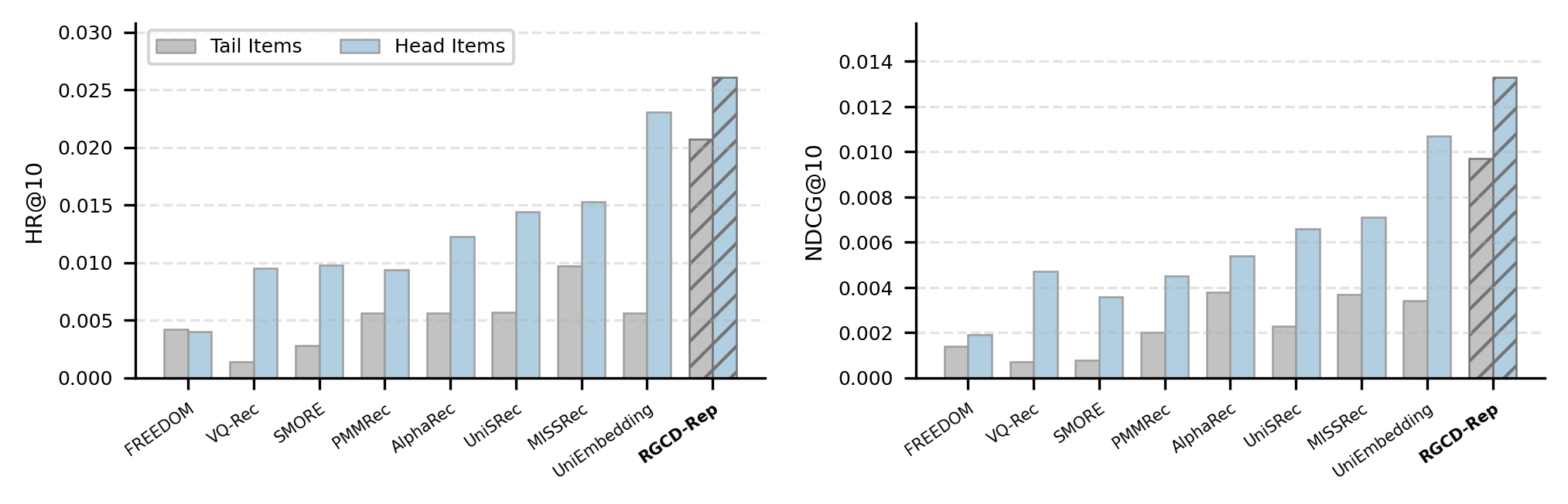
On tail live rooms and on users new to live streams, RGCD-Rep's lead over the strongest baseline is larger than on head rooms and active users, which suggests it fills in the signal the live-stream side lacks rather than just fitting existing live behavior better.
A one-week online test on Kuaishou and Kuaishou Lite added it as a new retrieval channel:
| App | Exposure | Click | Follow |
|---|---|---|---|
| Kuaishou | +0.37% | +0.34% | +0.83% |
| Kuaishou Lite | +0.38% | +0.13% | +0.93% |
Follows rise the most, consistent with the goal of helping users discover new streamers.
Limitations
- Only the short video to live stream direction is tested, not the reverse, and only on Kuaishou data.
- The offline test uses a single week of logs and absolute numbers are very low (HR@10 about 0.025), so the relative gaps are what matter.
- The three aspects (category, subject, topic) are hand-chosen and may not suit other content types.
- The transferable/non-transferable labels come from a hard top and bottom 20% split; the ratio and scoring both affect results, and the paper runs no sensitivity study on them.
- Training needs the 35B teacher to reason over every pair, and deployment retrained on about one million pairs, so offline cost is substantial.
How to use it
The deployment pattern is the most reusable part: the large model appears only offline, is distilled into a small model, and the small model precomputes all vectors into an index so serving is a lookup. If you have one data-rich domain and one data-poor domain, the step of splitting vectors into transferable and domain-specific parts and routing pairs by credibility can be tried on its own, starting with a behavior score to rank pairs. Hyperparameters such as the 20% split, temperature 0.05 and the routing scale of 10 need retuning on your own data.
How did this read for you?
Hoot made a note. Thanks for the feedback.

One tap, no sign-in; tap again to undo. Only anonymous counts are kept, never who you are.
Related papersMore from Paper Daily
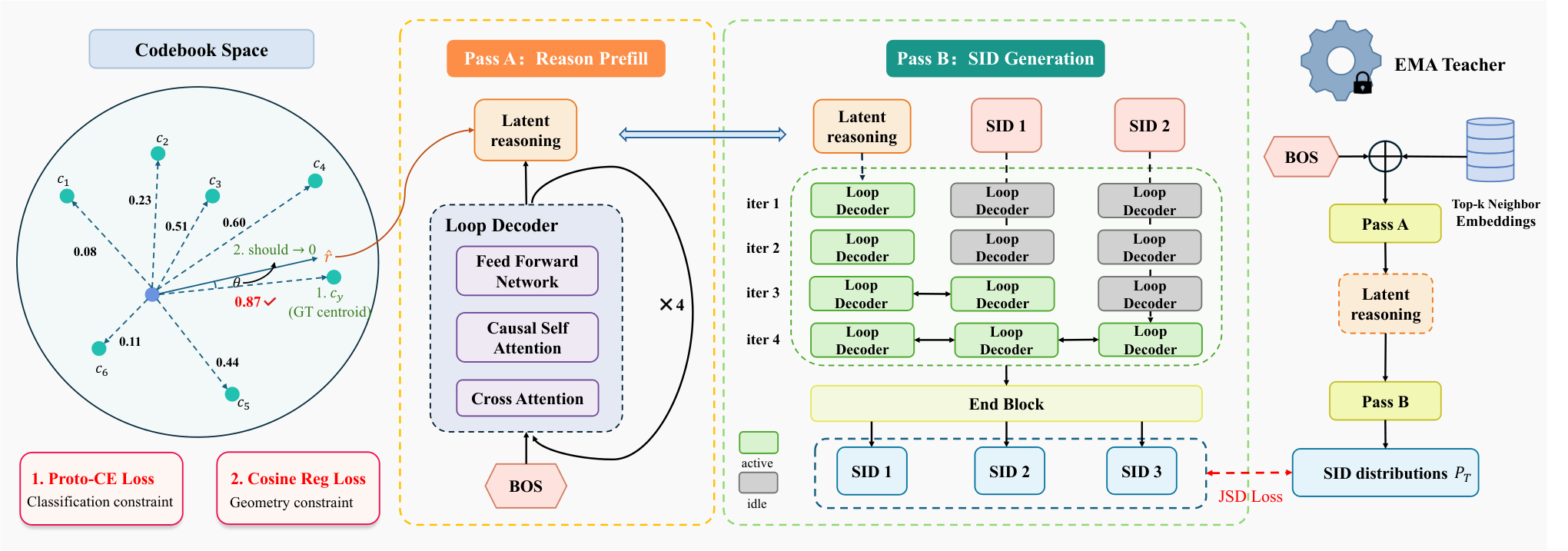 Generative · 2026-11-06BRIDGE: Bridging the Semantic Quantization Gap for Generative RecommendationGenerative retrieval predicts the next item's Semantic ID (SID) one code at a time from user history, but ordinary next-code training checks only the probability assigned to the correct code. When that probability stays the same, redistributing the remaining probability among incorrect candidates does not change this cross-entropy loss. BRIDGE (the generative retrieval model studied here) also us…
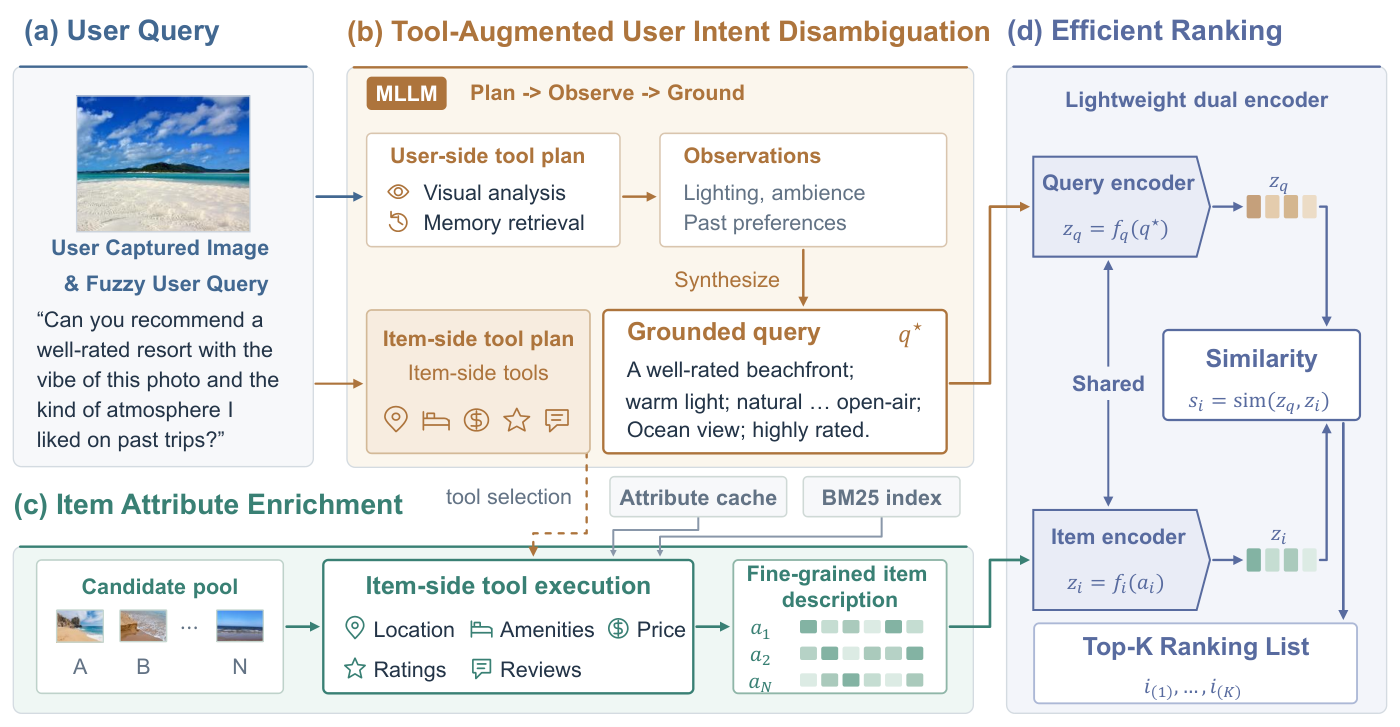 Generative · 2026-11-11IntentLens: Grounding Underspecified Multimodal Queries for Recommendation via Tool-Augmented ReasoningOn devices such as smart glasses, users often give only a picture and one vague sentence, leaving style, budget and venue requirements unsaid. Existing recommenders either rely on past behavior or assume the request is already explicit, so direct similarity between query and candidates easily ranks the wrong places first. For example, a user points at a cafe dish and wants a similar vibe but a mo…
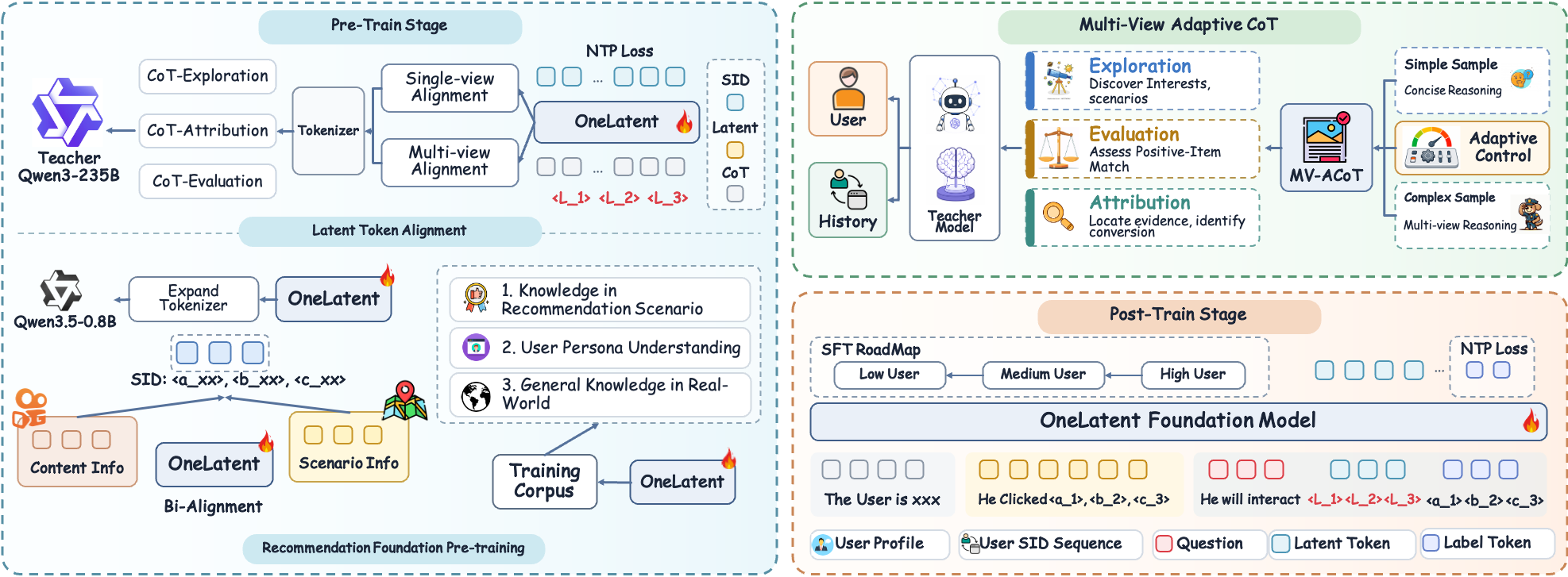 Generative · 2026-10-24OneLatent: Latent Reasoning for Efficient Foundation Recommendation ModelsWhen a large language model serves as a recommendation foundation model and first writes a natural-language reasoning trace before outputting the next item's semantic ID, the reasoning text is far longer than the semantic ID and holds back both decoding time and throughput. OneLatent appends 3 fixed special tokens after the user context and trains in several steps. First the model learns to repro…
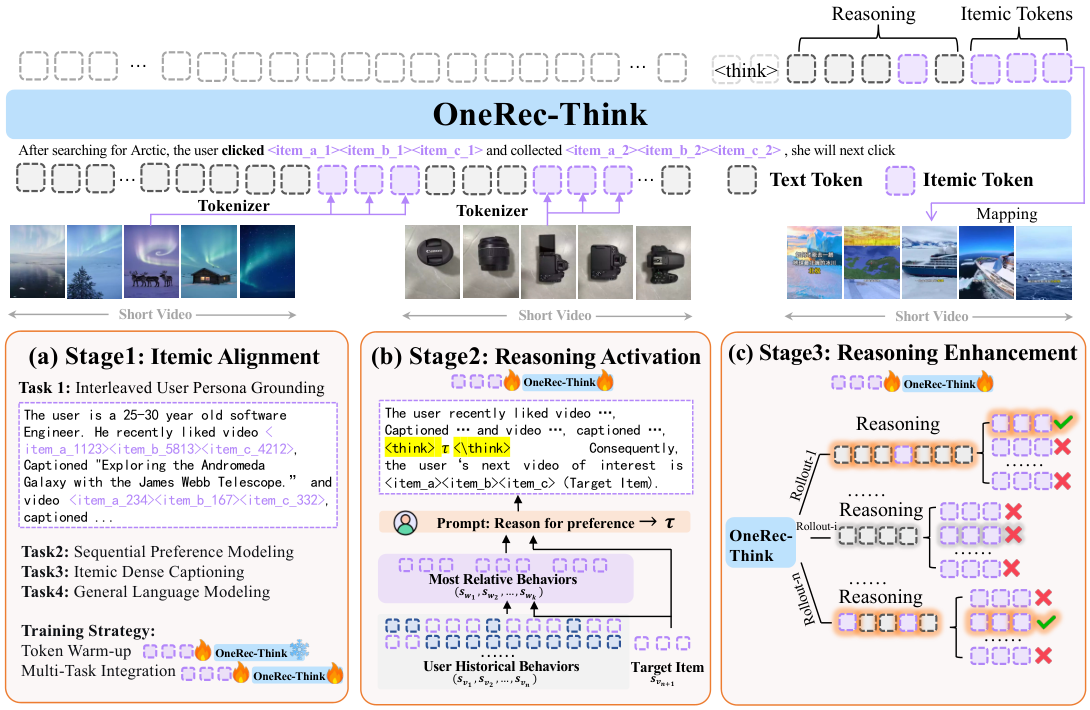 Generative · 2026-07-13OneRec-Think: In-Text Reasoning for Generative RecommendationDeep dive: OneRec-Think: In-Text Reasoning for Generative Recommendation.
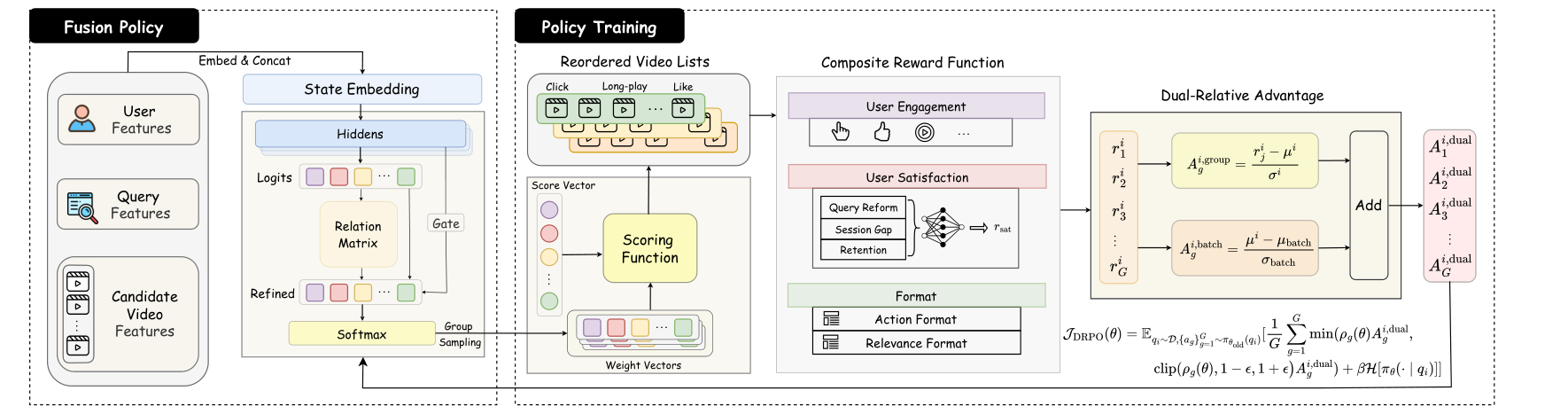 Retrieval · 2026-08-03SaFRO: Satisfaction-Aware Fusion via Dual-Relative Policy Optimization for Short-Video SearchDeep dive: SaFRO: Satisfaction-Aware Fusion via Dual-Relative Policy Optimization for Short-Video Search.
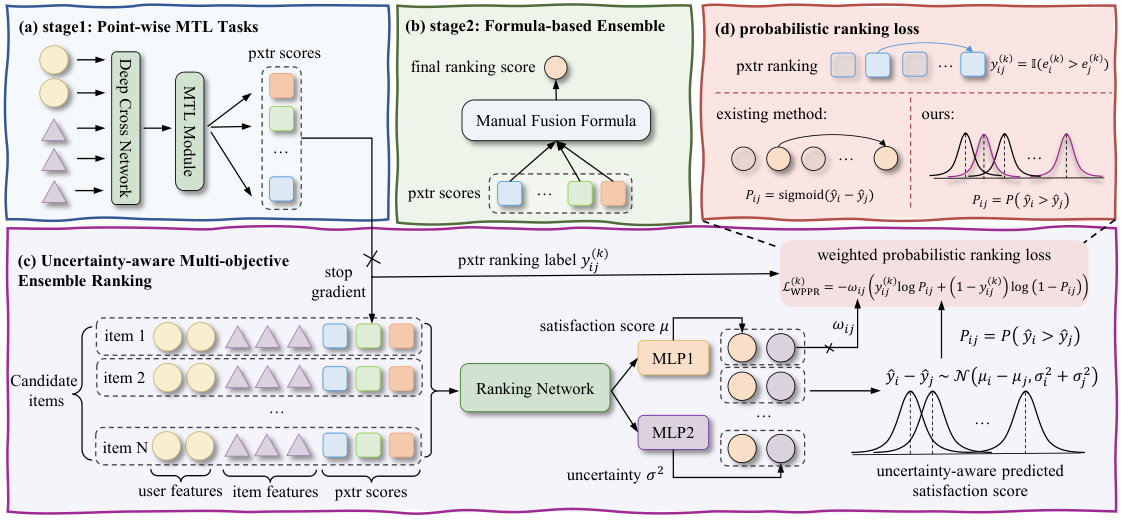 Personalization · 2026-07-22Uncertainty as Remedy: Mitigating Satisfaction Label Bias in Short Video Multi-Objective Ensemble RankingDeep dive: Uncertainty as Remedy: Mitigating Satisfaction Label Bias in Short Video Multi-Objective Ensemble Ranking.
 Personalization · 2026-10-22ECHO: Efficient Cascade with Homogeneous Operators for Distillation-Guided 100K-Sequence ModelingECHO makes 100K-event histories affordable by retaining reusable original records before candidate-aware retrieval. A full-history teacher supervises selection, while retrieval and aggregation share relevance parameters. Kuaishou reports a 0.613% increase in app usage time in an online test.
 Generative · 2026-07-31SSRLive: Live Streaming Recommendation with Dynamic Semantic IDDeep dive: SSRLive: Live Streaming Recommendation with Dynamic Semantic ID.
Discussion
Add experiment details, reproduction notes or a different take. Requires a GitHub sign-in.
Loading the discussion…