Contents · 6 sections
1Teleoperating a robot for demos keeps the arm in the loop; HandUMI records with jaws worn on the hands2The robot keeps its gripper; only the capture tips are swapped3How one recording is retargeted to seven arms4How 562 demonstrations were kept5What towel folding on a real PiPER actually showed6Cross-embodiment evidence stays in simulation; the real test is this one taskSHARE

Teleoperating a robot for demos keeps the arm in the loop; HandUMI records with jaws worn on the hands
Leader arms, replica arms, or VR-controller teleoperation all require robot access for each demonstration.
Another route is to keep the robot out of the capture loop: a person wears an interface, and the recording is mapped onto a target arm later. Robot-free interfaces such as UMI (a robot-free capture interface) already decouple capture from arm kinematics, but a mismatch in contact geometry or opening motion may still hinder transfer. The closest open system is YUBI, which also tracks Quest controllers and measures aperture with an encoder. HandUMI makes a different set of choices: translating parallel jaws worn on the hands, fingertips shaped to match the robot's installed gripper, and no need to refit that gripper. The authors do not compare the two systems directly.
The paper is from Mu Robotics, McGill University, Mila - Quebec AI Institute, Pontificia Universidad Católica del Perú (PUCP), NONHUMAN, Technical University of Munich (TUM), and Universidad Peruana de Ciencias Aplicadas (UPC). Hardware and software are open source under Apache-2.0. Parts cost USD (US dollars) 207.11 per pair, or USD 557 with a shared Quest 3S, excluding the optional ZED Mini (a depth camera), host computer, tax, and shipping. All experiments used a PICO (a headset) 4 Ultra.
The same robot-agnostic recordings are retargeted by inverse kinematics (IK) to seven simulated bimanual arms: median position error is at most 1.2 mm, and at most 4.7% of episodes are rejected. On a real AgileX PiPER bimanual towel-folding task, policies trained only on this retargeted data succeed in 12 of 20 unassisted attempts with ACT, and in 7 of 20 with fine-tuned π₀.₅.
Robot-free demonstrations can be retargeted through simulated IK to several arms, and can train a policy that folds a towel on a real PiPER; the cross-embodiment evidence stops at simulation, and the real-robot test covers only this one task, setup, and random seed.
The robot keeps its gripper; only the capture tips are swapped
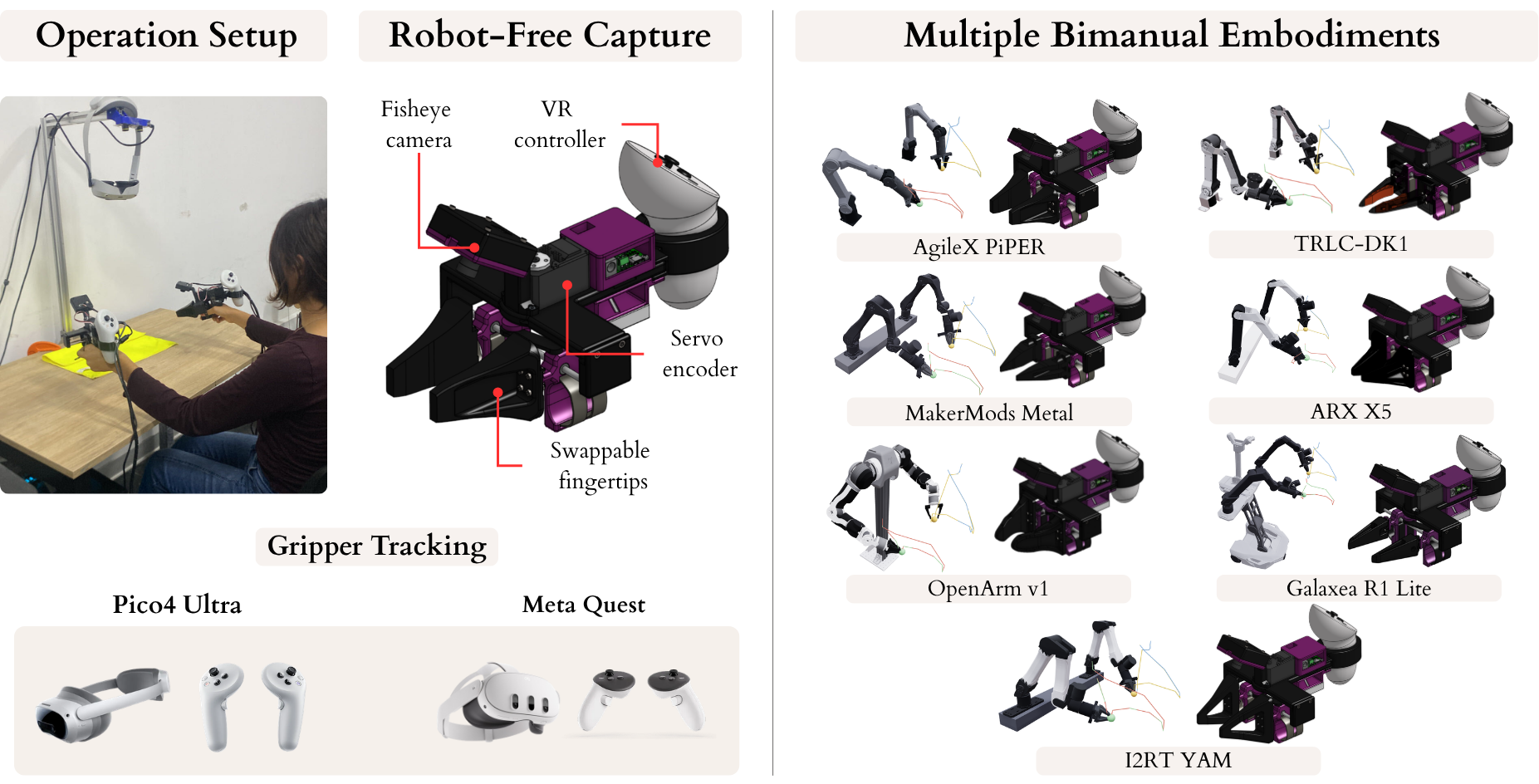
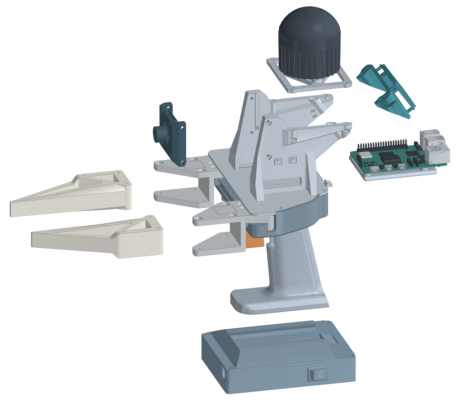
On a shared wearable body, modular mounts allow swapping fingertips, controller types, and cameras. Printed finger cradles drive a pair of translating parallel jaws through a crank. A Feetech STS3215 12-bit encoder measures jaw width via two-point calibration. An IMX335 (an image sensor) fisheye records 1280×960 at 30 fps, and an optional ZED Mini can add a workspace view.
The swappable tips currently match the AgileX PiPER, the ARX (a robot arm) X5, the Dream Gripper used on the TRLC-DK1, the Trossen WidowX AI, and the UMI soft finger. At execution time the robot still uses its installed gripper; a new gripper needs a new capture tip. Contact geometry remains embodiment-dependent. Relative to YUBI, the authors list three differences: the robot keeps its gripper instead of being refitted with YUBI's; the jaws here translate, whereas YUBI records a jaw angle and models revolute fingers; and the tips copy installed grippers, whereas YUBI's paper describes one finger design. These are design differences, not the result of a head-to-head experiment.
Pose does not come from wrist-camera SLAM (simultaneous localization and mapping). A swappable provider supplies timestamped 6-DoF controller poses. Quest 3 and Quest 3S use a new TCP application that implements the protocol of YUBI's Apache-2.0 software and refers to its client APK (Android application package); the PICO 4 Ultra uses XRoboToolkit. A ChArUco board defines the table frame. A monotonic workstation clock timestamps every source. Rows target 40 ms behind real time and take the nearest camera (30 fps) and encoder (100 Hz) samples, with a 60 ms freshness limit. Sensor loss longer than one second discards the episode. Recording can be started and stopped by voice or by a double-squeeze.
Gated calibration covers gripper range, intrinsics (mean reprojection error at most 0.8 px), camera mount and table frame (RMS at most 8 mm), and a per-tip tool-center-point (TCP) pivot fit (RMS under 5 mm, maximum sample residual under 10 mm). A guided touch protocol also asks both tips to meet at the same reference point (15 mm spacing limit) and on the table (height ±15 mm), with 20 samples per location by default; no result can be tied to the affected sessions. SHA-256 fingerprints identify configurations, not accuracy.
How one recording is retargeted to seven arms
What is stored is robot-agnostic: LeRobot v3 records hold two 6-DoF controller poses and the jaw widths, and do not depend on a particular arm's joints. A ChArUco board defines the table frame, and each fingertip's tool center point (TCP) comes from a pivot fit. A configuration file then supplies each arm's kinematics and limits, those calibrated TCPs, and a linear gripper map that sends 0–66 mm onto the PiPER stroke; speed and force are not matched.
PyRoki IK uses these target poses to turn the robot-free recordings into joint commands for seven bimanual arms: PiPER, OpenArm v1, TRLC-DK1, I2RT YAM (a robot arm), MakerMods Metal Arm, Galaxea R1 Lite, and ARX X5. The millimetre-level position errors in Table 3 later measure how closely this IK retargeting tracks those target poses in simulation. Per-robot screening checks IK error, self-collision, and base-joint swing. Replay for PiPER and OpenArm shares mapping, IK, and smoothing with MuJoCo. Hoot says

200, 80 and 280 mm are a sketch, to show the gap between the controller origin and the fingertip target. 1.17 mm is the median PiPER position error in the paper's Table 3. Capture gets a fingertip TCP from a pivot fit, and the profile also supplies TCPs; this figure does not treat those as proven to be one and the same calibration.
Source
Controller poses and jaw width, table frame, fingertip TCP pivot fits, profile kinematics/limits/TCPs, and PyRoki IK: paper §2. The 1.17 mm median PiPER position error in Table 3: §3.1. 200+80=280 is a sketch, not an experimental number from the paper.Table 3 of the paper replays the 562 kept episodes and the 79 dropped ones on these seven simulated arms; Metal ran only the 79, after a compute failure. Position error is the median, in the table below. The abstract bound of median position error ≤ 1.2 mm is therefore the highest of these medians, which is PiPER at 1.17 mm.
| Simulated arm | Median position error (mm) | Rejected (%) | Self-collision (%) | Joint limit (%) |
|---|---|---|---|---|
| PiPER | 1.17 | 0.0 | 0.0 | 0.1 |
| OpenArm | 0.14 | 4.7 | 0.0 | 27.5 |
| TRLC-DK1 | 0.18 | 3.1 | 2.7 | 2.3 |
| YAM | 0.19 | 0.8 | 0.0 | 4.7 |
| Metal | 0.09 | 0.0 | 0.0 | 0.4 |
| R1 Lite | 0.03 | 0.0 | 16.4 | 0.0 |
| ARX X5 | 0.09 | 0.0 | 0.0 | 0.1 |
An episode is rejected if the start is unreachable or if the 99th percentile of position error exceeds 3 cm, so the abstract bound of ≤ 4.7% of episodes rejected is the upper end of these rates, which is OpenArm. Up to 22.9% of episodes exceed URDF (Unified Robot Description Format) velocity limits, on OpenArm. OpenArm is 7-DoF; the others are 6-DoF. These numbers therefore show kinematic retargeting in simulation, not real contact.
PiPER uses the laboratory table; placements for the other arms are hyperparameters, not a held-out set—OpenArm and ARX X5 were scanned on 19 episodes and evaluated on 10. These numbers test kinematic retargeting, not real contact. The PiPER-tip recordings likewise test kinematics, not contact; PiPER's rotation residual enters later policy training, with unknown effect.
How 562 demonstrations were kept
The three operators were the authors, one of whom had prior experience with the device. Wearing PICO units and PiPER tips, and working without a robot on site, they recorded the full cohort over four days, about five hours in total. Apart from three unfolded towels and one tracking freeze, 79 of 641 episodes (12%) were dropped because PiPER retargeting swings a base joint past 60°. That filter biases the set toward PiPER's workspace; the other arms still accept 64 to 79 of those dropped episodes.
The 562 kept episodes contain 201,397 frames and 111.9 minutes, and they pass the offline quality gate: duration, finite values, tracking, sensor health, sync, pose jumps, freezes, and aperture checks. Tracking, health, and sync each allow up to 1% bad rows; health and sync also exclude the first 0.2 s. A single row more than 60 ms off does not reject an episode.
After a faulty camera recalibration, 40 episodes received a post-hoc +1.9 cm height correction estimated from grasp contacts; 31 of them remain in the cohort. Fit residuals and the offline checks cannot independently verify the physical table height, and the reason the gates missed the fault is unverified.
Sampling-grid skew is in Table 2, over 198,025 rows with warm-up excluded. These figures measure how far each stream sits from the shared sampling grid, not end-to-end latency.
| Stream | Median (ms) | 95th percentile (ms) | Rows above 60 ms |
|---|---|---|---|
| Left wrist camera | 8.5 | 16.4 | 3 |
| Right wrist camera | 8.6 | 16.3 | 2 |
| Top camera | 8.9 | 16.2 | 2 |
| Encoder (100 Hz) | 2.5 | 4.8 | 4 |
| PICO tracking | 40.3 | 40.4 | 0 |
PICO leads the host clock by about 40 ms, so its median sits near 40 ms. Both wrists are tracked on 100.00% of rows. One sentence in the text labels this skew table as Table 3, but Table 3 is the retargeting-error table, so the numbers above belong to Table 2.
TCP fits use 750 samples per side and pass both gates: RMS of 4.0 mm and 3.4 mm, with maximum Euclidean residuals from a sample to the fitted pivot of 7.013 mm and 7.021 mm. These numbers therefore show internal consistency, not absolute accuracy. Table-frame RMS is 1.6–4.2 mm and 0.3–0.7°; two remounts differ by 6–7 mm in TCP height.
What towel folding on a real PiPER actually showed
The evaluation task is bimanual towel folding on PiPER: the arms grasp two corners of a flat towel and fold it in half.
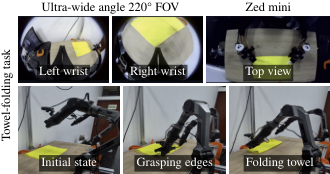
The robot-free recordings are first turned into PiPER joint commands by IK. During training, those 14-D commands (radians, with grippers in [0, 1]) are used as both the state and the action to predict, together with two wrist views and without the top view. The real PiPER keeps the same IMX335 cameras and the same gripper-relative mounts. Open-loop replay on the real PiPER validated that the recorded trajectories can be executed on the real arms; the later unassisted rollouts also run on this real PiPER.
ACT uses one recipe on the first 101 episodes (19.3 minutes) and on the full cohort of 562; π₀.₅ is fine-tuned on the full cohort, with the unfine-tuned base model as a reference. A 10% episode holdout selects the checkpoint with the lowest validation loss. ACT uses batch 96, learning rate 10⁻⁵, and chunk 100; π₀.₅ uses batch 16, learning rate 4×10⁻⁵, and chunk 50. Each model is tested in 20 unassisted attempts, at random towel positions within the training area, unmatched across models. An operator judges a final fold in half live, without a numeric tolerance.
| Model | Training data | Successes / attempts | 95% Wilson interval |
|---|---|---|---|
| ACT | First 101 episodes (19.3 min) | 0/20 | 0–16% |
| ACT | All 562 episodes | 12/20 | 39–78% |
| π₀.₅, not fine-tuned | Base model | 0/20 | 0–16% |
| π₀.₅, fine-tuned | All 562 episodes | 7/20 | 18–57% |
The 12/20 of full-cohort ACT and the 7/20 of fine-tuned π₀.₅ are not statistically distinguishable at n=20 (Fisher exact p=0.20). ACT on the first 101 episodes, and π₀.₅ without fine-tuning, each succeed in 0/20. The paper calls the former a scale probe, confounded by later added sessions and calibrations; the latter is a sanity check for HandUMI fine-tuning. The 12/20 versus 0/20 contrast is therefore not a clean causal test of dataset size.
Cross-embodiment evidence stays in simulation; the real test is this one task
HandUMI abstracts arm kinematics while retaining the robot's own gripper. New grippers require new capture tips, and contact geometry remains embodiment-dependent. The cross-embodiment evidence is simulated IK; real tests cover one PiPER task, one setup, and one random seed, with no failure analysis. Holdouts can share sessions with training. Capture is also bounded by the headset and limited to parallel jaws. The gain from tip matching, jaw accuracy, fingertip load, and the value of audio are all still unmeasured.
How did this read for you?
Hoot made a note. Thanks for the feedback.

One tap, no sign-in; tap again to undo. Only anonymous counts are kept, never who you are.
Related papersMore from Paper Daily
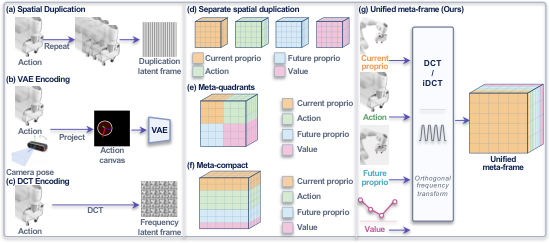 Embodied · 2026-11-12From Video Frames to Robot Meta-Frames: A Unified Latent Interface for World Action ModelsWhen a video diffusion model is turned into a robot world action model, low-dimensional signals such as joint state, actions and value must enter a latent space that has only seen natural video. The usual fix gives each signal its own frame, which lengthens the sequence and the attention cost. The authors first probe a frozen denoiser: signals tiled directly across the frame need large correction…
 Embodied · 2026-11-02UMI-Live for In-The-Wild Bimanual Robotics Data CollectionMost of the training data came from handheld grippers, collected at a different place and under different lighting than the test scene, with only a small share of real-robot teleoperation. Fine-tuned on this mix, pi0.5 succeeded in all 10 trials of a bimanual task that puts oranges into a bowl. The demonstrations come from UMI-Live, an open-source bimanual handheld data-collection system released…
 Embodied · 2026-10-28Zero-HLM: Generalizable Humanoid Loco-Manipulation without Real Robot DataTeaching a humanoid a long task such as walking to a table, picking up a banana and putting it in a basket usually takes a hundred or more teleoperated real-robot demonstrations, and moving the table often means collecting them again. Zero-HLM builds all of its data in simulation instead. It scans a real room with a smartphone, rebuilds it as a simulated scene that looks like a photo and supports…
 Embodied · 2026-11-11Learn the Task, Not the Schedule: Reducing Spurious Cross-Arm Coupling in Bimanual Imitation LearningIn two-armed robot demonstrations, which hand moves first is often just the operator's habit, yet imitation learning cannot separate the orderings a task requires from the ones that happened by chance, so when one arm is paused the other waits too. The authors audited four public bimanual datasets and found that tasks whose order could change rarely include more than one recorded order, and more…
Discussion
Add experiment details, reproduction notes or a different take. Requires a GitHub sign-in.
Loading the discussion…