Contents · 5 sections
1Measuring "does it look like a picture" with a frozen denoiser2Writing numbers into bands, then inverse DCT back to one frame3One frame as the interface for policy, world model and value function4From 11 frames to 8, with success rate slightly up5Change the background or the starting pose, and it falls behind Cosmos PolicySHARE

The MetaWAM paper shows that when you feed robot signals into a pretrained video diffusion model, what matters is not how many frames they occupy but whether they look like a normal picture to the denoiser.
A World Action Model (WAM below: a model that uses a pretrained video diffusion model to predict robot actions and future frames together) works like this. Camera images are encoded into a latent video, and a video diffusion model (VDM) denoises the next few frames. In the same pass it also denoises the next chunk of actions, the future joint state, and how much return this step is likely to earn (the value). The VDM was trained on natural video, so its denoiser only knows what pictures look like.
The difficulty is that joint states, actions and values are short lists of numbers, while every latent frame is a channels × height × width tensor. Illustrative example: a 7-DoF Franka arm is aligning a cup with a coaster, and its current joint state is 7 numbers, say (0.1, −0.4, 0.0, −2.1, 0.0, 1.6, 0.8). These 7 numbers must first become a "frame" before the denoiser will process them.
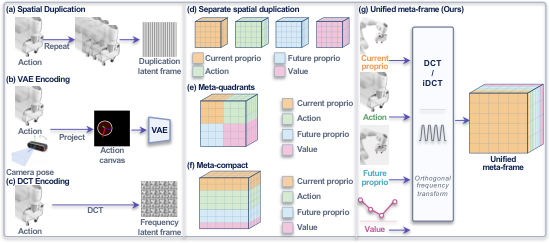
The closest existing approach is Cosmos Policy: each signal gets its own frame, and the raw values are copied across the spatial grid. The 7 numbers thus become a constant tiled pattern in the latent (illustrative). The authors' diagnosis is that a video denoiser pushes exactly this kind of tiled pattern toward "normal pictures", so the written-in numbers get altered too.
The other cost of this approach is sequence length. Input joints, actions, future joints and value each take a frame; add 6 camera frames and one blank leading frame and you get 11 frames, while attention cost grows with the square of the frame count. Another family of methods (such as DreamZero) attaches a dedicated action encoder and decoder, which means modifying the pretrained backbone.
MetaWAM's answer is to write all robot numbers into the DCT (discrete cosine transform, which splits an image into a sum of cosine waves) coefficients of one frame, then apply an inverse DCT to get back one spatial frame. On RoboCasa kitchen tasks the sequence shrinks from 11 frames to 8, per-query inference is about 39% faster, and success rate rises from 67.1% to 68.9%. This means the saved frames were not bought with accuracy.
Measuring "does it look like a picture" with a frozen denoiser
To compare injection schemes you first need a ruler. The authors use a frozen Cosmos-Predict2 denoiser (the denoising part of the video model MetaWAM builds on) as a probe: add noise to a latent carrying the injected signal, let the denoiser restore it, and see how much it changed. The change divided by the magnitude of the clean latent is the relative reconstruction error. Illustrative: the clean latent has magnitude 10 and the denoiser output differs from it by 6, so the error is 0.6. A latent the denoiser finds familiar needs only small touch-ups; the more it changes, the further the latent sits from what it has seen.
First, inject a single signal (30 action chunks) and compare three encodings. At noise level σ=1.0, spatial duplication has error 0.6459, rendering into an image and passing it through the VAE gives 0.6379, and writing into DCT coefficients gives 0.5922. Across the five levels from σ=0.01 to 5.0, DCT is lowest every time. This shows that passing cleanly through the VAE is not the same as being accepted by the denoiser: the VAE-encoded latent is still treated as foreign.
Next, inject three signals (action chunk, joint state, value) and compare four layouts. So the names line up later, here is what each one is:
- Separate Spatial Dup.: each of the three signals gets its own frame with spatial duplication; this is the Cosmos Policy approach.
- Meta-Quadrants: all three signals in one frame, each given an equally sized spatial region, with values copied along the channels inside that region.
- Meta-Compact: also one frame, but regions are sized by signal dimension; the action chunk gets a large region, joints and value small ones.
- Unified Meta-Frame: this paper's layout; the three signals go into disjoint channel groups, are written as DCT coefficients, and are inverse-transformed into one frame.
| Multi-signal layout | Frames | Relative reconstruction error at σ=1.0 ↓ |
|---|---|---|
| Separate Spatial Dup. | 3 | 0.6178 |
| Meta-Quadrants | 1 | 0.6730 |
| Meta-Compact | 1 | 0.6234 |
| Unified Meta-Frame | 1 | 0.5613 |
The second row is the counterintuitive one. Meta-Quadrants also uses only one frame, yet its error is higher than putting each signal in its own frame. In the authors' explanation, values break abruptly where regions meet, and such discontinuous boundaries are also something the denoiser tries to "fix".
Saving frames is not enough: packed into one frame by region, the signals do worse than three frames; written as frequency coefficients, the error drops to 0.5613.
Writing numbers into bands, then inverse DCT back to one frame
Since the problem is appearance, the authors switch to a different encoding: the numbers must be recoverable exactly, and the resulting pattern should no longer be a constant tiling. They chose the DCT. A 2D DCT splits an image into a sum of cosine waves, each coefficient being the weight of one wave; the inverse DCT adds the weighted waves back into an image. The orthonormal DCT is invertible, so a forward and inverse pass leaves the numbers unchanged.
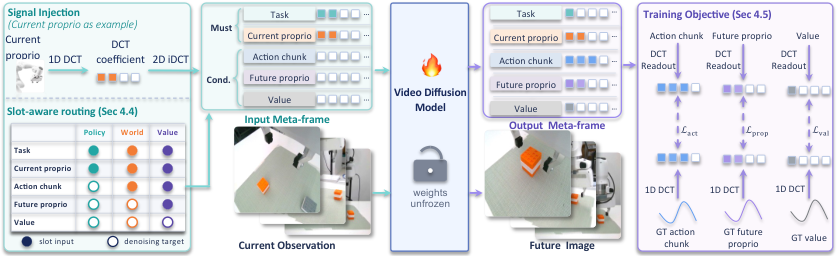
MetaWAM splits the latent channels of one frame into five disjoint channel groups, which the authors call channel bands (bands below): task type, current joints, action chunk, future joints and value each get one. The full packing and readout pipeline:
| Step | Input | Operation | Output | Training only? |
|---|---|---|---|---|
| 1 Pack | Normalized signals | Write values directly into fixed coefficient slots on row 0 (k_H=0) of the signal's own band; all other coefficients are 0 | A sparse coefficient tensor | No |
| 2 Lift | Coefficient tensor | Orthonormal 2D inverse DCT per channel | Spatial meta-frame | No |
| 3 Denoise | 8-frame latent sequence | The VDM denoises as usual, architecture unchanged | Denoised output meta-frame | No |
| 4 Read out | Output meta-frame | 2D DCT, then take coefficients at the fixed slots | Actions, future joints, value | No |
| 5 Supervise | Read-out signals | Huber loss, plus an L1 penalty on coefficients outside the allocated slots | Gradients flow straight to the denoiser | Yes |
A meta-frame here is a latent frame dedicated to robot numbers rather than camera images. Hoot says

Training: one policy sample
- Task, current joints
- Ground truth written in; band open, used as a clean condition
- Action, future joints, value
- Demonstration ground truth also written in, but band closed: noised along with the sequence, used as denoising targets
- Loss
- Diffusion denoising loss + Huber loss on read-out signals + L1 penalty on off-slot coefficients
Here the ground truth is only the answer key that teaches the denoiser
Inference: one policy query
- Task, current joints
- Packed the same way into the input meta-frame (the reused blank leading frame)
- Action, future joints, value
- Unknown, nothing to write; as denoising targets they are generated by the denoiser together with the future frames
- Readout
- 2D DCT on the denoised output meta-frame, take the coefficients at the fixed slots: these are the normalized actions
The slot allocation is identical in training and inference, so readout needs no learned decoder
What a "band" actually is
- Grouping
- Latent channels: each signal gets its own disjoint group of channels
- Inside a channel
- It holds DCT coefficients; values sit in fixed slots on row 0 (k_H=0), all other coefficients are 0
- Why "band"
- The paper's term is frequency-domain channel band: grouped by channel, with the numbers placed on frequency-domain coefficients inside the group
So the split is over channels, not over frequency ranges
Policy task as the example: task and current joints are clean conditions, the other three bands are denoising targets. Step 1 is marked "No" in the table because packing also runs at inference, but at inference only the known task and current joints are packed.
Source
paper §4.2 band layout and readout (Eq. 2–3, fixed coefficient slots on the k_H=0 row, allocation fixed across training and inference); §4.3 input meta-frame; §4.4 band masks: open = clean condition, closed = denoising target; §4.5 training objective (Eq. 4 noises the clean sequence, Eq. 5–6 readout losses and off-slot penalty); Fig. 3A small example you can check in your head for steps 1, 2 and 4 (illustrative, looking only at 4 cells along the width). Write two joint values, 1 and 0.5, as coefficients (1, 0.5, 0, 0). The inverse DCT gives roughly 0.83, 0.64, 0.36, 0.17, a descending slope. Applying the DCT to this slope at readout gives back exactly (1, 0.5, 0, 0), and the first two slots are the original joint values.
The example shows two things. First, the numbers are spread over cosine waves instead of being tiled as constants; the authors' explanation is that this sits closer to the denoiser's prior, but that is an explanation, and the small example does not prove it is why accuracy holds. Second, readout is a single fixed mathematical transform, with no decoder to learn.
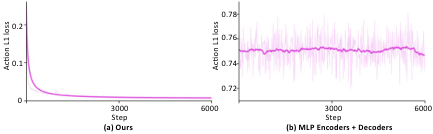
Why not simply learn an encoder and decoder? In the appendix the authors tried a DreamZero-style MLP encoder-decoder. Over the same 6000 training steps, MetaWAM's action L1 loss quickly falls to near 0, while the MLP interface stays around 0.75. The authors' explanation is that the zero-initialized projection passes no signal at first, and that every encoder update also shifts the denoising target. This only shows the learned interface did not train in this setup, not that it cannot work elsewhere.
One frame as the interface for policy, world model and value function
Actions, future joints and value all live in fixed bands of the same output meta-frame and never move between frames. The three tasks differ only in which bands are "known conditions" and which are "targets to denoise". MetaWAM gives each sample a mask that switches bands on or off:
| Task | Bands opened as conditions | Bands kept as denoising targets |
|---|---|---|
| Policy | Task, current joints | Action, future joints, value |
| World model | Task, current joints, action | Future joints, value |
| Value | Task, current joints, action, future joints | Value |
Back to the cup example (illustrative): as a policy, the model only knows where the 7 joints are now and must denoise the next motion. As a world model, it is also given the action and must predict where the joints end up. As a value function, it is given the states before and after and only the return remains to estimate.
If the mask could only switch whole frames, this would be impossible: action and value sit in the same frame, so you could not open the action while hiding the value. The input-side meta-frame costs no extra frame either. It reuses the blank leading frame the tokenizer already reserves, and carries the task type and current joints.
From 11 frames to 8, with success rate slightly up
The 8 frames are: input meta-frame, three current camera views, output meta-frame, three future camera views. All ablations run on RoboCasa: 24 kitchen tasks with only 50 human demonstrations each, 3600 trials in total under the Cosmos Policy protocol.
| Layout | Frames | Success rate | Per-query inference | Future-view PSNR | Value MAE |
|---|---|---|---|---|---|
| Separate Spatial Dup. | 11 | 67.1% | 0.479 s | 19.27 | 0.072 |
| Meta-Quadrants | 8 | 65.9% | 0.291 s | 18.86 | 0.081 |
| Meta-Compact | 8 | 68.1% | 0.291 s | 19.41 | 0.065 |
| Unified Meta-Frame | 8 | 68.9% | 0.291 s | 19.95 | 0.046 |
The three 8-frame layouts have identical latency, so the 39% speedup comes from dropping 3 frames, not from how signals are arranged. This means differences in success rate belong to the layout: Meta-Quadrants falls to 65.9%, matching its highest probe error. Meta-Compact, however, reaches 68.1%, only 0.8 points below this paper's layout, so the frequency encoding's edge in success rate is small.
World and value prediction are not sacrificed either. Unified Meta-Frame has the highest future-view PSNR (peak signal-to-noise ratio; higher means the predicted image is closer to the real one), and the lowest future-joint error and value MAE (mean absolute error). This shows the saved frames did not come at the expense of the world-model and value tasks.
Do probe scores rank the layouts the same way as success rate? The authors read the signal straight back from the frozen denoiser's output to see how much survives: Unified retains 0.7146, the three alternatives fall between 0.60 and 0.66, and the four layouts rank in the same order as success rate. The authors themselves say this is only a diagnostic for comparing layouts, not a predictor of success rate.
Against outside methods, MetaWAM uses only 50 demonstrations per task on RoboCasa and still beats π0 trained on 300 (62.5%). This suggests it holds up in the low-data regime, but since demonstration counts differ, this comparison is only a reference point.
On a real Franka arm, the authors ran three tasks (sweeping, placing a cup, building blocks) with 20 trials each. In-distribution success is 85.0%, versus 78.3% for Cosmos Policy. With distractors and background changes it is 68.3% versus 63.3%. This shows that the frame-saving interface also beats the per-frame injection baseline on a real robot.
Change the background or the starting pose, and it falls behind Cosmos Policy
LIBERO is a common simulated arm-manipulation benchmark, and LIBERO-Plus adds seven kinds of perturbation to its scenes, including camera, background and initial state. On LIBERO-Plus MetaWAM scores 83.4 overall, above Cosmos Policy's 82.2, and 82.9 versus 75.8 under camera-viewpoint changes.
But under background changes it is 72.6 versus 88.9, under robot initial-state changes 59.9 versus 63.3, and on original LIBERO its 98.1% is slightly below the baseline's 98.5%. So its robustness is uneven, and the slightly higher total hides two clear weak spots.
Back to the cup example (illustrative): an initial-state perturbation changes the starting point of exactly those 7 numbers written into the current-joint band, because the arm starts in a pose that differs from the demonstrations. Under this kind of perturbation, MetaWAM's success rate is below Cosmos Policy's. The authors acknowledge this sensitivity to background and initial state in their limitations, and note that the fixed band layout and loss weights may need adjusting when signal scales differ substantially.
MetaWAM's band encoding was chosen only after a frozen denoiser was used to measure whether it "accepts" the input; before trying another signal interface, this ruler is worth applying first.
Going from 11 frames to 8 brings the speedup. With the same single frame, Meta-Quadrants loses points and Meta-Compact gains slightly; the frequency encoding has the highest success rate of the three 8-frame layouts (68.9%), 0.8 points above Meta-Compact.
How did this read for you?
Hoot made a note. Thanks for the feedback.

One tap, no sign-in; tap again to undo. Only anonymous counts are kept, never who you are.
Related papersMore from Paper Daily
 Embodied · 2026-10-30SuperMimic: Scaling Humanoid Whole-Body Control with One Differentiable World ModelTeaching a humanoid robot whole-body control by tracking large amounts of human motion data is currently very compute-hungry: the strongest motion tracker, SONIC (a previously released tracker trained with PPO on a cluster), trains for about 7 days on 128 GPUs. SuperMimic starts from a simple observation: the motions differ wildly, but the robot's body obeys one set of physics. It first learns a…
 Embodied · 2026-10-28Zero-HLM: Generalizable Humanoid Loco-Manipulation without Real Robot DataTeaching a humanoid a long task such as walking to a table, picking up a banana and putting it in a basket usually takes a hundred or more teleoperated real-robot demonstrations, and moving the table often means collecting them again. Zero-HLM builds all of its data in simulation instead. It scans a real room with a smartphone, rebuilds it as a simulated scene that looks like a photo and supports…
 Embodied · 2026-11-12APS-VLA: Action-Guided and Future-Aware Token Pruning for Efficient Vision-Language-Action ModelsA VLA processes hundreds of visual tokens at every step, which makes inference slow, yet the next action often depends on a small part of the image. This paper adds a small scorer in front of a frozen VLA and learns from demonstration trajectories which tokens to keep. Training asks two things: the kept tokens must let the original model produce the same action it gives with the full image, and t…
Discussion
Add experiment details, reproduction notes or a different take. Requires a GitHub sign-in.
Loading the discussion…