Contents · 5 sections
1Moving old KV out of GPU memory is only useful if the freed space can be used2Different cache demands share one memory budget3Reuse two slots across global-attention layers4Streaming every request would exceed the transfer budget5End-to-end gains combine allocation and streamingSHARE

Moving old KV out of GPU memory is only useful if the freed space can be used
Hybrid-model serving can hit two memory limits at once. Long contexts consume global-attention KV cache, while more concurrent requests consume sliding-window caches or recurrent states. Reserving more memory for one component can starve another. Offloading some KV does not automatically make the released capacity available to other caches.
TideCache addresses both problems together. It shares physical GPU memory across cache components, then uses computation between global-attention layers to prefetch historical KV from host memory. A request needs a reusable GPU slot for a layer's prefix when that layer executes, rather than keeping every layer's prefix resident throughout decoding.
The reduced residency applies to selected historical prefixes. Newly generated KV always stays on the GPU. The work is by authors from the Massachusetts Institute of Technology, the Swiss Federal Institute of Technology Zurich, and the University of California San Diego and is implemented in SGLang.
Different cache demands share one memory budget
Global attention reads all previous positions, so its KV cache grows with context length. Sliding-window attention retains a bounded window, and recurrent layers retain fixed-size state. For a given model and implementation, these bounded caches do not keep growing with context length, but each concurrent request needs its own state.
Global-KV demand therefore depends on concurrency times mean context length. Bounded-state demand mainly depends on concurrency. Application names alone do not identify the bottleneck: an agent is not inherently one cache-demand pattern, nor is chat another.
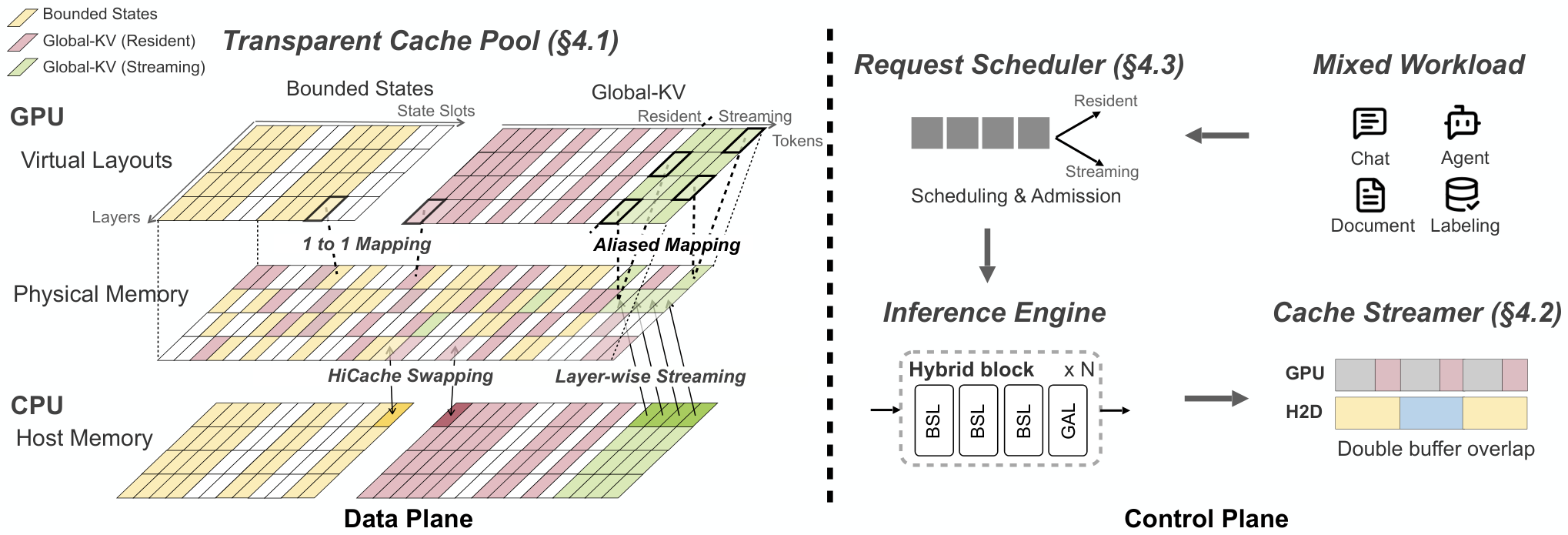
The Transparent Cache Pool preserves each component's virtual addresses while reassigning physical GPU pages underneath. Attention backends, indexing, and CUDA graphs continue to see their existing layouts. Hoot says

- Live backing: unchanged
- The same idle physical page
- Unmapped virtual row
- Park donor rows, wait for earlier computation, then unmap and remap idle backing. Ranks enable the move at a consistent boundary.
Illustration: cells are fixed virtual rows; colors represent physical backing, not actual addresses or measured capacity.
Source
Paper §4.1, Transparent Cache Pool and Figure 5 move protocol.It does not move live data used by active requests. Growth first uses unassigned pages, then idle capacity in other subpools, and finally evictable cold prefixes. Donor rows are removed from free lists and earlier computation must finish before their backing is remapped. Compute ranks apply the adjustment at the same boundary.
Sharing resolves partition imbalance, but it does not increase total GPU memory. Accommodating additional historical prefixes also requires reducing how many layers' prefixes are resident simultaneously.
Reuse two slots across global-attention layers
Hybrid models do not run global attention at every layer. Intervening sliding-window or recurrent layers compute without reading the entire global KV history. The Cache Streamer uses those intervals to prefetch the next global-attention layer's prefix from host memory.
Two physical slots serve multiple global-attention layers. Each layer still accesses its own virtual tensor addresses, but those ranges alias the reusable physical slots. One slot can be read while the other receives a later layer's prefix.
Only historical prefixes already present in host cache are streamed. Newly generated KV remains in a separate resident region and is backed up by HiCache after the turn. It is not repeatedly offloaded and restored for every generated token. In contrast, streamed host prefixes are transferred layer by layer again at every new decode step. The first slot use in a new step also waits for its last reader in the previous step.
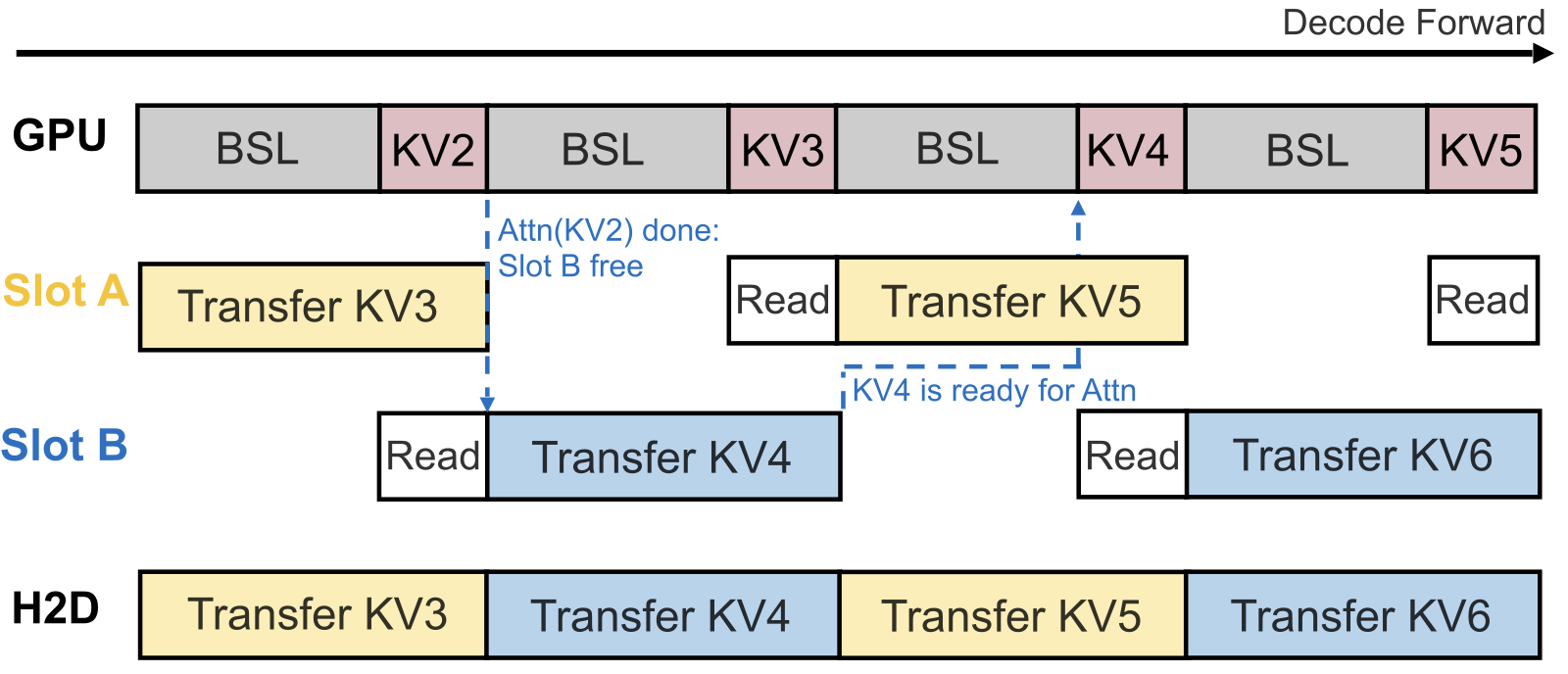
Correct reuse requires two dependencies. A transfer must not overwrite a slot while its previous reader still uses it. A later attention operation must not read before the new data arrives.
Free and Ready signals coordinate those dependencies. The copy stream waits for and clears Free, performs the transfer, and publishes Ready. Operations inside the graph wait for and clear Ready before reading, then publish Free after the final read. Clearing consumed signals prevents an earlier step's signal from satisfying a later wait.
<details>
<summary>The two-slot order used in the illustration</summary>
The illustration uses four global-attention layers sharing two historical-prefix slots. It is not a measured layer count or a scaled timing trace. Numbers after KV identify the global-attention layer. Blue means read, green means copy; other computation occurs between those layers.
| Order | Slot A | Slot B |
|---|---|---|
| First | Read KV 1 | Copy KV 2 |
| Next | Copy KV 3 | Read KV 2 |
| Then | Read KV 3 | Copy KV 4 |
| Last | Reusable | Read KV 4 |
After reading KV 1, A publishes Free before it may be overwritten by KV 3. Reading KV 3 waits for Ready after the copy finishes. B likewise waits for Ready before reading and publishes Free before copying KV 4. Consumed signals are cleared. New KV stays in a separate resident region, outside these slots. Late transfers still stall readers; the schematic implies no online gain.
</details>
Before replay, the Cache Streamer updates row mappings and copy parameters. The host submits the first transfer for each slot outside the graph, launches the full graph, then submits remaining transfers. In-graph signals wait for those external copies. Transfer addresses and lengths may change while the full decode graph is still launched once. A late transfer stalls its consumer. Pipelining does not make transfer cost disappear under every condition.
Streaming every request would exceed the transfer budget
The scheduler first checks bounded-state capacity. It then considers resident-memory pressure, reusable host-prefix length, and the total rows already assigned to streaming. It chooses resident or streamed execution accordingly. A streamed request can be skipped temporarily when slots are full, allowing requests needing other available resources to proceed.
Sustained bandwidth BW (bytes transferred per unit time) and computation time bound how many transferred rows can be hidden in one step:
C = η × BW × T / (L × b)
BW is sustained transfer bandwidth, T is computation time, L is the number of global-attention layers, and b is KV bytes per row per layer. The factor η leaves scheduling slack. Meeting this aggregate bound is insufficient by itself: each transfer must also meet its layer's read deadline.
Sharing two slots across many layers therefore does not multiply system throughput by the layer count. Benefits also depend on overlap opportunities, host-cached prefixes, and capacity in the other cache components.
End-to-end gains combine allocation and streaming
The evaluation covers seven model/platform configurations on GB300 and GH200 (Grace Hopper superchip). Two large models use truncated layer configurations, not measurements of the complete models. Workloads mix independent requests with replayed multi-turn coding-agent traces. The reference is SGLang with HiCache using its better tested partition ratios.
Under the tested memory pressure, TideCache completes up to 2.04 times as many agent turns. Overall P50 per-token latency falls by 20–59%, and agent P50 time to first token improves by 1.40–3.05 times. These summarize results across configurations, not one configuration exhibiting every extreme.
The latency metrics describe different populations. Per-token latency is end-to-end request latency divided by actual output-token count, with the median taken over the mixed workload. Time to first token measures submission to first token for agent-session requests. Both include queueing; neither is pure decode compute time.
The shifting-workload experiment makes the components' contributions clearer. The following Figure 10 results use Qwen3.8-27B on GH200 and the same three-phase workload changes within the measurement window.
| Method | Completed agent turns |
|---|---|
| SGLang without HiCache | 57 |
| SGLang with HiCache | 115 |
| TideCache without streaming | 174 |
| Full TideCache | 183 |
Full TideCache completes about 59% more turns than HiCache. However, the dynamic-allocation variant without streaming already completes 174 turns. The entire gain cannot be attributed to layer-wise transfers.
The direct streaming comparison is 174 versus 183 turns. Agent time to first token falls from 8.13 to 5.68 seconds. Dynamic sharing lets released pages serve another cache component; streaming further relieves historical-prefix residency.
These results come from hybrid models on high-bandwidth CPU–GPU superchips. They support examining allocation and data movement together, rather than counting offloaded KV alone. Without sufficient overlap, reusable host prefixes, or link bandwidth, the same memory saving need not produce the same serving gain.
How did this read for you?
Hoot made a note. Thanks for the feedback.

One tap, no sign-in; tap again to undo. Only anonymous counts are kept, never who you are.
Related papersMore from Paper Daily
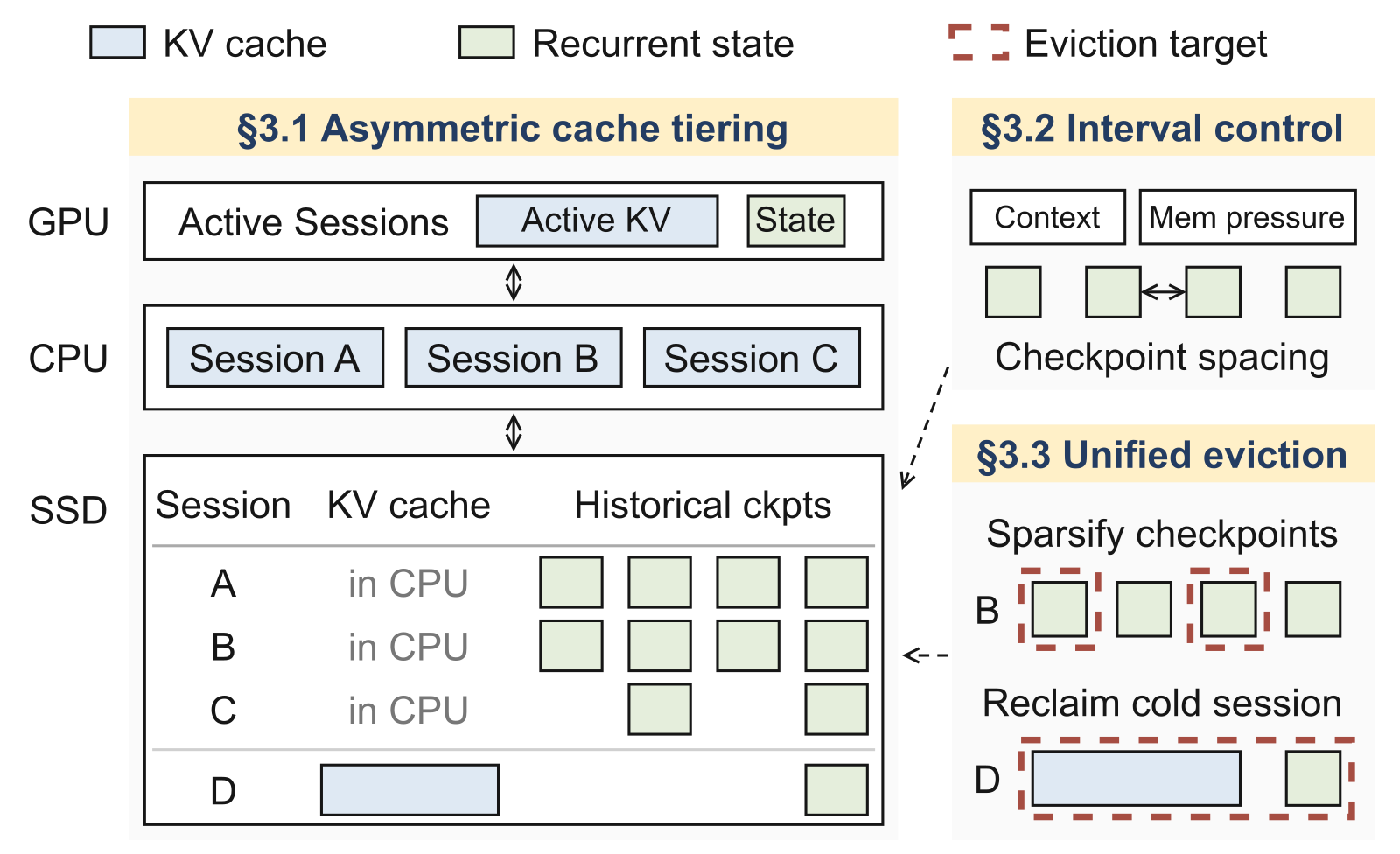 Infra · 2026-11-03HiState: Hierarchical Prefix Cache Management for Hybrid LLM Serving in Agentic WorkloadsThe recurrent layers of a hybrid model compress the whole prefix into a fixed-size snapshot, and it cannot be cut back to an earlier position. So even when the KV is still cached, if the snapshot at the match point was never saved or has already been evicted, a long stretch must be recomputed from an earlier snapshot, or from scratch. HiState exploits an asymmetry: a cache hit reads every matchin…
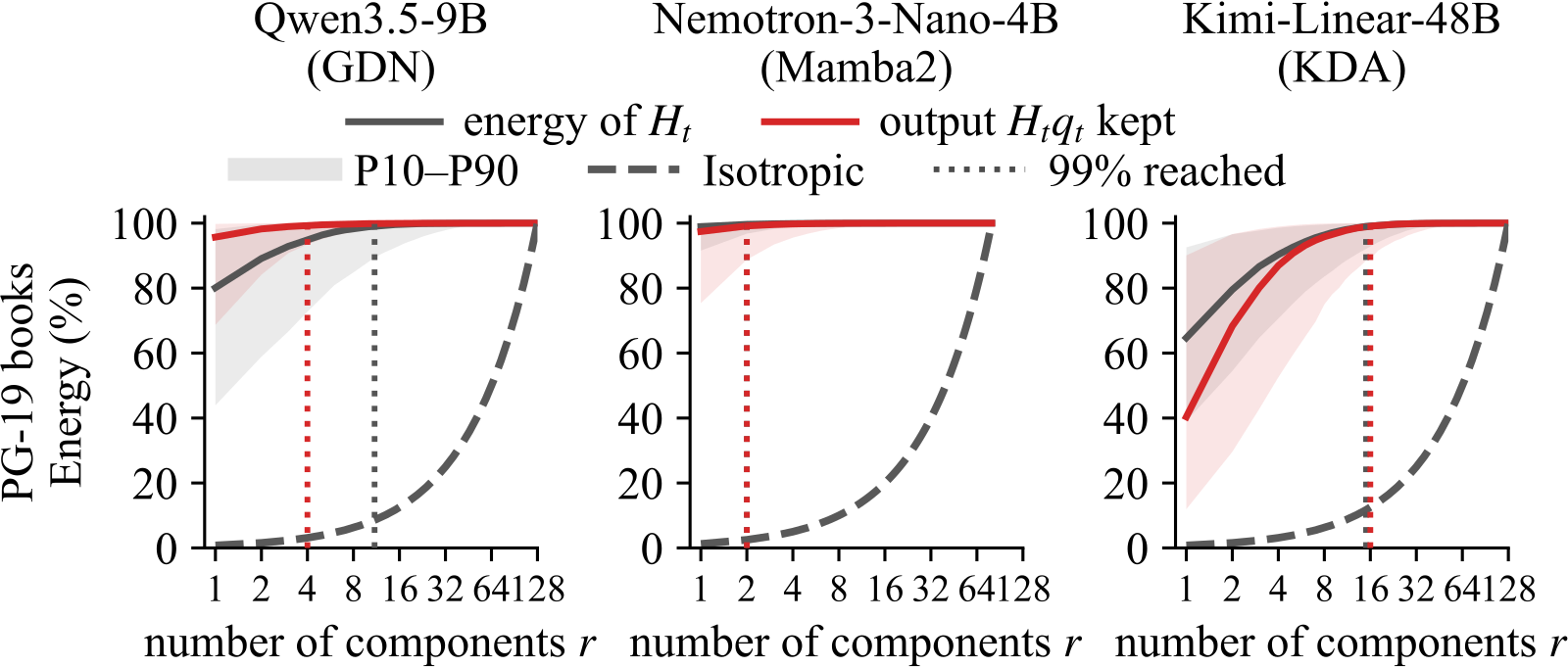 Infra · 2026-11-13SinkState: On-the-Fly SVD of Recurrent States for Efficient Hybrid LLM ServingThe linear attention layers in hybrid models compress history into a fixed-size state matrix, and every decoding step reads the whole matrix out and writes it back. With a large batch, this memory traffic takes most of the decoding time. The authors find these states are actually low-rank: the vectors that linear layers write into and read from the state sit in a small subspace that does not chan…
 Infra · 2026-11-02Rimuru: Unified Memory Management for Modern LLM Serving via Elastic Expert OffloadingPutting an MoE model's expert weights and its KV cache into one shared pool of GPU memory, and shifting how much each side gets as load changes, lets a memory-limited machine serve many more concurrent requests. Rimuru is a serving system built this way. When requests pile up, it moves rarely used experts out of GPU memory to free pages for the KV cache, and when traffic drops, it brings experts…
 Infra · 2026-10-26KVStream: Adaptive Parallel Storage Management for KV Caching in Large-Scale LLM ServingLong-context inference keeps reusing the same prefixes: system prompts, whole documents, code repositories and multi-turn session histories. Their KV cache no longer fits in GPU memory or host memory, so it has to live on disk and be read back on the next hit, which puts disk reads on the critical path of every inference step. Existing systems read only from the node-local NVMe, while the paralle…
 Infra · 2026-11-10Inside the Trap: A Renewal Law for Prefix-Cache Collapse in LLM Agent ServingMulti-turn LLM agents rely on prefix caching to skip repeated work, but this paper finds a trap. After a sudden burst of sessions, an engine can fall into a state where every turn misses the cache and the backlog never drains, even at a load it handled before. In paired tests on two serving engines, two GPUs and two models, a burst of 200 sessions left the engine stuck to the end in all 30 runs,…
 Infra · 2026-11-04Rethinking KV Cache Eviction for Agentic LLM ServingWhen the KV cache runs out of room, vLLM and SGLang both evict from the end of cached sequences, to keep the opening prefix that many requests can share. But an agent sends its long history back every turn, and later tokens cost more to recompute, because each attends to every token before it. Penelope does the opposite: it still keeps the shared prefix, but evicts the rest of the history from th…
 Infra · 2026-11-04When Cache Pressure Becomes a Trap: Metastability in Agent ServingA ten-minute traffic surge can leave an agent serving engine with prefill and decode disaggregated unable to recover. After the surge ends and traffic returns to a level the engine handled before, goodput on SGLang stays about 88% lower over the following hour, and utilization and queue length give almost no warning beforehand. Behind it is a loop: too little cache causes recomputation, calls slo…
 Infra · 2026-11-02Nemotron 3.5 Super and Lightning: Open, Efficient Mixture-of-Experts Hybrid Mamba-Transformer Models for Agentic AIOpen models built for agents often have to choose between capability and inference cost. NVIDIA's Nemotron 3.5 Super optimizes both. It is a hybrid Mamba-Transformer mixture-of-experts model that activates only about a tenth of its parameters per token, and it scores 51.78% on SWE-bench Pro, ahead of the previous-generation Ultra with several times more active parameters. The deployment design ma…
Discussion
Add experiment details, reproduction notes or a different take. Requires a GitHub sign-in.
Loading the discussion…